
Hydroxychloroquine,
does it really help with Improvement in dryness, fatigue, and pain in primary Sjogren syndrome?
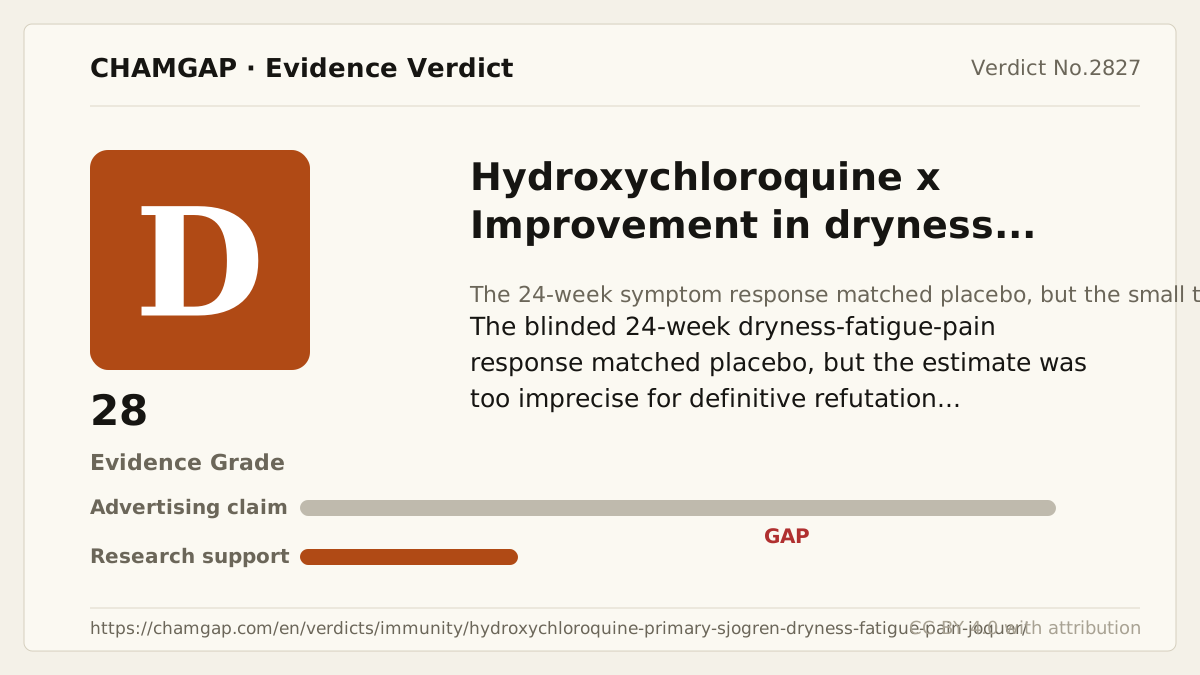
research showsThe grade is D with 28 points. At week 24, response was 10/56 (17.9%) with hydroxychloroquine versus 11/64 (17.2%) with placebo, an absolute difference of 0.7 percentage points, OR 1.01 (95% CI 0.37 to 2.78), P=0.98. The trial was null, but its wide interval did not exclude important benefit.
ads claimThe same medicine answers different questions in different indications. Verdict 1049 is F with 6 points for hand osteoarthritis, verdict 1103 is B with 64 points for early rheumatoid arthritis, and verdict 640 is F with 4 points for hospitalized COVID-19; none was pooled into this Sjogren verdict. In the same disease, verdict 601 is C with 57 points for rebamipide eye drops and ocular symptoms/epithelial injury, while verdict 2666 is C with 50 points for a polysaccharide lozenge and dry mouth/salivary flow.
Useful facts when choosing a product
- Hydroxychloroquine is a prescription medicine used in routine rheumatology care.
- Hydroxychloroquine sold as Duroc tablets is a reimbursed prescription medicine in South Korea.
- Serious adverse events through week 24 were two versus three; during the open-label second 24 weeks they were three in the original drug group and four in the original placebo group.
What the research actually shows
Fifteen French university hospitals randomized 120 participants. Weeks 0 to 24 compared hydroxychloroquine 400 mg/day with placebo under double blinding; from weeks 24 to 48, everyone received open-label hydroxychloroquine. Limitation name: total sample of 120. Avoidability: possible - despite a rare autoimmune disease, multinational collaboration could have expanded enrollment beyond 200. Placebo control and blinding were feasible and used. Assistance Publique-Hopitaux de Paris sponsored the trial with a French Ministry of Research grant, while sanofi-aventis supplied hydroxychloroquine and placebo, making the support mixed public funding and company in-kind product.
Why this is classified as D (28)
The patient-centered primary endpoint was null in a 120-participant trial, but the wide interval and absence of a prespecified minimally important difference leave benefit possible, giving D with 28 points.
Counterpoint. The paper states, "Because we lack a priori-defined minimally clinically important improvement scores for dryness, pain, and fatigue ... we estimated [them] ... in a post hoc analysis." The 25-point sample-size assumption was not used as a clinical threshold.
Rejudgment record. Cross-check applied — Cross-checked JOQUER for the week-24 endpoint, event counts, OR and interval, open-label extension, post hoc importance threshold, and mixed public plus Sanofi in-kind support
| Endpoint | P | Patient-reported treatment goal - the symptom is the goal |
| Replication | R1 | Single confirmatory trial |
| Independence | I1 | Mixed funding sources |
| Effect size | E0 | Null |
| Precision | C0 | The confidence interval leaves room for benefit |
The scoring table and the verdict agree (D).
Sub-claim grades by effect
This ingredient is marketed for several effects. A single overall grade blends strong and weak claims together, so each effect is graded separately here. The overall grade reflects the strongest disconfirming or core claim.
| Effect (sub-claim) | Grade | Basis |
|---|---|---|
| Composite dryness, fatigue, and pain response at week 24 | D | The result was null at 17.9% versus 17.2%, but the interval was wide. |
| Comparative efficacy through week 48 | ? | All participants received active drug after week 24, so placebo-controlled efficacy was not preserved. |
Cross-check — Codex and Claude
Evidence Table
| Study | Design | Sample | Funding | Endpoint | Result | Weight |
|---|---|---|---|---|---|---|
| Study 1 | 15-hospital randomized double-blind placebo-controlled 24-week trial followed by 24-week open-label treatment | 64 | Sponsored by Assistance Publique-Hopitaux de Paris with a French Ministry of Research grant; sanofi-aventis supplied drug and placebo | Proportion with at least 30% reduction in two of three dryness, fatigue, and pain scores at week 24 | 10/56 (17.9%) versus 11/64 (17.2%); absolute difference 0.7 points; OR 1.01 (95% CI 0.37 to 2.78); P=0.98 | Pivotal single null symptom trial |
Receipt — 1 References
All 1 cited sources were verified for existence at the original page (as of 2026-08-18).
Reviewed and approved: Chamgap Editorial Team · Approval date: 2026-08-18 · Corrections: none
Cite this verdict
[Chamgap] Hydroxychloroquine Is Ineffective for Dryness, Fatigue, and Pain in Primary Sjögren Syndrome: JOQUER — Evidence Grade D·28. 1 cited sources checked. Source: https://chamgap.com/en/verdicts/immunity/hydroxychloroquine-primary-sjogren-dryness-fatigue-pain-joquer/ · CC BY 4.0CC BY 4.0 — free to use with attribution; do not distort grades, numbers, or verdict meaning.
What this document does and does not do
Chamgap is an information source. It reports what research has and has not confirmed; it does not tell readers what to take or buy. That decision belongs to readers and, when needed, medical or legal professionals. This verdict reflects literature available up to the search date and may change as new research appears. Nothing here is medical advice.