
Double gloving during surgery,
does it really help with Reduced inner-glove perforation and visible skin contamination?
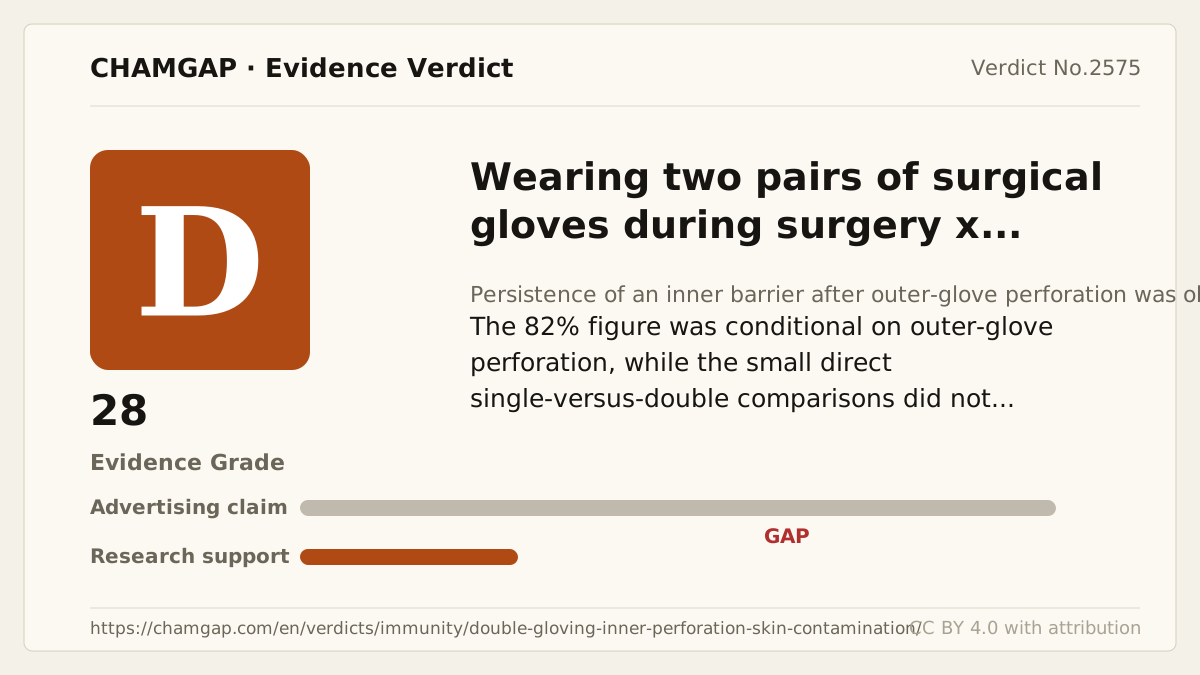
research showsThe grade is D. The headline 82% is conditional on the outer glove being perforated; it is not a randomized between-group effect estimate. Direct comparisons were skin contamination in 8/19 versus 5/22, RR about 0.54 (95% CI 0.21-1.37), and perforation counts of 19 versus 10, RR about 0.53 (0.25-1.09), so the small sample did not establish a difference. The authors recommended routine double gloving, but actual blood-borne infection was not measured. This gives D with 28 points.
ads claimIt is true that an intact inner glove often remains when the outer glove is perforated. Evidence does not yet continue from that process fact to fewer blood-borne infections in surgical staff.
Useful facts when choosing a product
- The study used the same hospital-supplied brand of latex glove in all cases.
- A total of 83.3% of perforations went unnoticed during surgery.
- Preoperative skin abrasions were detected in 17.4% of participating surgeons and assistants.
What the research actually shows
Thomas S, Agarwal M, and Mehta G studied 66 general-surgery procedures lasting more than one hour. Sealed envelopes immediately before surgery assigned the operating surgeon to single or double gloves, and the first assistant used the opposite pattern. A total of 396 used gloves and 40 unused control pairs were tested. The 82% figure was limited to cases with an outer-glove perforation. In direct comparisons, confidence intervals for skin contamination, 8/19 versus 5/22, and perforation, 19 versus 10, both crossed the null. Users could not be blinded to glove layers, but that was unavoidable and was not counted as a defect. The report did not state whether envelopes were opaque and sequentially numbered, whether perforation and contamination assessors were masked, or whether registration and a prespecified primary outcome existed. Funding and conflict disclosures could not be confirmed.
Why this is classified as D (28)
The 82% figure is conditional after outer-glove perforation, not a between-group effect. Direct contamination and perforation comparisons crossed the null, and actual infection was not measured, yielding E0, C0, and D with 28 points.
Counterpoint. Failure to establish a between-group difference does not mean double gloving is useless. The authors recommended routine use based on the observed persistence of an inner barrier.
Rejudgment record. Cross-check applied — We confirmed that 82% was conditional on outer-glove perforation and cross-checked the direct skin-contamination comparison of 8/19 versus 5/22, perforation counts of 19 versus 10, their RR intervals, and absence of clinical infection measurement.
| Endpoint | S | Surrogate marker - laboratory or imaging measures |
| Replication | R1 | Single confirmatory trial |
| Independence | I1 | Mixed funding sources |
| Effect size | E0 | Null |
| Precision | C0 | The confidence interval leaves room for benefit |
The scoring table and the verdict agree (D).
Sub-claim grades by effect
This ingredient is marketed for several effects. A single overall grade blends strong and weak claims together, so each effect is graded separately here. The overall grade reflects the strongest disconfirming or core claim.
| Effect (sub-claim) | Grade | Basis |
|---|---|---|
| Reduced inner-glove perforation | D | The inner glove remained intact in 82% of cases with outer-glove perforation, but the direct between-group perforation comparison did not establish a difference. |
| Reduced blood-borne infection in surgical staff | ? | Actual infection incidence was not measured. |
Cross-check — Codex and Claude
Evidence Table
| Study | Design | Sample | Funding | Endpoint | Result | Weight |
|---|---|---|---|---|---|---|
| Thomas S, Agarwal M, Mehta G, 2001 | Prospective randomized single-versus-double-gloving comparison | 396 | Not confirmed | Inner- and outer-glove perforation and visible skin contamination | Four matching inner perforations among 22 outer perforations, a conditional 82% protection when the outer glove was perforated; direct comparisons were skin contamination 8/19 vs 5/22, RR about 0.54 (95% CI 0.21-1.37), and perforation counts 19 vs 10, RR about 0.53 (0.25-1.09) | Single small process-surrogate trial |
Receipt — 1 References
All 1 cited sources were verified for existence at the original page (as of 2026-08-14).
Reviewed and approved: Chamgap Editorial Team · Approval date: 2026-08-14 · Corrections: none
Cite this verdict
[Chamgap] Double gloving during surgery x reduced inner-glove perforation and skin contamination — Evidence Grade D·28. 1 cited sources checked. Source: https://chamgap.com/en/verdicts/immunity/double-gloving-inner-perforation-skin-contamination/ · CC BY 4.0CC BY 4.0 — free to use with attribution; do not distort grades, numbers, or verdict meaning.
What this document does and does not do
Chamgap is an information source. It reports what research has and has not confirmed; it does not tell readers what to take or buy. That decision belongs to readers and, when needed, medical or legal professionals. This verdict reflects literature available up to the search date and may change as new research appears. Nothing here is medical advice.