
Copper-containing hospital surfaces,
does it really help with Reduced healthcare-associated infection?
research showsThe grade is C. HAI occurred in 10/294 patients (3.4%) in copper rooms versus 26/320 (8.1%) in standard rooms, RR 0.42; a count-based 95% CI is approximately 0.21-0.86. Patients were assigned among available rooms, but the paper did not report a patient-level random sequence. NCT01565798 was registered after study completion, so these two avoidable defects retain B2.
ads claimCommercial copper films or sheets may not match the trial's bulk alloys and cannot replace hand hygiene or cleaning.
Useful facts when choosing a product
- Six high-touch objects covering less than 10% of room surface area were modified.
- The paper reported infection per patient; a patient-day infection rate was not reported.
- US Army contract W81XWH-07-C-0053 funded the work. CDA-related disclosures covered research grants, travel support, an employee and consultants, technical support, and involvement in material acquisition.
What the research actually shows
Across three ICUs, selected rooms had copper-alloy bed rails, chair arms, overbed tables, IV poles, call buttons, and data-input devices; control rooms retained standard surfaces. HAI used CDC/NHSN clinical surveillance definitions, while MRSA/VRE colonization used surveillance cultures. Routine cleaning continued in both arms, but room-level hand-hygiene performance was not reported. NCT01565798 was genuinely retrospective, first submitted in March 2012 after study completion in June 2011, and listed the same composite primary outcome reported in the paper. Disclosures state that K.A.S., H.H.A., and M.G.S. received CDA research grants; M.G.S. received CDA travel support; H.T.M. was a CDA employee; and P.A.S. advised CDA and Olin Brass on technology transfer and antimicrobial-copper applications. P.A.S. acquired and purchased materials from vendors with US Army Materiel Command funds, while CDA staff Adam Estelle, Wilton Moran, and Jim Michels provided technical support.
Why this is classified as C (54)
A large observed reduction with an unreported random sequence and retrospective registration gives C with 54 points.
Counterpoint. Only 36 infections occurred in one small multicenter ICU experiment.
Rejudgment record. Cross-check applied — Lower per-patient HAI limited by an unreported random sequence for available-room allocation and retrospective registration
| Endpoint | H | Hard endpoint - actual events such as death |
| Replication | R1 | Single confirmatory trial |
| Independence | I1 | Mixed funding sources |
| Effect size | E+ | Meets the clinically important threshold |
The scoring table and the verdict agree (C).
Sub-claim grades by effect
This ingredient is marketed for several effects. A single overall grade blends strong and weak claims together, so each effect is graded separately here. The overall grade reflects the strongest disconfirming or core claim.
| Effect (sub-claim) | Grade | Basis |
|---|---|---|
| Reduced healthcare-associated infection | C | Per-patient HAI was 3.4% versus 8.1%, with major allocation concerns. |
| Reduced surface bioburden | C | Separate environmental sampling found lower bioburden, a different endpoint. |
Cross-check — Codex and Claude
Evidence Table
| Study | Design | Sample | Funding | Endpoint | Result | Weight |
|---|---|---|---|---|---|---|
| Study 1 | Controlled trial of predesignated rooms in three ICUs; labeled randomized by the paper | 320 | US Army Medical Research and Materiel Command contract W81XWH-07-C-0053; CDA-related grants, travel support, employee and consultant roles, technical support, and material-acquisition involvement | CDC/NHSN-defined HAI; separate composite with MRSA/VRE colonization | HAI 10/294 (3.4%) vs 26/320 (8.1%), calculated RR 0.42 (about 0.21-0.86); composite 7.1% vs 12.3% | Pivotal but bias-prone evidence |
Receipt — 3 References
All 3 cited sources were verified for existence at the original page (as of 2026-08-08).
Reviewed and approved: Chamgap Editorial Team · Approval date: 2026-08-08 · Corrections: none
Cite this verdict
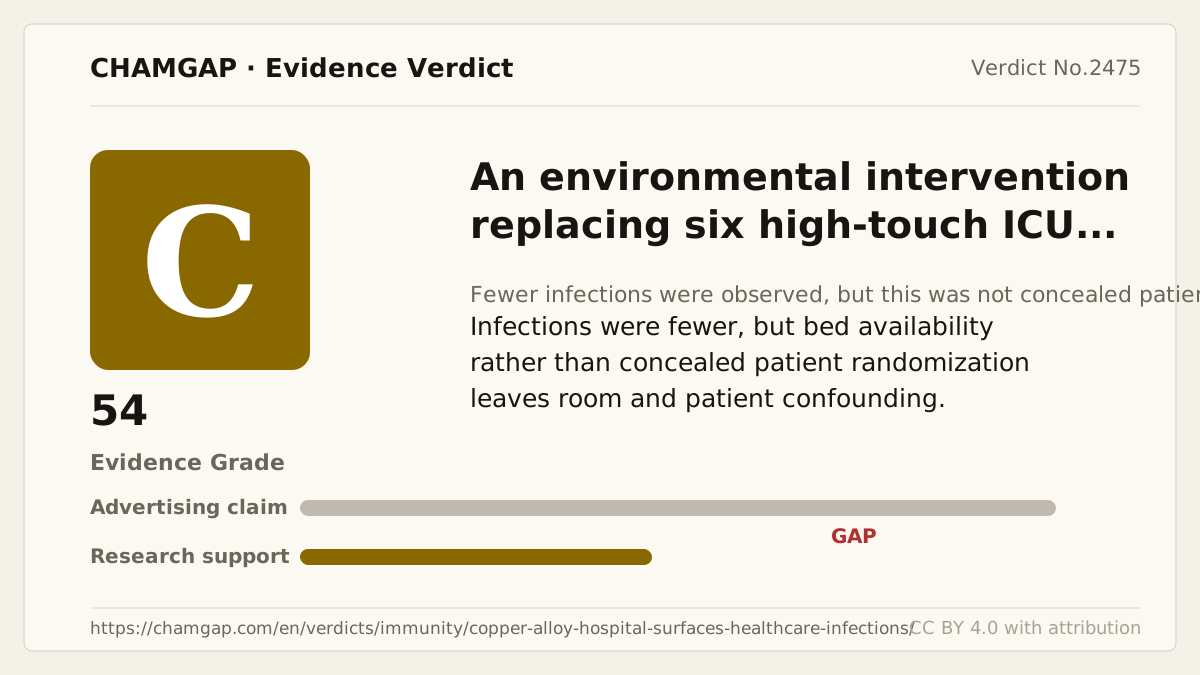
[Chamgap] Copper-containing hospital surfaces x fewer healthcare-associated infections — Evidence Grade C·54. 3 cited sources checked. Source: https://chamgap.com/en/verdicts/immunity/copper-alloy-hospital-surfaces-healthcare-infections/ · CC BY 4.0CC BY 4.0 — free to use with attribution; do not distort grades, numbers, or verdict meaning.
What this document does and does not do
Chamgap is an information source. It reports what research has and has not confirmed; it does not tell readers what to take or buy. That decision belongs to readers and, when needed, medical or legal professionals. This verdict reflects literature available up to the search date and may change as new research appears. Nothing here is medical advice.