
Ceftolozane-tazobactam,
does it really help with Noninferior 28-day mortality versus meropenem in ventilated nosocomial pneumonia?
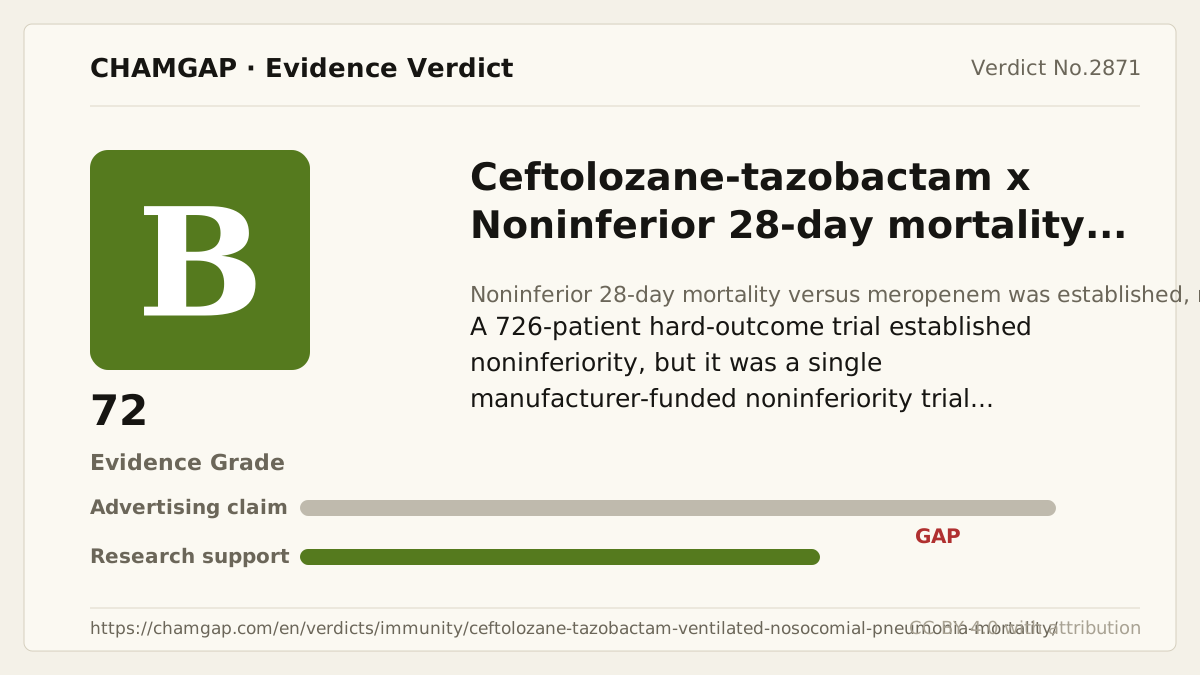
research showsThe grade is B. In ASPECT-NP, 28-day all-cause mortality was 87/362 (24.0%) versus 92/364 (25.3%). The upper confidence limit of 7.4 percentage points remained below the prespecified 10-point margin, establishing noninferiority to meropenem.
ads claimNoninferiority does not mean the new antibiotic saves more lives than meropenem. ICU selection should integrate Gram-negative susceptibility, infection site, renal function, and antimicrobial stewardship.
Useful facts when choosing a product
- Intravenous ceftolozane-tazobactam 3 g was compared with meropenem 1 g every 8 hours for 8 to 14 days.
- The primary outcome was 28-day all-cause mortality.
- The supported conclusion is noninferiority within a prespecified 10-point margin.
What the research actually shows
This double-blind active-controlled trial randomized 726 adults at 263 hospitals in 34 countries. ① Defect name: noninferiority design. ② Listed item: noninferiority design. ③ Original evidence that its requirement was met: "randomised, controlled, double-blind, phase 3, non-inferiority trial" and "at a 10% non-inferiority margin." ④ Avoidable: yes. A superiority design was possible, but the chosen question allowed loss of efficacy within a margin. Fixed-time ITT mortality used all 726 randomized participants, so missing primary outcomes were 0/726=0%, below 15%. The paper states "Funding: Merck & Co." and included Merck-employed authors.
Why this is classified as B (72)
A large randomized mortality trial and a precise noninferiority result are strengths, but absent independent replication, manufacturer-only funding, and the avoidable noninferiority design limit the grade to B with 72 points.
Counterpoint. Pathogen identification and susceptibility may justify a different choice for an individual patient.
Rejudgment record. Cross-check applied — Direct review of 28-day ITT mortality, the 10-point noninferiority margin, Merck funding, and design limitations
| Endpoint | H | Hard endpoint - actual events such as death |
| Replication | R1 | Single confirmatory trial |
| Independence | I0 | Evidence comes only from manufacturer studies |
| Effect size | E+ | Meets the clinically important threshold |
The scoring table and the verdict agree (B).
Sub-claim grades by effect
This ingredient is marketed for several effects. A single overall grade blends strong and weak claims together, so each effect is graded separately here. The overall grade reflects the strongest disconfirming or core claim.
| Effect (sub-claim) | Grade | Basis |
|---|---|---|
| Noninferior 28-day all-cause mortality | B | The 95% CI upper limit of 7.4 points did not cross the 10-point margin. |
| Mortality superiority over meropenem | D | The trial was not designed or positive for superiority. |
Cross-check — Codex and Claude
Evidence Table
| Study | Design | Sample | Funding | Endpoint | Result | Weight |
|---|---|---|---|---|---|---|
| Study 1 | Multicenter randomized double-blind active-controlled phase 3 noninferiority trial | 364 | Original statement: "Funding: Merck & Co."; Merck-employed authors included | 28-day all-cause mortality | 87/362 (24.0%) versus 92/364 (25.3%); weighted difference 1.1 points (95% CI -5.1 to 7.4), within the prespecified 10-point margin | Pivotal hard-outcome evidence |
Receipt — 1 References
All 1 cited sources were verified for existence at the original page (as of 2026-08-18).
Reviewed and approved: Chamgap Editorial Team · Approval date: 2026-08-18 · Corrections: none
Cite this verdict
[Chamgap] Benefit of Ceftolozane-Tazobactam for Noninferior 28-Day Mortality in Ventilated Nosocomial Pneumonia — Evidence Grade B·72. 1 cited sources checked. Source: https://chamgap.com/en/verdicts/immunity/ceftolozane-tazobactam-ventilated-nosocomial-pneumonia-mortality/ · CC BY 4.0CC BY 4.0 — free to use with attribution; do not distort grades, numbers, or verdict meaning.
What this document does and does not do
Chamgap is an information source. It reports what research has and has not confirmed; it does not tell readers what to take or buy. That decision belongs to readers and, when needed, medical or legal professionals. This verdict reflects literature available up to the search date and may change as new research appears. Nothing here is medical advice.