
Belimumab, a prescription BLyS-inhibiting monoclonal antibody,
does it really help with Increased week-52 SRI disease-activity response in active systemic lupus erythematosus?
research showsThe grade is C with 54 points. In BLISS-52, week-52 SRI response occurred in 167/290 (58%) with belimumab 10 mg/kg and 125/287 (44%) with placebo, an absolute difference of about +14 points and OR 1.83 (95% CI 1.30 to 2.59), P=.0006. Responders had to improve by at least four SELENA-SLEDAI points without new severe BILAG worsening or PGA worsening. The four-point within-person improvement was prespecified as clinically meaningful, but SRI is a composite disease-activity surrogate rather than death, hospitalization, or organ damage. The two BLISS trials belong to the same sponsor development program and are not counted as independent replication; manufacturer-only evidence caps the grade at C.
ads claimIt would be an overstatement to claim that the trial showed fewer deaths, hospitalizations, or accumulated organ damage. It directly showed more week-52 composite disease-activity responders when belimumab was added to standard therapy.
Useful facts when choosing a product
- SRI response required at least a four-point SELENA-SLEDAI reduction, no new BILAG A, no more than one new BILAG B, and no PGA worsening of at least 0.3 points.
- BLISS-52 and BLISS-76 were sister trials in the same development program.
- Belimumab was tested as an intravenous biologic added to standard lupus therapy.
What the research actually shows
BLISS-52 randomized 867 participants and included 865 treated participants in modified intention-to-treat analysis: 288 at 1 mg/kg, 290 at 10 mg/kg, and 287 placebo. The 10-mg/kg comparison was 58% versus 44%, about +14 points; the 1-mg/kg comparison was 51% versus 44%, about +7 points, OR 1.55 (95% CI 1.10 to 2.19). Sister trial BLISS-76 (NCT00410384) belonged to the same Human Genome Sciences and GSK development and sponsorship program, so it was not counted as independently funded replication. The paper's Funding statement named Human Genome Sciences and GlaxoSmithKline, and disclosures included company employment, stock, and consulting relationships. No existing belimumab verdict was present in the corpus, so no artificial cross-citation was added. Axis 6 B0 evidence ① Allocation concealment: "Patients were randomly assigned by use of a central interactive voice response system in a 1:1:1 ratio" ② Masking: "Patients, investigators, study coordinators, and sponsors were masked to treatment assignment." ③ Analysis population and missing data: "Method of analysis was by modified intention to treat."; week-52 SRI used "dropout = failure". ④ Prespecified primary endpoint: "The primary efficacy endpoint was the response rate at week 52, assessed with SRI." - matches the week-52 response rate in registration NCT00424476
Why this is classified as C (54)
SRI response increased using a prospectively meaningful responder definition, but the primary endpoint was a surrogate and evidence came only from one manufacturer development program, giving C with 54 points.
Counterpoint. The positive BLISS-52 result cannot automatically be converted into long-term reduction in organ damage, hospitalization, or death.
Rejudgment record. Cross-check applied — SRI response improved using a prespecified clinically meaningful component, but the endpoint was a disease-activity surrogate and evidence came only from one manufacturer program; central allocation, masking, missing-data handling, and the registered primary endpoint were directly checked
| Endpoint | S | Surrogate marker - laboratory or imaging measures |
| Replication | R1 | Single confirmatory trial |
| Independence | I0 | Evidence comes only from manufacturer studies |
| Effect size | E+ | Meets the clinically important threshold |
The scoring table and the verdict agree (C).
Sub-claim grades by effect
This ingredient is marketed for several effects. A single overall grade blends strong and weak claims together, so each effect is graded separately here. The overall grade reflects the strongest disconfirming or core claim.
| Effect (sub-claim) | Grade | Basis |
|---|---|---|
| Increased week-52 SRI disease-activity response | C | The 10-mg/kg comparison was 58% versus 44%, an absolute difference of about +14 points. |
| Reduced death, hospitalization, or accumulated organ damage | ? | The BLISS-52 primary endpoint was the SRI surrogate, not these hard clinical events. |
Cross-check — Codex and Claude
Evidence Table
| Study | Design | Sample | Funding | Endpoint | Result | Weight |
|---|---|---|---|---|---|---|
| Study 1 | Multinational centrally randomized double-blind placebo-controlled phase 3 trial | 287 | Funded by Human Genome Sciences and GlaxoSmithKline, with company employment, stock, and consulting relationships disclosed | Week-52 SRI composite disease-activity response rate | 10 mg/kg: 167/290 (58%) versus placebo 125/287 (44%), absolute difference about +14 points, OR 1.83 (95% CI 1.30 to 2.59), P=.0006; 1 mg/kg: 51% versus 44%, difference about +7 points, OR 1.55 (1.10 to 2.19). | Well-conducted pivotal evidence, but manufacturer-funded and based on a surrogate |
Receipt — 2 References
All 2 cited sources were verified for existence at the original page (as of 2026-08-18).
Reviewed and approved: Chamgap Editorial Team · Approval date: 2026-08-18 · Corrections: none
Cite this verdict
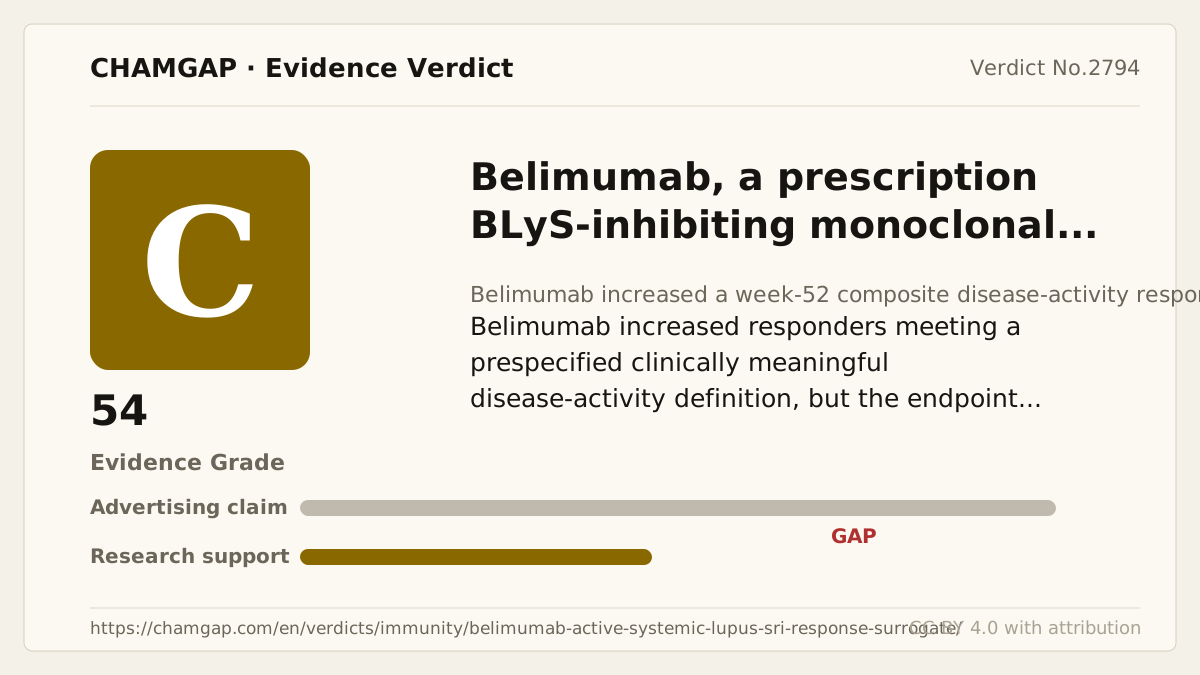
[Chamgap] Benefit of Belimumab for Disease-Activity Response in Active Systemic Lupus Erythematosus, a Surrogate Outcome — Evidence Grade C·54. 2 cited sources checked. Source: https://chamgap.com/en/verdicts/immunity/belimumab-active-systemic-lupus-sri-response-surrogate/ · CC BY 4.0CC BY 4.0 — free to use with attribution; do not distort grades, numbers, or verdict meaning.
What this document does and does not do
Chamgap is an information source. It reports what research has and has not confirmed; it does not tell readers what to take or buy. That decision belongs to readers and, when needed, medical or legal professionals. This verdict reflects literature available up to the search date and may change as new research appears. Nothing here is medical advice.