
Awake prone positioning,
does it really help with Reduced intubation or death?
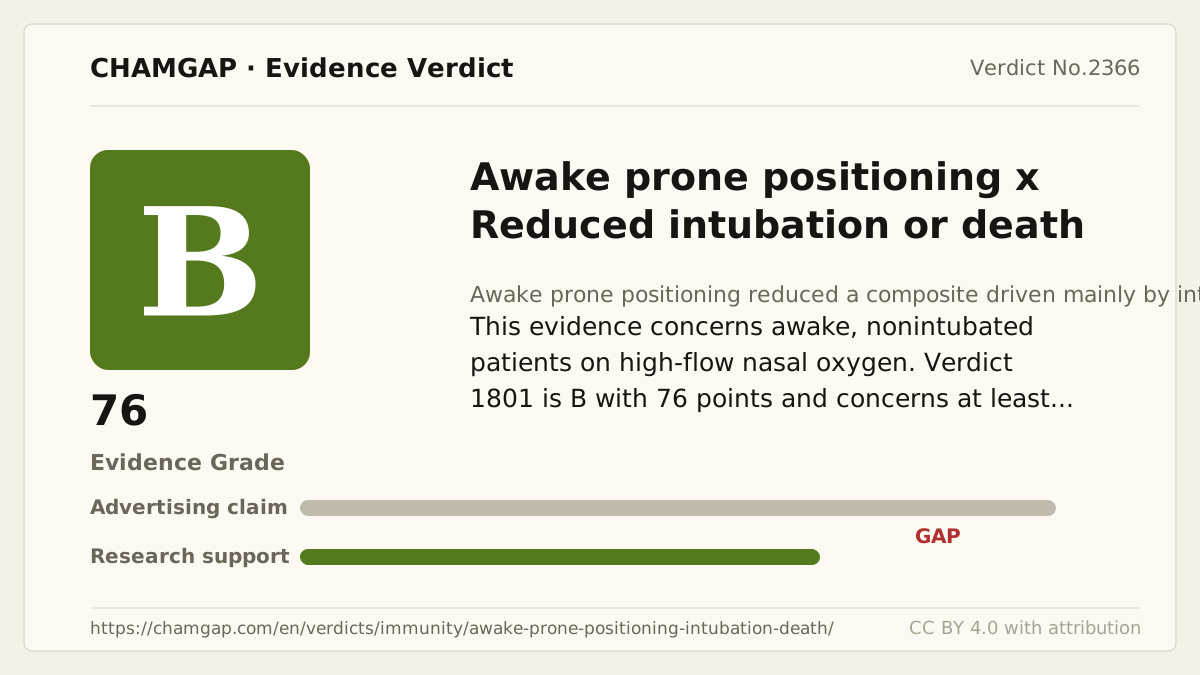
research showsAmong nonintubated patients with COVID-19 hypoxemia receiving high-flow oxygen, intubation or death fell from 46% to 40%. Mortality alone was not significantly reduced, and actual prone time was a median 5 hours per day.
ads claimMarketing can blur evidence from prolonged prone positioning during mechanical ventilation with shorter, awake positioning before intubation. These are different interventions at different stages of illness.
Useful facts when choosing a product
- The meta-trial prospectively combined six open-label randomized trials in Canada, France, Ireland, Mexico, Spain, and the United States.
- Of 1,126 randomized participants, 1,121 remained in the primary analysis: 564 prone and 557 usual care.
- Outcomes appeared better among patients averaging at least 8 hours daily, but that post-randomization adherence comparison was not used as causal evidence.
- Short achieved exposure makes failure of the posture difficult to separate from failure to tolerate or deliver it.
What the research actually shows
Patients were encouraged to remain prone as long and as frequently as possible; there was no common fixed target across all trials. Actual exposure through day 14 was a median 5.0 hours per day (IQR 1.6 to 8.8); the first session lasted a median 3.0 hours (IQR 1.2 to 4.0).
Why this is classified as B (76)
A large randomized dataset directly measured intubation and death and found a statistically significant 6-point absolute reduction in the composite. Mortality alone remained uncertain, and the decisive evidence is concentrated in one coordinated meta-trial.
Counterpoint. A 2024 trial targeting more than 12 hours per day favored prolonged over shorter prone positioning, but its comparator and exposure differ from the usual-care question here.
Rejudgment record. Cross-check applied — The assessment used the 28-day intubation-or-death outcome and achieved exposure in a prospective meta-trial of six open-label randomized trials.
| Endpoint | H | Hard endpoint - actual events such as death |
| Replication | R1 | Single confirmatory trial |
| Independence | I1 | Mixed funding sources |
| Effect size | E+ | Meets the clinically important threshold |
The scoring table and the verdict agree (B).
Sub-claim grades by effect
This ingredient is marketed for several effects. A single overall grade blends strong and weak claims together, so each effect is graded separately here. The overall grade reflects the strongest disconfirming or core claim.
| Effect (sub-claim) | Grade | Basis |
|---|---|---|
| Reduced intubation or death by day 28 | B | The result was 40% versus 46%, RR 0.86. |
| Reduced 28-day mortality | D | The mortality hazard ratio was 0.87 with a 95% CI of 0.68 to 1.11. |
Cross-check — Codex and Claude
Evidence Table
| Study | Design | Sample | Funding | Endpoint | Result | Weight |
|---|---|---|---|---|---|---|
| Study 1 | Prospective meta-trial of six open-label randomized trials | 1 | Mixed public, nonprofit, and Fisher & Paykel Healthcare support | Intubation or death within 28 days | 223/564 (40%) vs 257/557 (46%), RR 0.86 (0.75 to 0.98) | Decisive direct evidence |
| Study 2 | Meta-analysis of 17 randomized trials | 17 | Canadian public research support and author disclosures | Intubation and mortality | 55 fewer intubations per 1,000 (95% CI 19 to 87 fewer); little or no mortality effect | Context for the randomized evidence base |
Receipt — 2 References
All 2 cited sources were verified for existence at the original page (as of 2026-08-07).
Reviewed and approved: Chamgap Editorial Team · Approval date: 2026-08-07 · Corrections: none
Cite this verdict
[Chamgap] Does awake prone positioning reduce intubation or death? — Evidence Grade B·76. 2 cited sources checked. Source: https://chamgap.com/en/verdicts/immunity/awake-prone-positioning-intubation-death/ · CC BY 4.0CC BY 4.0 — free to use with attribution; do not distort grades, numbers, or verdict meaning.
What this document does and does not do
Chamgap is an information source. It reports what research has and has not confirmed; it does not tell readers what to take or buy. That decision belongs to readers and, when needed, medical or legal professionals. This verdict reflects literature available up to the search date and may change as new research appears. Nothing here is medical advice.