
Subcutaneous zilebesiran,
does it really help with Change in 24-hour mean ambulatory systolic blood pressure at month 3 in mild-to-moderate hypertension?
research showsThe grade is C with 50 points. KARDIA-1 randomized 394 participants, and 330 had month-3 primary endpoint data. Placebo-adjusted changes in 24-hour mean ambulatory systolic blood pressure at month 3 were -14.1 mm Hg (95% CI -19.2 to -9.0), -16.7 (-21.2 to -12.3), and -15.7 (-20.8 to -10.6) across dose comparisons. The primary endpoint was a blood-pressure surrogate, capping the grade at C.
ads claimZilebesiran is not approved in Korea, but Korean news and investment reports already circulate it as a 'once-every-six-months blood-pressure injection.' Verdict 2865 concerns givosiran, another siRNA with a different indication. In the existing corpus, verdict 630 is C with 55 points for inclisiran, verdict 1621 is B with 78 points for vutrisiran, and verdict 2816 is C with 54 points for fitusiran; they address LDL-C, ATTR-CM, and hemophilia bleeding and were not pooled with hypertension.
Useful facts when choosing a product
- Zilebesiran is an investigational siRNA that suppresses hepatic angiotensinogen synthesis.
- Biannual dosing may reduce missed pills, but months-long pharmacodynamic activity can be difficult to reverse during hypotension, volume depletion, bleeding, or infection; the paper noted that RNA-interference reversal agents were being considered.
- Primary endpoint data were available in 68, 137, and 65 zilebesiran participants across dose comparisons and 60 placebo participants.
- Korean media describe a twice-yearly injection, but Korean marketing authorization was not identified.
What the research actually shows
· Defect name: Missing primary endpoint data · Listed item: Substantial attrition (≥15%) · Original evidence that the requirement was met: Of 394 randomized participants, 330 had month-3 primary endpoint data ("Primary end point data were available for 68 ... 137 ... 65 ... and 60 patients"), leaving 64 (16.2%) missing. Because the primary endpoint was a continuous measurement at a fixed time point, this is missingness rather than censoring. · Avoidability: Partly avoidable - wartime loss to follow-up was unavoidable, but additional sites and stronger follow-up could have reduced missingness. The trial randomized 394 participants, not below the 200-person small-study threshold; its primary assessment was at three months, not less than 12 weeks; and allocation concealment, masking, and a prespecified primary endpoint were confirmed. Alnylam Pharmaceuticals funded the trial and medical writing, and the sponsor participated in design, conduct, data work, interpretation, and manuscript preparation. Stiglitz, Goyal, Guo, and Zappe were Alnylam employees and stockholders, and several other authors disclosed Alnylam payments or grants.
Why this is classified as C (50)
The primary endpoint was change in 24-hour ambulatory systolic blood pressure, a surrogate, so the ceiling is C. The large blood-pressure effect is credited, but 16.2% lacked the month-3 primary endpoint and one Alnylam phase 2 trial did not test cardiovascular events, giving C with 50 points.
Counterpoint. The population had mild-to-moderate hypertension after antihypertensive washout. Results cannot automatically be transferred to severe hypertension, intensive multidrug treatment, long-term safety, or event prevention.
Rejudgment record. Cross-check applied — Cross-checked NCT04936035 and the JAMA report for the ambulatory-BP primary endpoint, allocation, masking, analysis, 64/394 (16.2%) missingness, Alnylam sponsorship, and harms
| Endpoint | S | Surrogate marker - laboratory or imaging measures |
| Replication | R1 | Single confirmatory trial |
| Independence | I0 | Evidence comes only from manufacturer studies |
| Effect size | E+ | Meets the clinically important threshold |
The scoring table and the verdict agree (C).
Sub-claim grades by effect
This ingredient is marketed for several effects. A single overall grade blends strong and weak claims together, so each effect is graded separately here. The overall grade reflects the strongest disconfirming or core claim.
| Effect (sub-claim) | Grade | Basis |
|---|---|---|
| Lower 24-hour systolic blood pressure at month 3 | C | Placebo-adjusted differences were -14.1 to -16.7 mm Hg, but the endpoint is a surrogate. |
| Fewer strokes or myocardial infarctions | ? | This phase 2 trial did not test cardiovascular events. |
Cross-check — Codex and Claude
Evidence Table
| Study | Design | Sample | Funding | Endpoint | Result | Weight |
|---|---|---|---|---|---|---|
| Study 1 | Phase 2 double-blind placebo-controlled dose-ranging randomized trial at 78 sites | 330 | Funded by Alnylam Pharmaceuticals with company employees as coauthors | Change in 24-hour mean ambulatory systolic blood pressure at month 3 | Versus placebo: -14.1 (-19.2 to -9.0), -16.7 (-21.2 to -12.3), and -15.7 (-20.8 to -10.6) mm Hg | Pivotal single manufacturer-funded phase 2 trial |
Receipt — 3 References
All 3 cited sources were verified for existence at the original page (as of 2026-08-18).
Reviewed and approved: Chamgap Editorial Team · Approval date: 2026-08-18 · Corrections: none
Cite this verdict
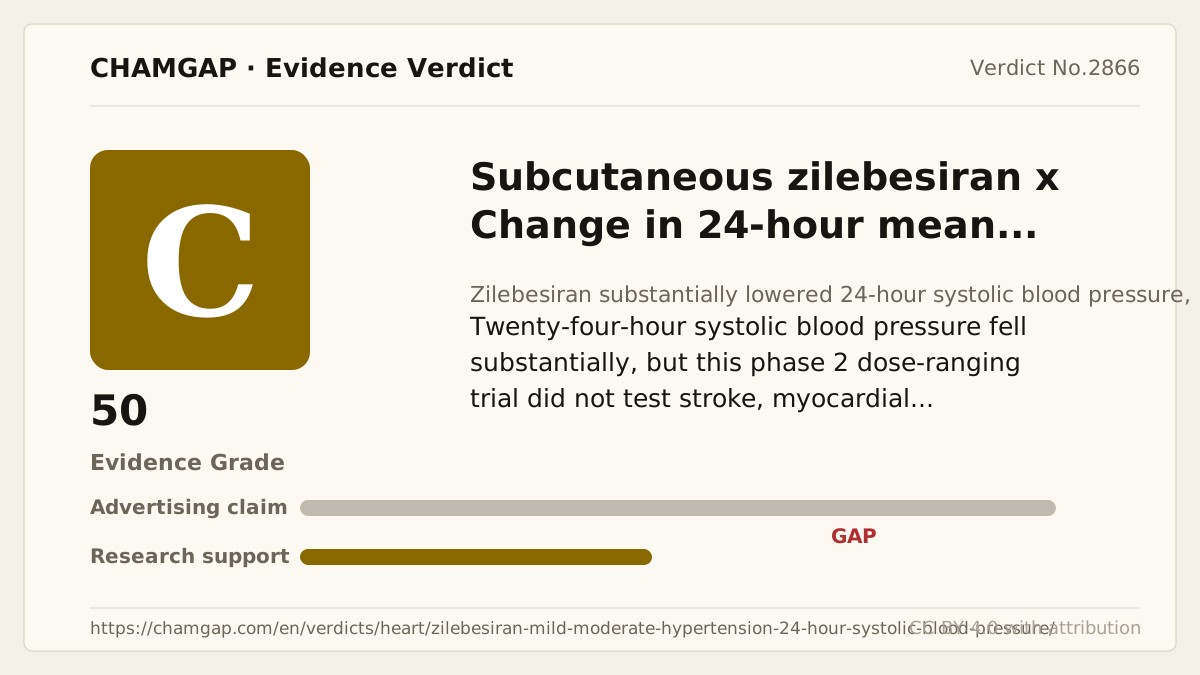
[Chamgap] Zilebesiran Benefits 24-Hour Systolic Blood Pressure in Mild-to-Moderate Hypertension — Evidence Grade C·50. 3 cited sources checked. Source: https://chamgap.com/en/verdicts/heart/zilebesiran-mild-moderate-hypertension-24-hour-systolic-blood-pressure/ · CC BY 4.0CC BY 4.0 — free to use with attribution; do not distort grades, numbers, or verdict meaning.
What this document does and does not do
Chamgap is an information source. It reports what research has and has not confirmed; it does not tell readers what to take or buy. That decision belongs to readers and, when needed, medical or legal professionals. This verdict reflects literature available up to the search date and may change as new research appears. Nothing here is medical advice.