
Real-time video home cardiac rehabilitation,
does it really help with Noninferior improvement in 12-week six-minute walk function versus centre-based rehabilitation in stable chronic heart failure?
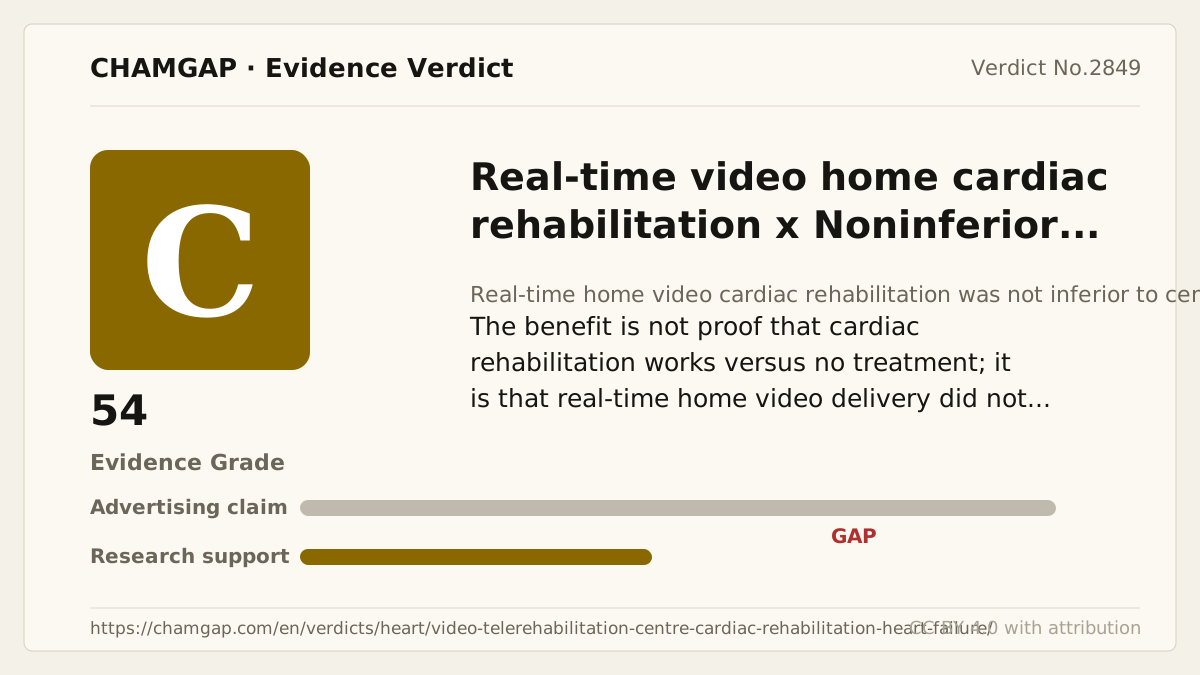
research showsThe grade is C. In 53 stable chronic heart failure patients, the 12-week between-group difference in six-minute walk change was 15 m (95% CI -28 to 59), meeting the prespecified -28 m noninferiority margin.
ads claimCompensated heart failure is included in Korean cardiac rehabilitation reimbursement, and remote rehabilitation is under discussion. This trial supports clinician-supervised real-time delivery in selected stable patients, not unsupervised exercise without video support.
Useful facts when choosing a product
- Both groups received 60-minute sessions twice weekly for 12 weeks plus additional home exercise.
- Attrition was 3/53 (5.7%) at Week 12 and 4/53 (7.5%) by Week 24.
- No death, cardiac arrest, syncope, or fall occurred during exercise sessions; minor events across groups included three angina, three diaphoresis, and two palpitation episodes.
What the research actually shows
Two Australian hospitals randomized 53 participants to twice-weekly, 12-week real-time video home rehabilitation or centre-based outpatient rehabilitation. Allocation used opaque, sealed, numbered envelopes administered centrally by an independent researcher. Clinicians and participants could not be blinded to delivery, but participants were asked not to reveal allocation and blinded assessors used a standardized hospital protocol. Defect name: Noninferiority design. Listed item: Noninferiority design. Avoidability: Avoidable - a sufficiently powered superiority or equivalence trial could have been added. Defect name: Small study. Listed item: Small study, total under 200 - actual total 53. Avoidability: Avoidable - multicentre recruitment could have enrolled at least 200. Unblinded subjective endpoint: not applicable - the primary endpoint was a performance test and assessors were blinded. Substantial attrition (>=15%): actual 3/53 (5.7%) at Week 12 - not applicable. Active-only control applied formally, but withholding standard rehabilitation was inappropriate and the question was delivery mode, so it was unavoidable and not counted. Verdict 1561 is A with 88 points: it asked whether cardiac rehabilitation works using hard endpoints, whereas this verdict asks whether that rehabilitation can be delivered remotely at home. These are different questions.
Why this is classified as C (54)
A publicly and foundation-funded assessor-blinded trial met its prespecified noninferiority criterion on a patient performance outcome, but a single 53-person noninferiority study with two listed limitations gives C with 54 points.
Counterpoint. The program required in-person assessments, real-time clinician supervision, and technology access, and does not generalize to unstable or exercise-ineligible patients.
Rejudgment record. Cross-check applied — An assessor-blinded publicly funded randomized trial met the prespecified margin but was a 53-person noninferiority study
| Endpoint | P | Patient-reported treatment goal - the symptom is the goal |
| Replication | R1 | Single confirmatory trial |
| Independence | I2 | Decisive evidence is publicly or non-profit funded |
| Effect size | E+ | Meets the clinically important threshold |
The scoring table and the verdict agree (C).
Sub-claim grades by effect
This ingredient is marketed for several effects. A single overall grade blends strong and weak claims together, so each effect is graded separately here. The overall grade reflects the strongest disconfirming or core claim.
| Effect (sub-claim) | Grade | Basis |
|---|---|---|
| Noninferior 12-week six-minute walk function | C | The 15 m difference, 95% CI -28 to 59, met the prespecified margin. |
| Noninferior 24-week six-minute walk function | ? | The lower confidence bound was -36 m, so noninferiority was not established. |
Cross-check — Codex and Claude
Evidence Table
| Study | Design | Sample | Funding | Endpoint | Result | Weight |
|---|---|---|---|---|---|---|
| Study 1 | Two-hospital randomized assessor-blinded 12-week noninferiority trial | 26 | National Heart Foundation Health Professional Scholarship 100297, Princess Alexandra Hospital Research Support Scheme, Prince Charles Hospital Foundation, and Queensland Health; no competing interests | Between-group difference in six-minute walk distance change from baseline to Week 12; prespecified 28 m noninferiority margin | Home-minus-centre difference 15 m (95% CI -28 to 59), noninferior at Week 12; 2 m (-36 to 41) at Week 24, noninferiority not established | Assessor-blinded publicly and foundation-funded small single trial |
Receipt — 1 References
All 1 cited sources were verified for existence at the original page (as of 2026-08-18).
Reviewed and approved: Chamgap Editorial Team · Approval date: 2026-08-18 · Corrections: none
Cite this verdict
[Chamgap] Real-Time Video Telerehabilitation Benefits Six-Minute Walk Function in Stable Chronic Heart Failure by Being Noninferior to Centre-Based Rehabilitation — Evidence Grade C·54. 1 cited sources checked. Source: https://chamgap.com/en/verdicts/heart/video-telerehabilitation-centre-cardiac-rehabilitation-heart-failure/ · CC BY 4.0CC BY 4.0 — free to use with attribution; do not distort grades, numbers, or verdict meaning.
What this document does and does not do
Chamgap is an information source. It reports what research has and has not confirmed; it does not tell readers what to take or buy. That decision belongs to readers and, when needed, medical or legal professionals. This verdict reflects literature available up to the search date and may change as new research appears. Nothing here is medical advice.