
TYRX antibacterial envelope,
does it really help with Reduced major CIED infection within 12 months after higher-risk device procedures?
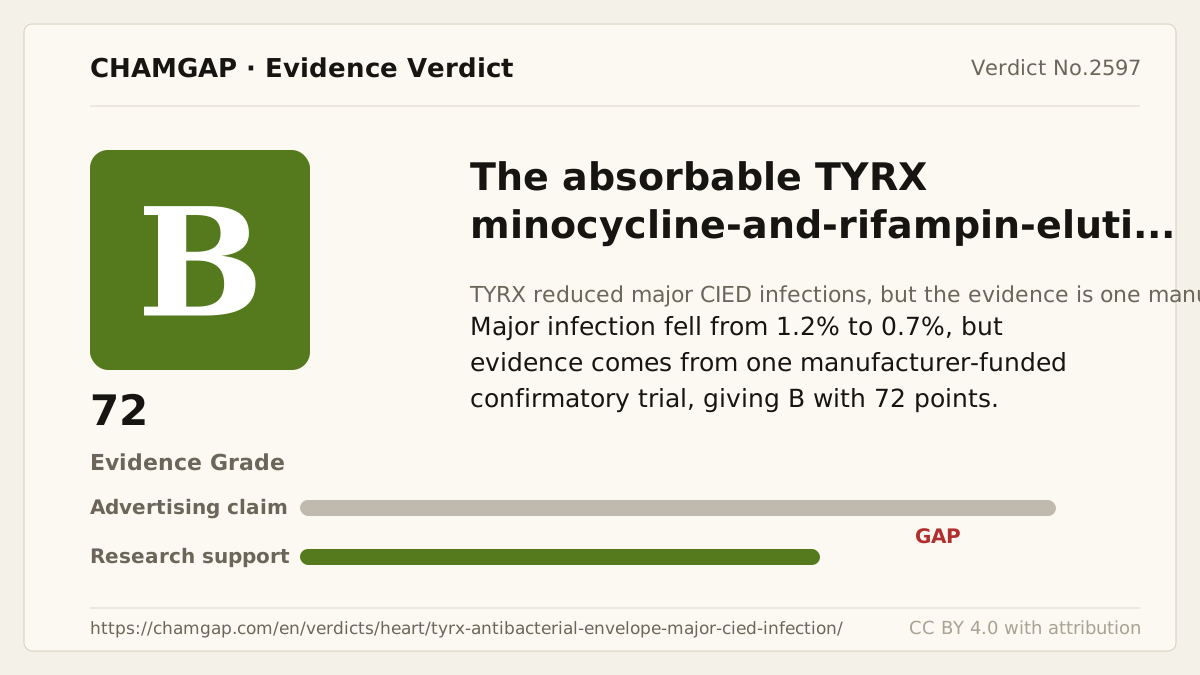
research showsThe grade is B with 72 points. In the 6,983-participant WRAP-IT analysis, major infection by 12 months occurred in 25/3,495 (0.7%) with TYRX versus 42/3,488 (1.2%) with control, HR 0.60 (95% CI 0.36 to 0.98). This was a large procedural trial of real infections, so manufacturer funding alone does not cap it at C, but it remains one trial without independent replication.
ads claimThe envelope truly releases minocycline and rifampin and is designed to be absorbed in about nine weeks. WRAP-IT also found fewer infections, but that does not constitute replication by an independent research program.
Useful facts when choosing a product
- TYRX is an absorbable mesh placed in the CIED pocket, designed to release minocycline and rifampin for at least seven days and absorb in about nine weeks.
- All WRAP-IT participants received preprocedure intravenous antibiotics and standard sterile technique.
- The trial excluded dialysis, chronic immunosuppression, recent device infection, and other very-high-risk settings.
What the research actually shows
Tarakji and the WRAP-IT Investigators randomized 6,983 patients at 181 centers undergoing replacement, upgrade, revision, or first CRT-D implantation. Participants were single-blinded and infections were independently adjudicated. The 12-month major-infection endpoint matched NCT02277990. The article states that Medtronic funded the trial, and several authors were employees or shareholders. The publicly accessible report did not specify the implementation of allocation concealment, which was retained as one design limitation.
Why this is classified as B (72)
A large hard-outcome procedural trial found fewer major infections, but it remains one manufacturer-funded development study without independent replication, giving B with 72 points.
Counterpoint. The absolute reduction was small and net value depends on baseline risk and cost; excluded highest-risk groups need separate evidence.
Rejudgment record. Cross-check applied — Cross-checked sample size, primary infection endpoint, event counts, hazard ratio, manufacturer funding, and analysis scope against the NEJM article and NCT02277990
| Endpoint | H | Hard endpoint - actual events such as death |
| Replication | R1 | Single confirmatory trial |
| Independence | I0 | Evidence comes only from manufacturer studies |
| Effect size | E+ | Meets the clinically important threshold |
The scoring table and the verdict agree (B).
Sub-claim grades by effect
This ingredient is marketed for several effects. A single overall grade blends strong and weak claims together, so each effect is graded separately here. The overall grade reflects the strongest disconfirming or core claim.
| Effect (sub-claim) | Grade | Basis |
|---|---|---|
| TYRX reduces major CIED infection through 12 months | B | WRAP-IT found 0.7% versus 1.2%, but it was one manufacturer-funded trial. |
| TYRX does not increase procedure- or system-related complications | B | Rates were 6.0% versus 6.9%, HR 0.87 (0.72 to 1.06). |
Cross-check — Codex and Claude
Evidence Table
| Study | Design | Sample | Funding | Endpoint | Result | Weight |
|---|---|---|---|---|---|---|
| Study 1 | Prospective multicenter randomized single-blind postmarketing trial | 3,488 | Funded by Medtronic | Major CIED infection through 12 months | 25/3,495 (0.7%) versus 42/3,488 (1.2%), HR 0.60 (95% CI 0.36 to 0.98) | Large hard-infection trial but a single manufacturer-funded confirmation |
Receipt — 1 References
All 1 cited sources were verified for existence at the original page (as of 2026-08-14).
Reviewed and approved: Chamgap Editorial Team · Approval date: 2026-08-14 · Corrections: none
Cite this verdict
[Chamgap] TYRX antibacterial envelope x major CIED infection prevention — Evidence Grade B·72. 1 cited sources checked. Source: https://chamgap.com/en/verdicts/heart/tyrx-antibacterial-envelope-major-cied-infection/ · CC BY 4.0CC BY 4.0 — free to use with attribution; do not distort grades, numbers, or verdict meaning.
What this document does and does not do
Chamgap is an information source. It reports what research has and has not confirmed; it does not tell readers what to take or buy. That decision belongs to readers and, when needed, medical or legal professionals. This verdict reflects literature available up to the search date and may change as new research appears. Nothing here is medical advice.