
Trendelenburg position,
does it really help with Sustained improvement in cardiac output and tissue oxygen delivery?
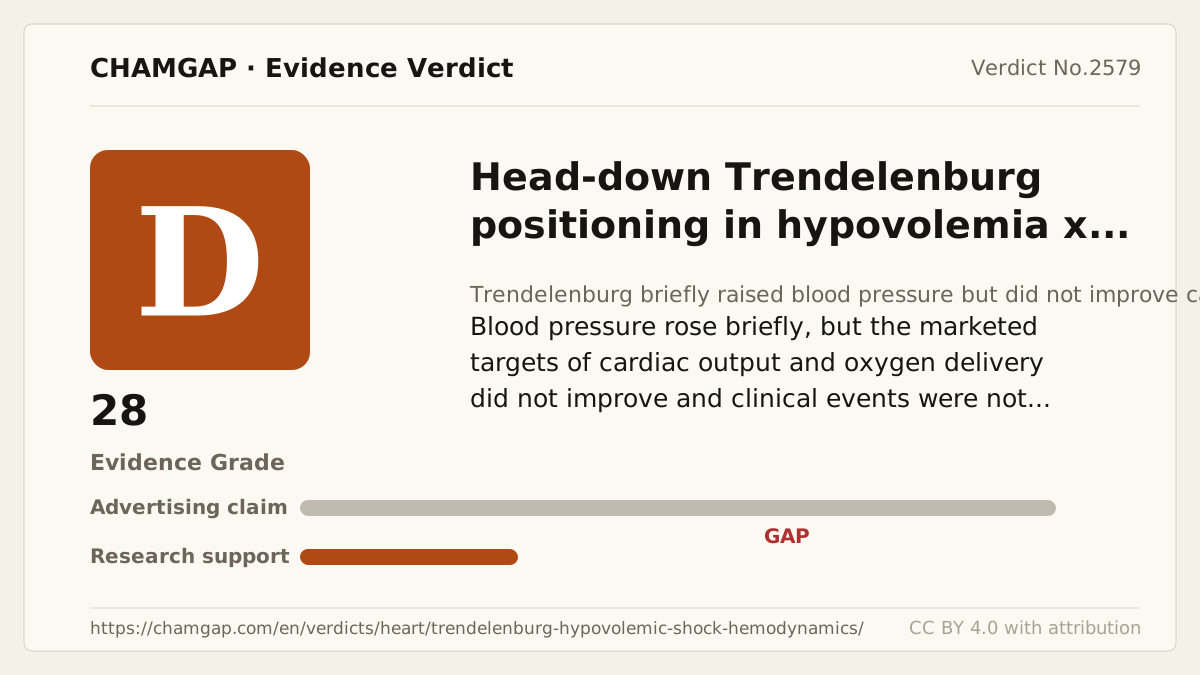
research showsThe grade is D. The pivotal human study was one sequential self-controlled study of eight postoperative hypovolemic adults. Mean arterial pressure rose transiently from 64.9±4.9 to 75.6±3.5 mmHg, but cardiac index, oxygen delivery, oxygen consumption, and oxygen extraction did not improve significantly. Survival, organ failure, and fluid or vasopressor requirements were not measured, and confidence intervals were not reported. This gives D with 28 points.
ads claimA temporary rise in a blood-pressure reading is not the same as improved organ blood flow, oxygen delivery, or recovery. This study observed the former but did not establish the latter.
Useful facts when choosing a product
- Trendelenburg is a supine position with the head lower than the torso and legs.
- In the eight-person study, mean arterial pressure rose from 64.9±4.9 to 75.6±3.5 mmHg and wedge pressure from 4.6±1.1 to 7.9±0.8 mmHg.
- Cardiac index and oxygen delivery and consumption did not change significantly in the same measurements.
What the research actually shows
Sing RF, O'Hara D, Sawyer MA, Marino PL applied Trendelenburg positioning to eight postoperative hypovolemic adults and measured invasive hemodynamic and oxygen-transport variables sequentially. The prospective design was self-controlled and had no randomized concurrent comparator. Comparator absence was part of the study's design classification, not a separate avoidable bias defect; the remaining avoidable defect was the eight-person sample. Mean arterial pressure, wedge pressure, and systemic vascular resistance increased, whereas cardiac index, oxygen delivery, oxygen consumption, and oxygen extraction did not. Funding, acknowledgments, and key confidence intervals could not be verified in publicly available material.
Why this is classified as D (28)
Human physiology was measured, but evidence consists of one eight-person sequential self-controlled study and the key cardiac-output and oxygen-delivery outcomes were null. Comparator absence was inherent to the design, while the eight-person sample was the one avoidable defect, giving B1; absent clinical events and precise intervals leave the grade at D with 28 points.
Counterpoint. A short-term rise in mean arterial pressure was real but cannot be interpreted as improved survival, organ failure, or perfusion.
Rejudgment record. Cross-check applied — The original abstract was cross-checked for design, actual eight-person sample, pre-post MAP, wedge pressure and vascular resistance, null cardiac index and oxygen transport, and absent clinical events and confidence intervals.
| Endpoint | S | Surrogate marker - laboratory or imaging measures |
| Replication | R1 | Single confirmatory trial |
| Independence | I1 | Mixed funding sources |
| Effect size | E0 | Null |
| Precision | CX | No pooled confidence interval could be confirmed |
The scoring table and the verdict agree (D).
Sub-claim grades by effect
This ingredient is marketed for several effects. A single overall grade blends strong and weak claims together, so each effect is graded separately here. The overall grade reflects the strongest disconfirming or core claim.
| Effect (sub-claim) | Grade | Basis |
|---|---|---|
| Short-term increase in mean arterial pressure | C | Mean arterial pressure rose from 64.9 to 75.6 mmHg. |
| Sustained improvement in cardiac output and tissue oxygen delivery | D | Cardiac index and oxygen delivery and consumption did not change significantly. |
Cross-check — Codex and Claude
Evidence Table
| Study | Design | Sample | Funding | Endpoint | Result | Weight |
|---|---|---|---|---|---|---|
| Sing RF, O'Hara D, Sawyer MA, Marino PL, 1994 | Prospective sequential self-controlled physiology study | 8 | Original funding and acknowledgment section could not be verified | Mean arterial pressure, pulmonary wedge pressure, cardiac index, oxygen delivery, and oxygen consumption | MAP 64.9±4.9 to 75.6±3.5 mmHg and wedge pressure 4.6±1.1 to 7.9±0.8 mmHg; no significant change in cardiac index, oxygen delivery, consumption, or extraction | Only very small human physiology study |
Receipt — 1 References
All 1 cited sources were verified for existence at the original page (as of 2026-08-14).
Reviewed and approved: Chamgap Editorial Team · Approval date: 2026-08-14 · Corrections: none
Cite this verdict
[Chamgap] Trendelenburg position x circulation in hypovolemic shock — Evidence Grade D·28. 1 cited sources checked. Source: https://chamgap.com/en/verdicts/heart/trendelenburg-hypovolemic-shock-hemodynamics/ · CC BY 4.0CC BY 4.0 — free to use with attribution; do not distort grades, numbers, or verdict meaning.
What this document does and does not do
Chamgap is an information source. It reports what research has and has not confirmed; it does not tell readers what to take or buy. That decision belongs to readers and, when needed, medical or legal professionals. This verdict reflects literature available up to the search date and may change as new research appears. Nothing here is medical advice.