
Switching from hydrochlorothiazide to chlorthalidone,
does it really help with Reduced major nonfatal cardiovascular events or noncancer death?
research showsThe grade is D. In the 13,523-participant pragmatic DCP trial, the primary outcome occurred in 702/6756 (10.4%) with chlorthalidone and 675/6767 (10.0%) with continued hydrochlorothiazide, an absolute difference of +0.4 percentage point; HR 1.04 (95% CI 0.94-1.16), P=.45. The favorable tail reached HR 0.94, leaving only about a 6% lower hazard and not supporting a large benefit.
ads claimA pragmatic design compares drugs through ordinary prescribing and follow-up, improving relevance to routine practice. It also includes real-world nonadherence and switching, so the estimate is closer to the effect of a switching policy than perfect-adherence pharmacologic efficacy.
Useful facts when choosing a product
- Thiazide prescribing is common in Korean hypertension care, making the choice to maintain or switch drugs highly relevant.
- Verdict 935 is A with 84 points for whether amlodipine lowers blood pressure and cardiovascular risk in adult hypertension. It asks whether a drug works as antihypertensive therapy.
- Verdict 1339 is D with 35 points for hydrochlorothiazide preventing recurrent calcium kidney stones, a different indication for the same drug. This verdict asks whether a person already taking HCTZ should switch to chlorthalidone.
- Hypokalemia occurred in 6.0% versus 4.4%, a significant absolute increase of +1.6 points (P<.001).
What the research actually shows
This open-label pragmatic comparative-effectiveness trial was embedded in routine care across 72 VA health systems. The 13,523 randomized participants were analyzed by assignment, and vital status was confirmed for everyone except those who withdrew consent. Although treatment was open label, outcomes were objective EHR events with blinded manual adjudication when needed, so lack of participant blinding was not counted as a defect. Axis 6 B0 evidence ① Allocation concealment: "Once confirmed, electronic randomization was performed." - central electronic allocation after eligibility and provider assent ② Blinding: "Manually adjudicated outcomes were evaluated by investigators and staff who were unaware of group assignment." - open treatment with objective events and blinded adjudication ③ Analysis population and missing data: "only those consented subjects for whom a randomized drug order is entered will be considered as ITT subjects and included in the ... primary efficacy analysis." Vital status was confirmed for all except consent withdrawals. ④ Prespecified primary outcome: "The primary outcome was the first occurrence of a composite outcome consisting of a nonfatal cardiovascular event or non-cancer related death." - consistent with NCT02185417
Why this is classified as D (34)
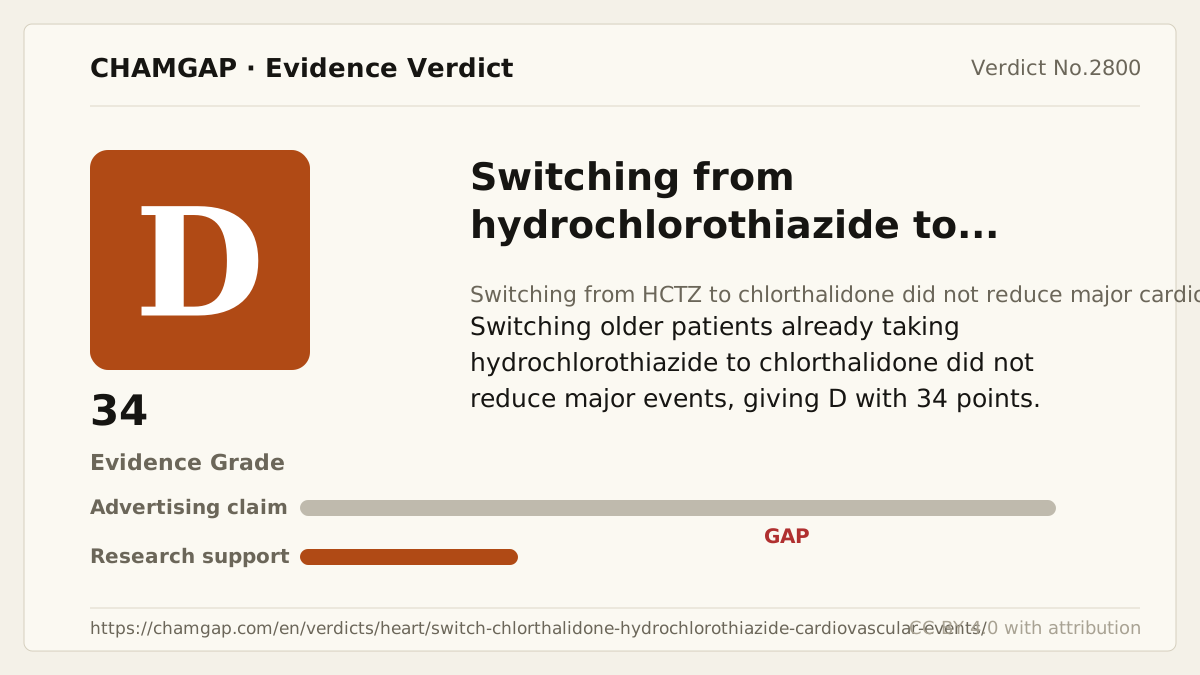
A large publicly funded pragmatic trial was null for hard cardiovascular events, without a declared benefit-exclusion threshold, giving D with 34 points.
Counterpoint. The favorable bound of HR 0.94 leaves no large benefit, but without a prespecified clinical boundary it does not prove exclusion of every small benefit.
Rejudgment record. Cross-check applied — A null hard composite in a 13,523-person publicly funded pragmatic trial with the favorable confidence bound at HR 0.94
| Endpoint | H | Hard endpoint - actual events such as death |
| Replication | R1 | Single confirmatory trial |
| Independence | I2 | Decisive evidence is publicly or non-profit funded |
| Effect size | E0 | Null |
| Precision | C0 | The confidence interval leaves room for benefit |
The scoring table and the verdict agree (D).
Sub-claim grades by effect
This ingredient is marketed for several effects. A single overall grade blends strong and weak claims together, so each effect is graded separately here. The overall grade reflects the strongest disconfirming or core claim.
| Effect (sub-claim) | Grade | Basis |
|---|---|---|
| Reduced major cardiovascular events or noncancer death | D | HR was 1.04 (95% CI 0.94-1.16), with an absolute difference of +0.4 point. |
Cross-check — Codex and Claude
Evidence Table
| Study | Design | Sample | Funding | Endpoint | Result | Weight |
|---|---|---|---|---|---|---|
| Study 1 | Pragmatic randomized comparative-effectiveness trial embedded in VA care | 6767 | Veterans Affairs Cooperative Studies Program | First nonfatal cardiovascular event or noncancer death | 702/6756 (10.4%) versus 675/6767 (10.0%), absolute difference +0.4 point, HR 1.04 (95% CI 0.94-1.16), P=.45 | Pivotal large hard cardiovascular-outcome evidence |
Receipt — 1 References
All 1 cited sources were verified for existence at the original page (as of 2026-08-18).
Reviewed and approved: Chamgap Editorial Team · Approval date: 2026-08-18 · Corrections: none
Cite this verdict
[Chamgap] No Benefit of Switching to Chlorthalidone for Major Cardiovascular Events or Noncancer Death versus Hydrochlorothiazide — Evidence Grade D·34. 1 cited sources checked. Source: https://chamgap.com/en/verdicts/heart/switch-chlorthalidone-hydrochlorothiazide-cardiovascular-events/ · CC BY 4.0CC BY 4.0 — free to use with attribution; do not distort grades, numbers, or verdict meaning.
What this document does and does not do
Chamgap is an information source. It reports what research has and has not confirmed; it does not tell readers what to take or buy. That decision belongs to readers and, when needed, medical or legal professionals. This verdict reflects literature available up to the search date and may change as new research appears. Nothing here is medical advice.