
Upper-limb remote ischemic preconditioning using a blood-pressure cuff,
does it really help with Reduced death, myocardial infarction, stroke, and other major events after cardiac surgery?
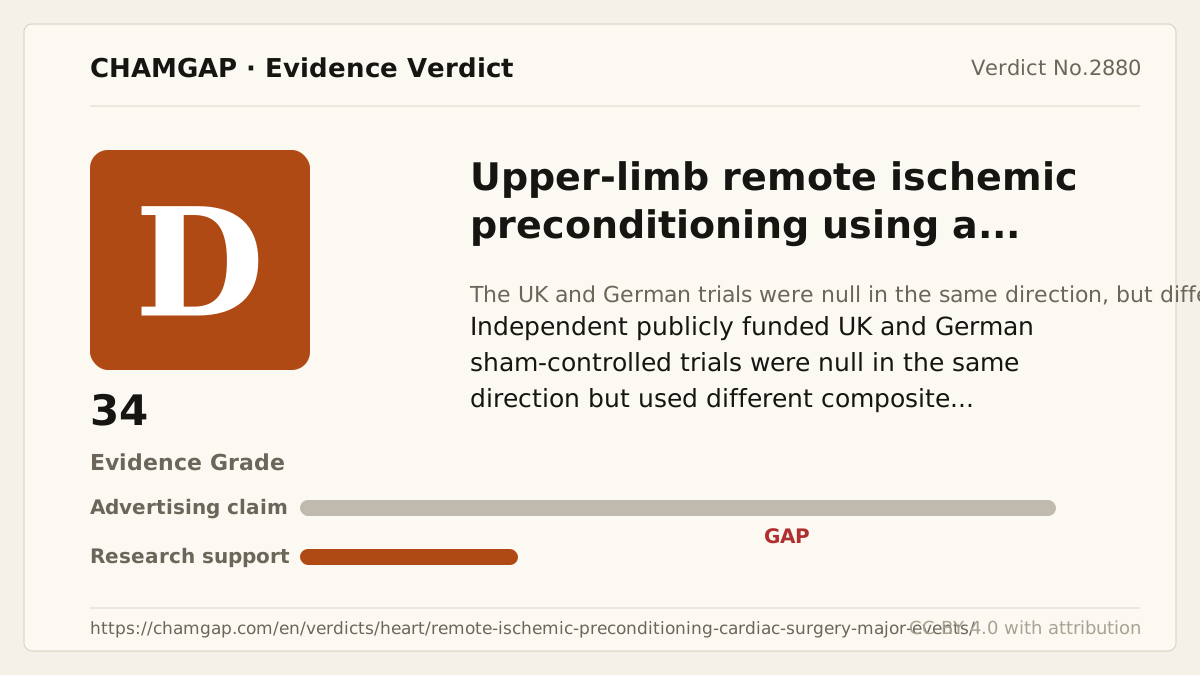
research showsThe grade is D. Independent UK and German trials produced null results in the same direction, but differences in composite components and observation periods mean this verdict does not count them as replication. ERICCA found HR 0.95 (95% CI 0.79 to 1.15), P=0.58, and RIPHeart found 14.3% versus 14.6%, P=0.89.
ads claimA plausible ischemic-conditioning mechanism is not the same claim as fewer deaths, infarctions, or strokes. Two large trials did not establish the latter.
Useful facts when choosing a product
- ERICCA was funded by the MRC/NIHR EME Programme and British Heart Foundation.
- RIPHeart was supported by German Research Foundation grant ME 3559/1-1.
- This is a perioperative research procedure, not a consumer product.
- Other cardiac-surgery verdicts such as 2722, 2724, 2728, 2737, and 2762 concern different drugs, transfusion, or surgical strategies.
What the research actually shows
The 15 ERICCA and 34 RIPHeart signatory authors had zero overlap, and funding was independently British and German. However, ERICCA enrolled high-risk coronary artery bypass surgery patients whereas RIPHeart enrolled elective cardiac surgery patients. ERICCA's 12-month MACCE included coronary revascularization; RIPHeart's discharge composite included acute renal failure. Those components are not interchangeable, and a 12-month time-to-event HR is not the same estimand as in-hospital cumulative risk, so comparability gates ① and ② are not met. The trials were independently null in the same direction, but differences in composite components and observation periods mean this verdict does not count them as replication. ERICCA used all 1,612 in ITT with survival censoring. RIPHeart excluded 18/1,403=1.28% from its full analysis set, below 15%.
Axis 6 B0 evidence ① Allocation concealment: ERICCA used 'a secure website ... through the Clinical Trials Unit'; RIPHeart randomization 'was performed centrally at the Clinical Trial Center Leipzig'. ② Blinding: both were double-blind and sham-controlled; RIPHeart concealed real and dummy cuffs under drapes after anesthesia. ③ Analysis set and missingness: ERICCA analyzed all 1,612 by intention to treat with censoring; RIPHeart used a prespecified full analysis set of 1,385 plus per-protocol sensitivity analysis. ④ Prespecified primary endpoint: ERICCA MACCE matched NCT01247545 and RIPHeart's discharge composite matched NCT01067703.
ERICCA censoring is not attrition, and RIPHeart's 1.28% exclusion is below 15%; neither is counted.
Why this is classified as D (34)
H, R1, I2, E0, B0, and C0 apply; the four strengths H, I2, B0, and large-hard-RCT status preserve D{3+} with 34 points.
Counterpoint. Propofol use, surgery mix, and cuff protocol may limit transportability.
Rejudgment record. Cross-check applied — Retained both independent publicly funded null trials as citations but counted one confirmatory trial because composite endpoints, observation periods, and estimands differ, while preserving the benefit allowed by C0 imprecision
| Endpoint | H | Hard endpoint - actual events such as death |
| Replication | R1 | Single confirmatory trial |
| Independence | I2 | Decisive evidence is publicly or non-profit funded |
| Effect size | E0 | Null |
| Precision | C0 | The confidence interval leaves room for benefit |
The scoring table and the verdict agree (D).
Sub-claim grades by effect
This ingredient is marketed for several effects. A single overall grade blends strong and weak claims together, so each effect is graded separately here. The overall grade reflects the strongest disconfirming or core claim.
| Effect (sub-claim) | Grade | Basis |
|---|---|---|
| Reduced 12-month MACCE | D | ERICCA found HR 0.95 (0.79 to 1.15), P=0.58. |
| Reduced discharge composite of death, MI, stroke, and acute renal failure | D | RIPHeart found 14.3% versus 14.6%, P=0.89. |
Cross-check — Codex and Claude
Evidence Table
| Study | Design | Sample | Funding | Endpoint | Result | Weight |
|---|---|---|---|---|---|---|
| Study 1 | UK multicenter randomized double-blind sham-controlled trial | 811 | MRC/NIHR Efficacy and Mechanism Evaluation Programme and British Heart Foundation | 12-month MACCE of cardiovascular death, MI, coronary revascularization, and stroke | 212/801 (26.5%) versus 225/811 (27.7%), absolute difference -1.2 points, HR 0.95 (95% CI 0.79 to 1.15), P=0.58. | Independent large UK null trial |
| Study 2 | German multicenter randomized double-blind sham-controlled trial | 693 | German Research Foundation grant ME 3559/1-1 | Composite through discharge of all-cause death, nonfatal MI, new stroke, and acute renal failure | 99/692 (14.3%) versus 101/693 (14.6%), absolute difference -0.3 points, P=0.89; no CI for the primary comparison was reported in the article. | Independent large German null trial |
Receipt — 2 References
All 2 cited sources were verified for existence at the original page (as of 2026-08-18).
Reviewed and approved: Chamgap Editorial Team · Approval date: 2026-08-18 · Corrections: none
Cite this verdict
[Chamgap] No Benefit of Remote Ischemic Preconditioning for Death, Myocardial Infarction, or Stroke in Cardiac Surgery — Evidence Grade D·34. 2 cited sources checked. Source: https://chamgap.com/en/verdicts/heart/remote-ischemic-preconditioning-cardiac-surgery-major-events/ · CC BY 4.0CC BY 4.0 — free to use with attribution; do not distort grades, numbers, or verdict meaning.
What this document does and does not do
Chamgap is an information source. It reports what research has and has not confirmed; it does not tell readers what to take or buy. That decision belongs to readers and, when needed, medical or legal professionals. This verdict reflects literature available up to the search date and may change as new research appears. Nothing here is medical advice.