
Emergency-department REBOA add-on,
does it really help with Improved 90-day survival in trauma patients with life-threatening torso hemorrhage?
research showsThe grade is D with 34 points. UK-REBOA randomized 90 patients and analyzed 89 for the 90-day primary outcome. Mortality was 54% with REBOA plus standard care versus 42% with standard care, absolute difference +11.3 points (95% credible interval -8.1 to 30.1), OR 1.58 (0.72 to 3.52), with an 86.9% posterior probability of harm. Six-hour mortality was 28% versus 9%, difference +15.8 points (95% credible interval 1.8 to 30.4), which did not include zero. The trial stopped early after meeting its harm rule.
ads claimREBOA is an invasive emergency procedure for selective use by trained trauma teams. Observational survivor-selection cannot be placed above this randomized evidence to advertise a general survival benefit.
Useful facts when choosing a product
- The registration is ISRCTN16184981.
- Only 19 of 46 patients (41%) assigned to REBOA had a device inserted and the balloon inflated.
- This Bayesian trial reported separate 95% credible intervals for 90-day and six-hour mortality.
- Median commencement of definitive hemorrhage control was 19 minutes later with REBOA.
What the research actually shows
This pragmatic open-label Bayesian trial at 16 UK major trauma centers randomized 90 patients and included 89 in the 90-day primary analysis after one withdrawal. Of the 46 assigned to REBOA plus standard care, only 19 (41%) actually had a device inserted and the balloon inflated. Ninety-day mortality was 25/46 (54%) versus 18/43 (42%), OR 1.58 (95% credible interval 0.72 to 3.52), absolute difference +11.3 points (95% credible interval -8.1 to 30.1), with an 86.9% posterior probability of harm. Six-hour mortality was 13/46 (28%) versus 4/44 (9%), OR 3.14 (1.13 to 9.76), difference +15.8 points (95% credible interval 1.8 to 30.4). These are Bayesian credible intervals, not confidence intervals. Death due to bleeding was 32% versus 17%, and median time to definitive hemorrhage control was 83 versus 64 minutes, a 19-minute delay. Days alive outside hospital by day 90 were 22 versus 41, difference -18.58 days (95% credible interval -32.86 to -3.93). Funding came from the NIHR Health Technology Assessment Programme and Scottish Government Chief Scientist Office, with no funder role.
Why this is classified as D (34)
A publicly funded randomized hard-outcome trial found no 90-day survival benefit and unfavorable early mortality; enrollment below 200 and harm-related early stopping give D with 34 points.
Counterpoint. Because the 90-day credible interval retained possible benefit, the precise conclusion is that REBOA did not improve survival and probably caused early harm, not that increased 90-day mortality is certain.
Rejudgment record. Cross-check applied — A publicly funded Bayesian randomized trial found no 90-day survival benefit and unfavorable early mortality and hemorrhage-control delay, with limitations from small enrollment and harm-related early stopping
| Endpoint | H | Hard endpoint - actual events such as death |
| Replication | R1 | Single confirmatory trial |
| Independence | I2 | Decisive evidence is publicly or non-profit funded |
| Effect size | E0 | Null |
| Precision | C0 | The confidence interval leaves room for benefit |
The scoring table and the verdict agree (D).
Sub-claim grades by effect
This ingredient is marketed for several effects. A single overall grade blends strong and weak claims together, so each effect is graded separately here. The overall grade reflects the strongest disconfirming or core claim.
| Effect (sub-claim) | Grade | Basis |
|---|---|---|
| Improved 90-day survival | D | Mortality was 54% versus 42%, and the 95% credible interval included the null. |
| Improved early survival | D | Six-hour mortality was significantly unfavorable, 28% versus 9%, but only one randomized trial exists. |
Cross-check — Codex and Claude
Evidence Table
| Study | Design | Sample | Funding | Endpoint | Result | Weight |
|---|---|---|---|---|---|---|
| Study 1 | Pragmatic open-label Bayesian randomized trial at 16 UK centers | 89 | NIHR Health Technology Assessment Programme and Scottish Government Chief Scientist Office | All-cause mortality at 90 days | 54% versus 42%, difference +11.3 points (95% credible interval -8.1 to 30.1), OR 1.58 (0.72 to 3.52), 86.9% posterior probability of harm; six-hour mortality 28% versus 9%, difference +15.8 points (1.8 to 30.4) | Only randomized hard-outcome trial; stopped early for harm |
Receipt — 1 References
All 1 cited sources were verified for existence at the original page (as of 2026-08-18).
Reviewed and approved: Chamgap Editorial Team · Approval date: 2026-08-18 · Corrections: none
Cite this verdict
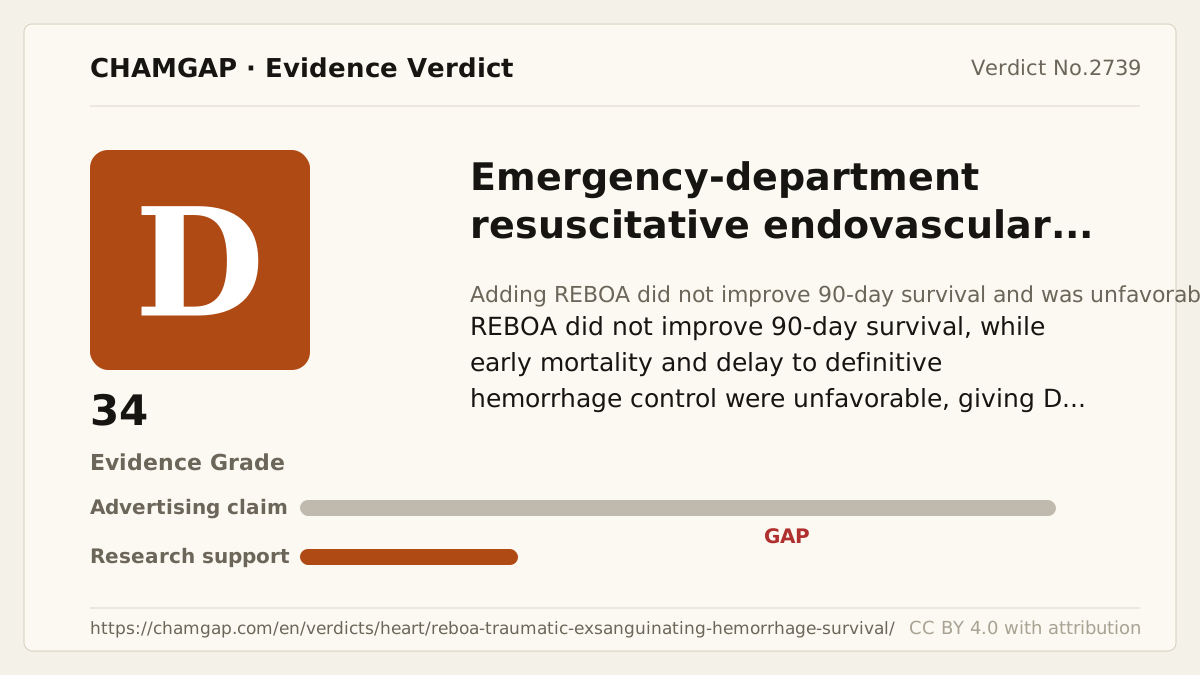
[Chamgap] Emergency-department REBOA add-on x survival after exsanguinating trauma — Evidence Grade D·34. 1 cited sources checked. Source: https://chamgap.com/en/verdicts/heart/reboa-traumatic-exsanguinating-hemorrhage-survival/ · CC BY 4.0CC BY 4.0 — free to use with attribution; do not distort grades, numbers, or verdict meaning.
What this document does and does not do
Chamgap is an information source. It reports what research has and has not confirmed; it does not tell readers what to take or buy. That decision belongs to readers and, when needed, medical or legal professionals. This verdict reflects literature available up to the search date and may change as new research appears. Nothing here is medical advice.