
Ramipril,
does it really help with Reduced cardiovascular death, myocardial infarction, and stroke in adults at high cardiovascular risk?
research showsRamipril is rated B with 72 points for reducing cardiovascular death, myocardial infarction, and stroke in adults at high cardiovascular risk without heart failure or a low ejection fraction. HOPE randomized 9,297 participants to ramipril 10 mg daily or placebo and followed them for a mean of 4.5 years; the primary composite occurred in 14.0% versus 17.8%, relative risk 0.78. Cardiovascular death, myocardial infarction, stroke, and all-cause mortality each declined significantly, and the benefit persisted despite a small early blood-pressure difference, making molecular attribution clear. However, HOPE-TOO is an extension of the same trial rather than a new trial, so the citations rest on a single trial reported repeatedly, and no replication by different investigators with different funding has been confirmed, which caps the grade at B under axis 2 R1. Separate ramipril trials did not replicate the result — DIABHYCAR was negative and PART-2 showed no significant event reduction — and the NIH (NHLBI)-funded PEACE trial of trandolapril in 8,290 patients with stable coronary disease found no significant difference in its primary endpoint, so direction is not consistent even at class level. Mixed public and industry funding falls under the large hard-outcome prescription-drug RCT exception, so no axis 3 cap is applied. Cough, hyperkalemia, worsening kidney function, hypotension, angioedema, and pregnancy contraindication remain separate safety issues.
ads claimPromotion or shorthand can expand ramipril into universal heart protection for all adults. HOPE applies to adults aged at least 55 years with vascular disease or diabetes plus another risk factor, without heart failure or a low ejection fraction, who received ramipril in addition to background care. The effect is molecule-specific rather than a multidrug-strategy artifact, but it cannot be assumed in low-risk populations, acute illness, pregnancy, or advanced kidney conditions.
Useful facts when choosing a product
- HOPE titrated ramipril from a low starting dose to a target of 10 mg once daily, and dosing for this indication must be individualized to blood pressure, kidney function, potassium, and concomitant medicines.
- ACE inhibitors can cause dry cough, hypotension, increased potassium, and a rise in creatinine, so blood pressure, kidney function, and electrolytes should be checked around treatment initiation and dose changes.
- Swelling of the face, lips, or tongue or difficulty breathing can signal rare but emergency angioedema, and patients with prior ACE-inhibitor-related angioedema should avoid re-exposure.
- Ramipril can cause serious fetal harm and is not used during pregnancy; contraindications and required washout intervals must be checked when combining or switching with angiotensin-receptor blockers, aliskiren, or sacubitril-valsartan.
What the research actually shows
HOPE used a 2-by-2 factorial design at 267 centers to assign 9,297 high-risk adults aged at least 55 years to ramipril up to 10 mg daily or placebo and to vitamin E or placebo. The ramipril comparison prespecified cardiovascular death, myocardial infarction, or stroke as its primary outcome and reduced its relative risk by 22% over a mean of 4.5 years. Individual components and all-cause mortality were also significant, with generally consistent effects across baseline-risk and concomitant-treatment subgroups. HOPE-TOO followed 4,528 participants from 174 original centers for another 2.6 years and reported maintenance of benefits for cardiovascular death, stroke, and heart-failure hospitalization, but it is supportive observational follow-up because ACE-inhibitor use became similar between groups after trial completion. This evidence is specific to ramipril in HOPE-eligible high-risk adults and should not automatically be transferred to every hypertensive patient or to other ACE inhibitors or angiotensin-receptor blockers.
Why this is classified as B (72)
In the 9,297-person double-blind HOPE trial, the cardiovascular-death, myocardial-infarction, or stroke composite was 14.0% versus 17.8%, relative risk 0.78, and all three components plus all-cause mortality declined significantly. Ramipril itself was compared with placebo, so attribution is molecular rather than to a multidrug strategy, and the trial used direct hard outcomes with a large sample and long follow-up. However, the citations rest on a single trial — HOPE and its HOPE-TOO extension are repeated reports of the same trial — and no replication by different investigators with different funding has been confirmed, so axis 2 R1 caps the grade at B with 72 points. Within the class, the Servier-funded EUROPA trial of perindopril in 12,218 patients was significantly positive but involves a different molecule, while the NIH (NHLBI)-funded PEACE trial of trandolapril in 8,290 patients was negative on its primary endpoint. Mixed public and industry funding falls under the large hard-outcome prescription-drug RCT exception, so no axis 3 cap is applied. Cough, hyperkalemia, worsening kidney function, angioedema, and pregnancy contraindication remain separate from efficacy.
Counterpoint. The verdict most directly applies to the HOPE population and regimen. It does not justify adding ramipril to an existing ACE inhibitor or angiotensin-receptor blocker or switching treatment without supervision, and absolute benefit depends on baseline cardiovascular risk and contemporary background care.
Rejudgment record. New verdict — Applied B with 72 points because, although molecule-specific ramipril randomization in the 9,297-person HOPE trial significantly reduced the cardiovascular-death, myocardial-infarction, or stroke composite, every component, and all-cause mortality as direct hard outcomes, the citations rest on a single trial (HOPE-TOO is an extension of the same trial) and no replication by different investigators with different funding has been confirmed, capping the grade at B under axis 2 R1; mixed public and industry funding falls under the large hard-outcome prescription-drug RCT exception, so no axis 3 cap was applied
| Endpoint | H | Hard endpoint - actual events such as death |
| Replication | R1 | Single confirmatory trial |
| Independence | I1 | Mixed funding sources |
| Effect size | E+ | Meets the clinically important threshold |
The scoring table and the verdict agree (B).
Sub-claim grades by effect
This ingredient is marketed for several effects. A single overall grade blends strong and weak claims together, so each effect is graded separately here. The overall grade reflects the strongest disconfirming or core claim.
| Effect (sub-claim) | Grade | Basis |
|---|---|---|
| Reduced composite cardiovascular death, myocardial infarction, or stroke | A | This prespecified direct hard outcome fell from 17.8% to 14.0% in HOPE, relative risk 0.78. |
| Reduced cardiovascular death | A | Cardiovascular death was significantly reduced from 8.1% to 6.1% in HOPE, relative risk 0.74. |
| Reduced myocardial infarction and stroke | A | Myocardial infarction was 9.9% versus 12.3% and stroke was 3.4% versus 4.9%, with both components significant. |
Cross-check — Codex and Claude
Evidence Table
| Study | Design | Sample | Funding | Endpoint | Result | Weight |
|---|---|---|---|---|---|---|
| Yusuf S et al.; Heart Outcomes Prevention Evaluation Study Investigators. 2000 | Multicenter 2-by-2 factorial randomized double-blind placebo-controlled trial | 5 | Mixed public, nonprofit, and industry support, including the Medical Research Council of Canada, Heart and Stroke Foundation of Ontario, Hoechst-Marion Roussel, AstraZeneca, and King Pharmaceuticals | Composite cardiovascular death, myocardial infarction, or stroke, with individual events and all-cause mortality | The primary composite was 14.0% versus 17.8%, RR 0.78; cardiovascular death was 6.1% versus 8.1%, myocardial infarction 9.9% versus 12.3%, stroke 3.4% versus 4.9%, and all-cause mortality 10.4% versus 12.2%, all significantly reduced. | Pivotal molecule-specific large hard-outcome randomized trial |
| Bosch J et al.; HOPE/HOPE-TOO Study Investigators. 2005 | Post-trial extension follow-up of the HOPE randomized groups | 4,528 | Extension of the HOPE program; separate extension funding was not reported in the PubMed abstract | Cardiovascular events, incident diabetes, and durability of original benefits over an additional 2.6 years | Benefits observed during randomization for cardiovascular death, stroke, and heart-failure hospitalization were maintained after ACE-inhibitor use became similar between groups. | Supportive durability evidence, not an independent replication |
Receipt — 2 References
All 2 cited sources were verified for existence at the original page (as of 2026-08-11).
Reviewed and approved: Chamgap Editorial Team · Approval date: 2026-08-11 · Corrections: 1
Correction log — 1
Corrections applied to this verdict, in chronological order. Changes are logged, not erased.
- 2026-08-11 · Grade correction for unmet independent-replication requirement — Both cited papers were repeated reports of the same HOPE population (a pre-registration-era trial without a registry number) — HOPE-TOO is an extension follow-up of a subset of original centers and participants. Chamgap's A requires axis 2 R2 (multiple RCTs by different investigators with different funding); separate ramipril RCTs did not replicate the result (DIABHYCAR was negative, PART-2 showed no significant event reduction), and the NIH (NHLBI)-funded PEACE trial of trandolapril in 8,290 patients was also negative on its primary endpoint, so no independent replication is confirmed. Axis 2 is R1 and the ceiling is B. The axes were recorded as B·H·R1·I1·E+·B1 and 72 points were assigned. The effect itself (primary composite 14.0% versus 17.8%, RR 0.78) is not disputed. Confirmed in the 2026-08-11 internal audit (workflow verification plus concordant Codex cross-check). (grade A→B)
Cite this verdict
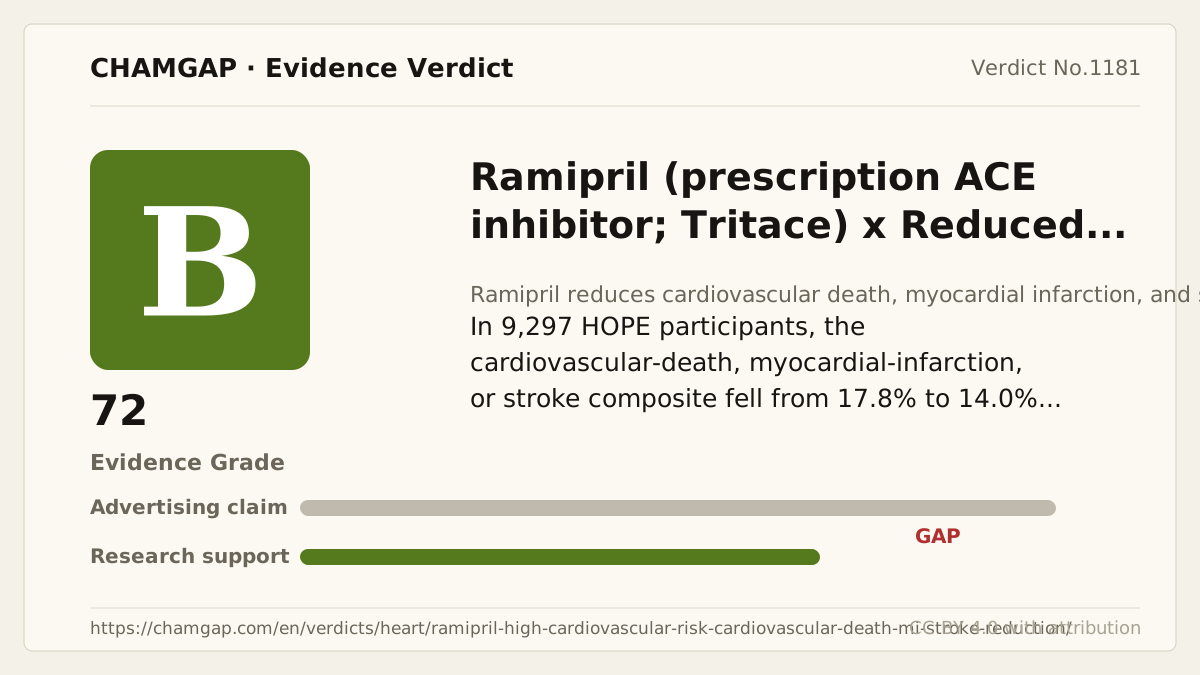
[Chamgap] Ramipril x reduced cardiovascular death, myocardial infarction, and stroke in adults at high cardiovascular risk — Evidence Grade B·72. 2 cited sources checked. Source: https://chamgap.com/en/verdicts/heart/ramipril-high-cardiovascular-risk-cardiovascular-death-mi-stroke-reduction/ · CC BY 4.0CC BY 4.0 — free to use with attribution; do not distort grades, numbers, or verdict meaning.
What this document does and does not do
Chamgap is an information source. It reports what research has and has not confirmed; it does not tell readers what to take or buy. That decision belongs to readers and, when needed, medical or legal professionals. This verdict reflects literature available up to the search date and may change as new research appears. Nothing here is medical advice.