
Pitavastatin,
does it really help with Prevention of major cardiovascular events in people with HIV receiving antiretroviral therapy?
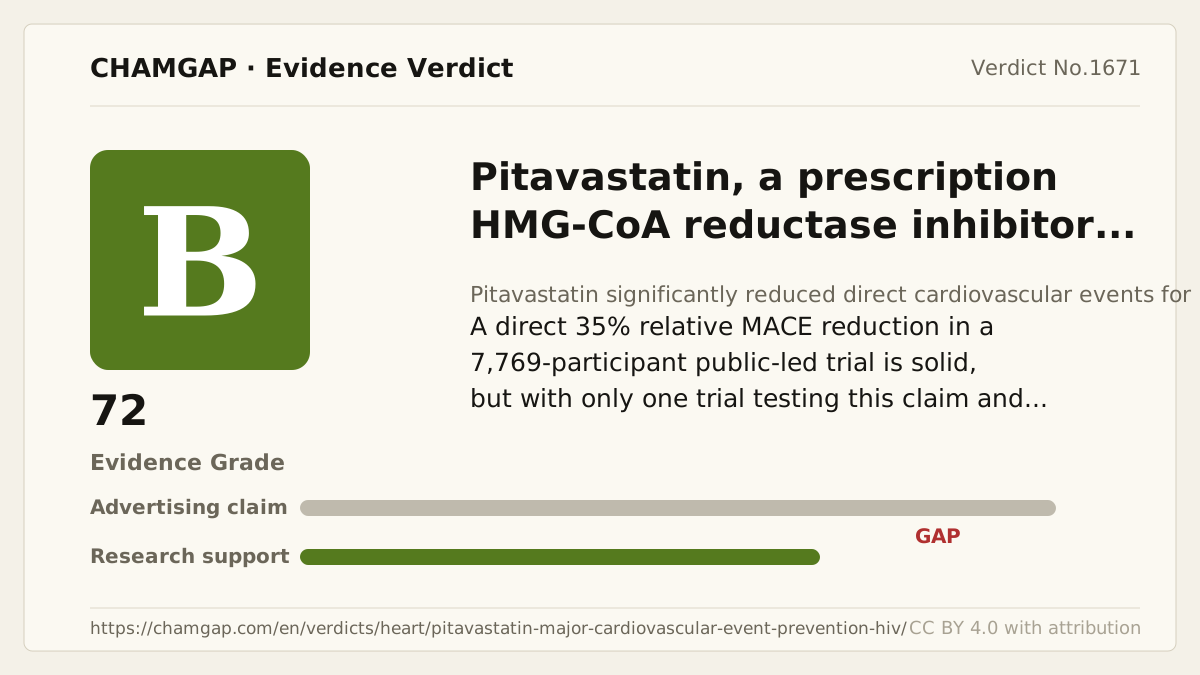
research showsPitavastatin is rated B with 72 points for preventing major cardiovascular events in people with HIV at low-to-moderate cardiovascular risk. REPRIEVE randomized 7,769 participants and included all 7,769 in the intention-to-treat primary analysis. The primary MACE rate was 4.81 versus 7.32 per 1,000 person-years, HR 0.65 (95% CI 0.48 to 0.90), P=.002, so the primary endpoint succeeded. This was a large, mainly NIH-funded, double-blind hard-outcome trial, but REPRIEVE is the only separately recruited randomized trial testing this claim in this population, and the statin meta-analysis covers other statins in general populations, so it cannot count as replication by different investigators and funders; the axis-2 R1 ceiling of B applies.
ads claimIt is inaccurate to expand the result into a claim that every person with HIV automatically needs this drug. Age, antiretroviral treatment, cardiovascular risk, interactions, and individual contraindications should be assessed clinically.
Useful facts when choosing a product
- REPRIEVE used pitavastatin calcium 4 mg once daily, selected partly for relatively few interactions with antiretroviral medicines.
- Participants were 40 to 75 years old without known cardiovascular disease and with low-to-moderate traditional risk, so absolute effects cannot be transferred unchanged to every risk group.
- Muscle symptoms, liver abnormalities, and incident diabetes require attention, while pregnancy potential, concomitant drugs, and individual contraindications should be reviewed before prescribing.
What the research actually shows
REPRIEVE randomly assigned 7,769 people with HIV who were receiving antiretroviral therapy and had low-to-moderate traditional cardiovascular risk to pitavastatin 4 mg or placebo under double masking. Both the randomized count and the actual intention-to-treat primary-analysis count were 7,769. Primary MACE occurred at 4.81 versus 7.32 per 1,000 person-years, HR 0.65 (95% CI 0.48 to 0.90), P=.002. At the second interim analysis on March 30, 2023, after 78% of planned information and 225 MACE events, the DSMB recommended early termination for efficacy. The trial was NIH-led, but the source explicitly reports funding and material support relationships with Kowa Pharmaceuticals America, Gilead Sciences, and ViiV Healthcare; funders reportedly had no role in analysis or manuscript drafting. The CTT individual-participant meta-analysis independently replicated major vascular-event reduction across 27 statin trials and 174,149 participants.
Why this is classified as B (72)
A large public-led double-blind trial met its prespecified direct clinical-event primary endpoint in all 7,769 randomized participants, with HR 0.65 and P=.002. However, REPRIEVE is the only trial testing this claim, and the 27-trial statin meta-analysis covers other statins in general populations, so it is not replication by different investigators and funders. With replication at axis-2 R1 the ceiling is B, and factoring in possible overestimation from early stopping, the verdict is B with 72 points.
Counterpoint. The average benefit is reliable, but fewer events are prevented in absolute terms when baseline risk is lower. Shared decision-making should incorporate antiretroviral therapy, other medicines, diabetes risk, and patient preferences.
Rejudgment record. Cross-check applied — Credited the successful prespecified MACE endpoint in all 7,769 REPRIEVE participants, but REPRIEVE is the only separately recruited randomized trial of this claim and the 27-trial statin meta-analysis covers other statins in general populations, so replication stands at R1 and the axis-2 ceiling of B applies
| Endpoint | H | Hard endpoint - actual events such as death |
| Replication | R1 | Single confirmatory trial |
| Independence | I1 | Mixed funding sources |
| Effect size | E+ | Meets the clinically important threshold |
The scoring table and the verdict agree (B).
Sub-claim grades by effect
This ingredient is marketed for several effects. A single overall grade blends strong and weak claims together, so each effect is graded separately here. The overall grade reflects the strongest disconfirming or core claim.
| Effect (sub-claim) | Grade | Basis |
|---|---|---|
| Prevention of a first major cardiovascular event in people with HIV | A | The prespecified primary endpoint succeeded in all 7,769 REPRIEVE participants, with HR 0.65 and P=.002. |
| Prevention of myocardial infarction and stroke in people with HIV | B | Individual components were directionally consistent, but the trial was powered for the composite rather than each component. |
| Long-term primary prevention in people at low-to-moderate risk | A | Direct clinical benefit over a median 5.1 years is supported by large statin-class replication. |
Cross-check — Codex and Claude
Evidence Table
| Study | Design | Sample | Funding | Endpoint | Result | Weight |
|---|---|---|---|---|---|---|
| Grinspoon SK et al. 2023 REPRIEVE | Multinational randomized double-blind placebo-controlled phase 3 trial | 7,769 | NIH-led, but the source explicitly reports funding and material support relationships with Kowa Pharmaceuticals America, Gilead Sciences, and ViiV Healthcare; funders reportedly had no role in analysis or manuscript drafting | Prespecified primary endpoint: first major adverse cardiovascular event | 4.81 versus 7.32 per 1,000 person-years; HR 0.65 (95% CI 0.48 to 0.90), P=.002. At the second interim analysis on March 30, 2023, after 78% of planned information and 225 MACE events, the DSMB recommended early termination for efficacy; early stopping can overestimate effects. | Key large direct clinical-event evidence |
| Cholesterol Treatment Trialists' (CTT) Collaborators. 2012 | Individual-participant-data meta-analysis of 27 randomized trials | 174,149 | British Heart Foundation, United Kingdom Medical Research Council, Cancer Research UK, European Community Biomed Programme, and Australian public and nonprofit bodies | Major vascular events | Major vascular events were reduced per 1 mmol/L LDL reduction, RR 0.79 (95% CI 0.77 to 0.81), replicating the statin-class clinical benefit. | Large independent class replication |
Receipt — 2 References
All 2 cited sources were verified for existence at the original page (as of 2026-08-11).
Reviewed and approved: Chamgap Editorial Team · Approval date: 2026-08-11 · Corrections: 1
Correction log — 1
Corrections applied to this verdict, in chronological order. Changes are logged, not erased.
- 2026-08-11 · Grade correction for unmet independent-replication requirement — Of the two cited papers, only REPRIEVE (NCT02344290) is an actual randomized trial; the second citation, CTT 2012, is an individual-participant meta-analysis of 27 statin trials in general populations — not a new trial, and involving different drugs and populations, so it cannot count as independent replication. Chamgap's A requires axis-2 R2 (multiple RCTs by different investigators and funders), and no separately recruited RCT other than REPRIEVE has tested pitavastatin against MACE in people with HIV. Axis 2 is R1, so the ceiling is B. The axes were recorded as B·H·R1·I1·E+·B1 and 72 points were assigned. The effect itself (MACE HR 0.65, 95% CI 0.48 to 0.90, P=.002) is not disputed. Confirmed in the 2026-08-11 internal audit (workflow verification plus a concurring Codex cross-check). (grade A→B)
Cite this verdict
[Chamgap] Pitavastatin x prevention of major cardiovascular events in people with HIV — Evidence Grade B·72. 2 cited sources checked. Source: https://chamgap.com/en/verdicts/heart/pitavastatin-major-cardiovascular-event-prevention-hiv/ · CC BY 4.0CC BY 4.0 — free to use with attribution; do not distort grades, numbers, or verdict meaning.
What this document does and does not do
Chamgap is an information source. It reports what research has and has not confirmed; it does not tell readers what to take or buy. That decision belongs to readers and, when needed, medical or legal professionals. This verdict reflects literature available up to the search date and may change as new research appears. Nothing here is medical advice.