
PFO closure,
does it really help with Reduction of recurrent stroke after a carefully evaluated cryptogenic ischemic stroke?
research showsThe grade is A. In patients no older than 60 with a carefully evaluated cryptogenic ischemic stroke, REDUCE and CLOSE found fewer recurrent strokes with closure plus antiplatelet therapy than with antiplatelet therapy alone. Rates were 1.4% versus 5.4% over a median 3.2 years in REDUCE and 0 of 238 versus 14 of 235 over a mean 5.3 years in CLOSE. Atrial arrhythmia and procedural complications prevent extrapolation to every person with a PFO.
ads claimFinding a PFO does not by itself establish an indication for closure. Promotion should disclose the age limit, complete cryptogenic-stroke workup, high-risk anatomy, background antithrombotic treatment, atrial arrhythmia, and procedural risk.
Useful facts when choosing a product
- REDUCE used Gore HELEX or CARDIOFORM devices, and both groups received antiplatelet therapy.
- CLOSE required a large right-to-left shunt or atrial septal aneurysm in patients aged 16 to 60 and allowed 11 approved devices.
- Name-by-name comparison of all article authors found no shared author. REDUCE was Gore funded and CLOSE was funded by the French Ministry of Health.
- Verdict 1908 is D with 30 points for migraine, a different indication from prevention of recurrent cryptogenic stroke.
What the research actually shows
REDUCE randomized 664 patients aged 18 to 59 with a recent cryptogenic ischemic stroke and PFO to closure plus antiplatelet therapy, 441, or antiplatelet therapy alone, 223; 82% had a moderate or large shunt. Serious device-related events occurred in 1.4% and serious procedure-related events in 2.5%. CLOSE ended enrollment with 663 participants, short of its target of 900; the closure comparison was 238 versus 235. The reason enrollment ended was not verified in the original article reviewed here. Procedural complications occurred in 14 of 238 closure patients (5.9%). DEFENSE-PFO randomized 120 high-risk PFO patients at two South Korean centers and received a research grant from the Cardiovascular Research Foundation, Seoul. It provided smaller, directionally consistent Korean evidence.
Why this is classified as A (86)
REDUCE and CLOSE measured recurrent stroke in comparable selected populations against antiplatelet therapy and found effects in the same direction. Their author teams did not overlap and their funding sources differed. One pivotal trial was manufacturer funded and one publicly funded, but replicated large hard-outcome evidence without a counted avoidable design defect supports A with 86 points.
Counterpoint. Absolute benefit accrued over years, whereas atrial arrhythmia and procedural harm can occur early. The result cannot be directly extended beyond age 60, to a small shunt alone, or to patients with another plausible stroke cause.
Rejudgment record. Cross-check applied — Direct comparison of REDUCE and CLOSE eligibility, hard outcomes, complete named author lists, distinct funding sources, and absolute harm rates
| Endpoint | H | Hard endpoint - actual events such as death |
| Replication | R2 | Independently replicated across trials |
| Independence | I1 | Mixed funding sources |
| Effect size | E+ | Meets the clinically important threshold |
The scoring table and the verdict agree (A).
Sub-claim grades by effect
This ingredient is marketed for several effects. A single overall grade blends strong and weak claims together, so each effect is graded separately here. The overall grade reflects the strongest disconfirming or core claim.
| Effect (sub-claim) | Grade | Basis |
|---|---|---|
| Reduction of recurrent stroke in selected patients no older than 60 | A | REDUCE and CLOSE replicated lower absolute event rates. |
| Prophylactic closure for every person with a PFO | ? | People without a qualifying stroke or with another plausible cause were outside these trials. |
| Reduction of migraine attacks | D | The separate migraine indication in verdict 1908 is D with 30 points and cannot be upgraded by stroke evidence. |
Cross-check — Codex and Claude
Evidence Table
| Study | Design | Sample | Funding | Endpoint | Result | Weight |
|---|---|---|---|---|---|---|
| Study 1 | Multinational randomized open-label trial with blinded endpoint adjudication | 223 | Sponsored by W. L. Gore and Associates, which collaborated in design and analysis | Coprimary clinical ischemic stroke and new brain infarction; median 3.2 years | Clinical ischemic stroke in 6/441 (1.4%) versus 12/223 (5.4%), HR 0.23 (95% CI 0.09 to 0.62) | Pivotal manufacturer-funded hard-outcome trial |
| Study 2 | Multicenter randomized open-label trial with blinded endpoint adjudication | 235 | French Ministry of Health Hospital Clinical Research Program | Fatal or nonfatal stroke; mean 5.3 years | 0/238 versus 14/235; new atrial fibrillation 4.6% versus 0.9%; procedural complications 14/238 (5.9%) | Independent publicly funded replication trial |
| Study 3 | Investigator-initiated randomized trial at two South Korean centers | 120 | Research grant from the Cardiovascular Research Foundation, Seoul | Two-year composite of stroke, vascular death, or major bleeding | No primary events with closure versus six with medical therapy | Small directionally consistent Korean evidence |
Receipt — 3 References
All 3 cited sources were verified for existence at the original page (as of 2026-08-07).
Reviewed and approved: Chamgap Editorial Team · Approval date: 2026-08-07 · Corrections: none
Cite this verdict
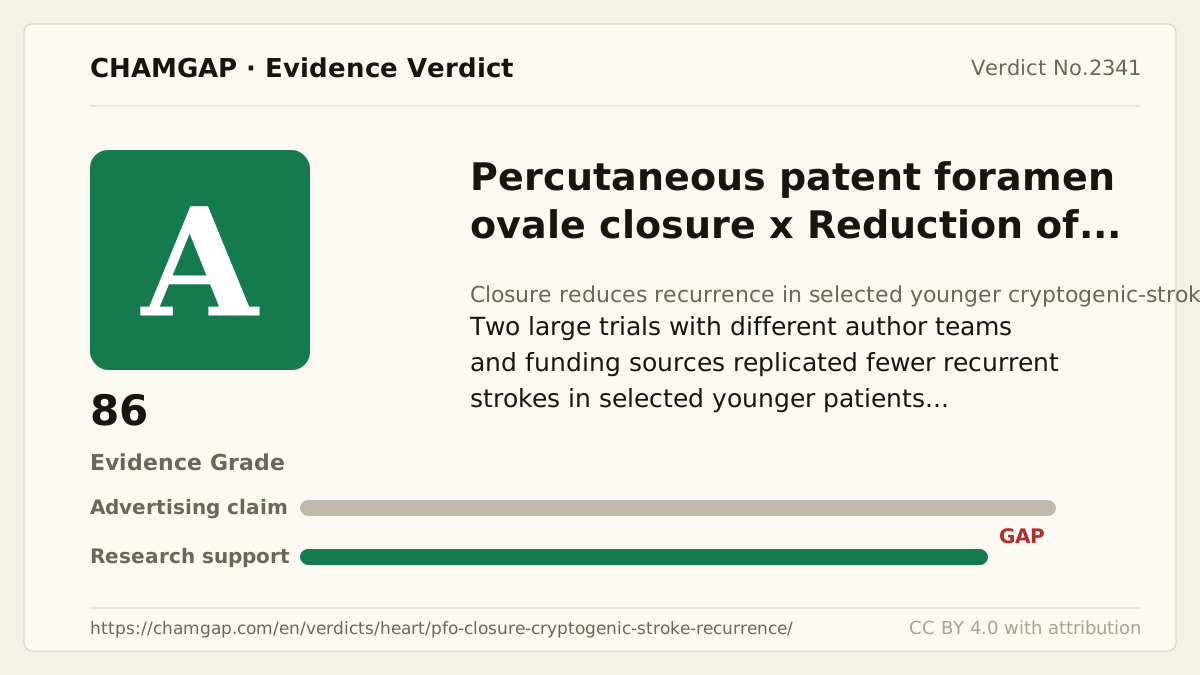
[Chamgap] PFO closure x prevention of recurrent cryptogenic stroke — Evidence Grade A·86. 3 cited sources checked. Source: https://chamgap.com/en/verdicts/heart/pfo-closure-cryptogenic-stroke-recurrence/ · CC BY 4.0CC BY 4.0 — free to use with attribution; do not distort grades, numbers, or verdict meaning.
What this document does and does not do
Chamgap is an information source. It reports what research has and has not confirmed; it does not tell readers what to take or buy. That decision belongs to readers and, when needed, medical or legal professionals. This verdict reflects literature available up to the search date and may change as new research appears. Nothing here is medical advice.