
Personalised cooler dialysate,
does it really help with Reduction in cardiovascular death or hospitalization for myocardial infarction, ischemic stroke, or heart failure?
research showsThe grade is D. MyTEMP followed 15,413 patients at 84 dialysis centers for four years. The primary composite occurred in 1,711/8,000 (21.4%) versus 1,658/7,413 (22.4%), adjusted HR 1.00 (96% CI 0.89 to 1.11), P=0.93. Benefit was not shown, but this was one trial and the interval still allows an 11% hazard reduction, so the result is D, not F, with 34 points.
ads claimThe temperature was genuinely lower, averaging 35.8 versus 36.4 degrees C, but that physical change did not reduce cardiovascular death or hospitalization.
Useful facts when choosing a product
- Mean dialysate temperature was 35.8 versus 36.4 degrees C.
- This was a center-policy trial rather than individually selected treatment.
- The registered primary endpoint was cardiovascular death or major cardiovascular hospitalization.
What the research actually shows
Eighty-four Ontario centers underwent covariate-constrained randomization and one well-balanced scheme was selected. Patients, nurses, and nephrologists could not be masked, but medical coders unaware of the trial and assignment recorded ICD-10 events. A consent waiver enabled inclusion under the allocated center policy, and the prespecified protocol and statistical plan matched the primary outcome. Funding came from CIHR, Heart and Stroke Foundation of Canada, Ontario Renal Network, Dialysis Clinic Inc., and other public or non-profit institutions. Verdict 1264 is B with 68 points for intravenous iron, a different intervention; verdict 2560 also differs in population and endpoint.
Why this is classified as D (34)
One large independent hard-outcome trial was null, but there was no repeated null evidence and the 96% interval left benefit possible, giving D with 34 points.
Counterpoint. D is limited to the four-year center-wide cardiovascular claim, not every symptom or selected patient use.
Rejudgment record. Cross-check applied — We cross-checked the MyTEMP paper, protocol, and registry for the primary endpoint, center randomization, all-patient administrative analysis, coder masking, and funding.
| Endpoint | H | Hard endpoint - actual events such as death |
| Replication | R1 | Single confirmatory trial |
| Independence | I2 | Decisive evidence is publicly or non-profit funded |
| Effect size | E0 | Null |
| Precision | C0 | The confidence interval leaves room for benefit |
The scoring table and the verdict agree (D).
Sub-claim grades by effect
This ingredient is marketed for several effects. A single overall grade blends strong and weak claims together, so each effect is graded separately here. The overall grade reflects the strongest disconfirming or core claim.
| Effect (sub-claim) | Grade | Basis |
|---|---|---|
| Reduced cardiovascular death or hospitalization | D | Adjusted HR was 1.00 (96% CI 0.89 to 1.11). |
Cross-check — Codex and Claude
Evidence Table
| Study | Design | Sample | Funding | Endpoint | Result | Weight |
|---|---|---|---|---|---|---|
| MyTEMP writing committee, 2022 MyTEMP | Pragmatic registry-based cluster randomized trial at 84 centers | 7,413 | CIHR, Heart and Stroke Foundation of Canada, Ontario Renal Network, and other non-profit institutions | Four-year cardiovascular death or major cardiovascular hospitalization | 1,711/8,000 (21.4%) versus 1,658/7,413 (22.4%), adjusted HR 1.00 (96% CI 0.89 to 1.11), P=0.93 | Pivotal large independent hard-outcome RCT |
Receipt — 1 References
All 1 cited sources were verified for existence at the original page (as of 2026-08-14).
Reviewed and approved: Chamgap Editorial Team · Approval date: 2026-08-14 · Corrections: none
Cite this verdict
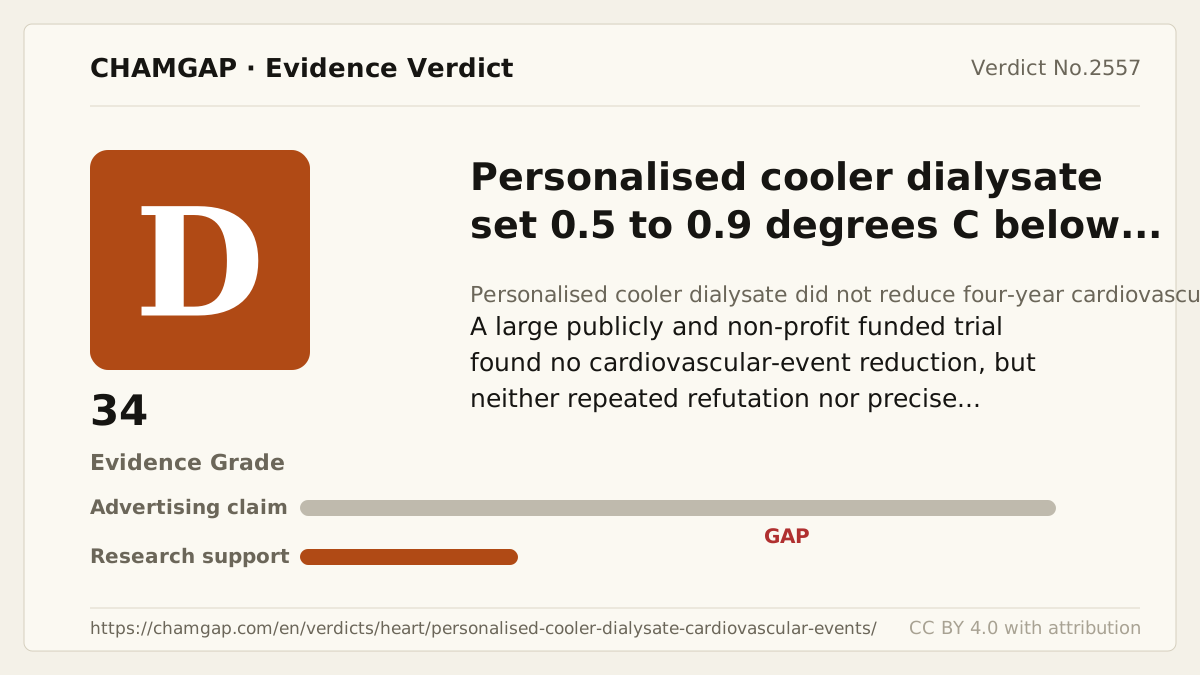
[Chamgap] Personalised cooler dialysate x fewer cardiovascular deaths or hospitalizations — Evidence Grade D·34. 1 cited sources checked. Source: https://chamgap.com/en/verdicts/heart/personalised-cooler-dialysate-cardiovascular-events/ · CC BY 4.0CC BY 4.0 — free to use with attribution; do not distort grades, numbers, or verdict meaning.
What this document does and does not do
Chamgap is an information source. It reports what research has and has not confirmed; it does not tell readers what to take or buy. That decision belongs to readers and, when needed, medical or legal professionals. This verdict reflects literature available up to the search date and may change as new research appears. Nothing here is medical advice.