
PERC no-testing rule-out strategy,
does it really help with Noninferior exclusion of three-month missed thromboembolism in very-low-risk emergency patients?
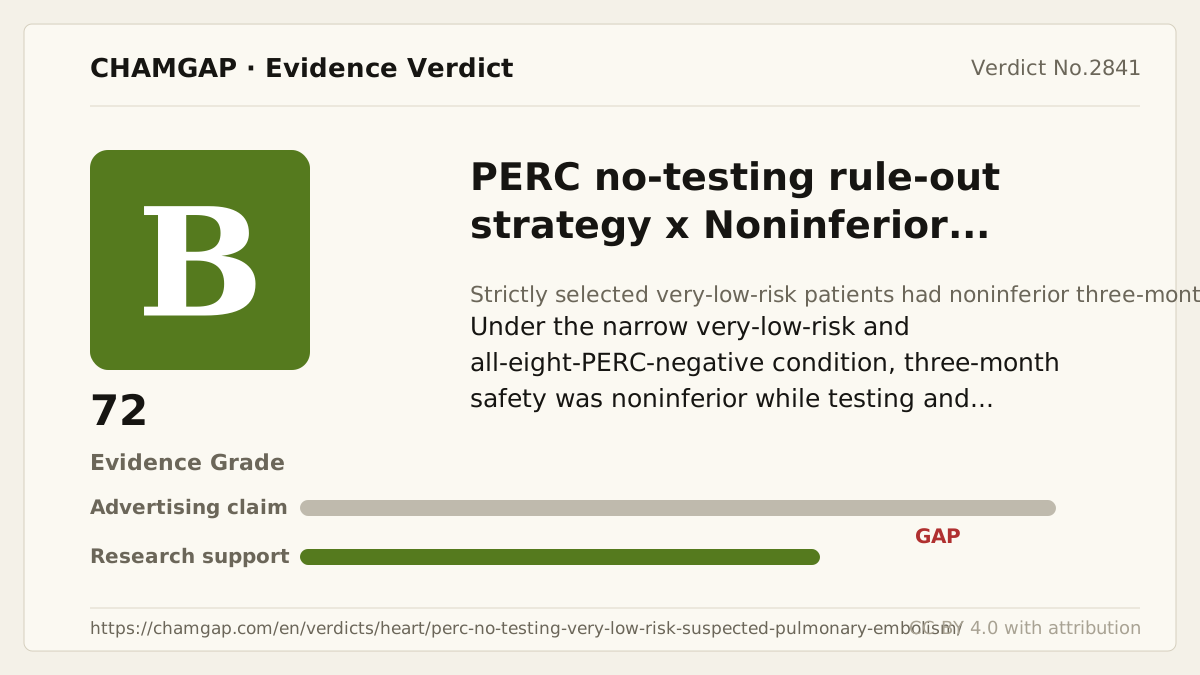
research showsThe grade is B with 72 points. In the primary analyzable population, missed symptomatic thromboembolism occurred in 1/847 (0.1%) versus 0/902, an absolute difference of 0.1 percentage points with a one-sided 95% upper bound of 0.8%, within the prespecified 1.5% margin. This is conditional de-testing evidence, not evidence that D-dimer testing is harmful.
ads claimDirect use is limited to clinician-estimated PE probability below 15% plus all eight negative criteria: age under 50, pulse under 100, oxygen saturation at least 95%, no unilateral leg swelling, no hemoptysis, no recent trauma or surgery, no prior PE or DVT, and no exogenous estrogen.
Useful facts when choosing a product
- CT pulmonary angiography fell from 23% to 13%, an absolute 9.7-point reduction.
- Median emergency stay was 36 minutes shorter: 4 h 36 min versus 5 h 14 min.
- Admission fell from 16% to 13%, an absolute 3.3-point reduction.
What the research actually shows
Fourteen French emergency departments underwent cluster-randomized crossover assignment to two six-month strategy sequences. In a cluster trial, concealment concerns hiding each emergency department's period sequence before recruitment and selection, not individual patient envelopes. A computer-generated block sequence was combined with a blinded numbered center list. Clinicians necessarily knew the strategy after a period began, while consecutive eligibility and blinded independent event adjudication reduced selection and outcome bias. Limitation: noninferiority design. Listed item: noninferiority design. Avoidability: impossible - the de-testing question asks whether omission stays within an acceptable safety margin. Substantial attrition (>=15%) was 60/1916 (3.1%), so it does not apply. The French Ministry of Health PHRC 2014 program funded the AP-HP-sponsored trial; author industry relationships were reported outside this work.
Why this is classified as B (72)
A hard three-month event, public independence, and a met prespecified margin are balanced against one RCT and noninferiority-design bias, giving B with 72 points.
Counterpoint. Do not extend this result to PERC-positive patients or clinician-estimated PE probability of 15% or more.
Rejudgment record. New verdict — Hard three-month event, public funding, met 1.5% margin, and cluster crossover noninferiority design
| Endpoint | H | Hard endpoint - actual events such as death |
| Replication | R1 | Single confirmatory trial |
| Independence | I2 | Decisive evidence is publicly or non-profit funded |
| Effect size | E+ | Meets the clinically important threshold |
The scoring table and the verdict agree (B).
Sub-claim grades by effect
This ingredient is marketed for several effects. A single overall grade blends strong and weak claims together, so each effect is graded separately here. The overall grade reflects the strongest disconfirming or core claim.
| Effect (sub-claim) | Grade | Basis |
|---|---|---|
| Three-month de-testing safety in very-low-risk PERC-negative patients | B | The primary-analysis upper bound was 0.8%, within the 1.5% margin. |
| Reduced testing and emergency resource use | B | CT use, emergency stay, and admission decreased. |
Cross-check — Codex and Claude
Evidence Table
| Study | Design | Sample | Funding | Endpoint | Result | Weight |
|---|---|---|---|---|---|---|
| Study 1 | Cluster-randomized crossover noninferiority trial in 14 French emergency departments | 902 | French Ministry of Health PHRC 2014; AP-HP sponsor | Symptomatic thromboembolic event within three months missed at the inclusion visit | 0.1% vs 0%; absolute difference 0.1 points, one-sided 95% upper bound 0.8%; margin 1.5% | Pivotal hard-event noninferiority RCT |
Receipt — 1 References
All 1 cited sources were verified for existence at the original page (as of 2026-08-18).
Reviewed and approved: Chamgap Editorial Team · Approval date: 2026-08-18 · Corrections: none
Cite this verdict
[Chamgap] PERC No-Testing Rule-Out Strategy for Three-Month Missed Thromboembolism in Very-Low-Risk Emergency Patients With Suspected Pulmonary Embolism — Benefit — Evidence Grade B·72. 1 cited sources checked. Source: https://chamgap.com/en/verdicts/heart/perc-no-testing-very-low-risk-suspected-pulmonary-embolism/ · CC BY 4.0CC BY 4.0 — free to use with attribution; do not distort grades, numbers, or verdict meaning.
What this document does and does not do
Chamgap is an information source. It reports what research has and has not confirmed; it does not tell readers what to take or buy. That decision belongs to readers and, when needed, medical or legal professionals. This verdict reflects literature available up to the search date and may change as new research appears. Nothing here is medical advice.