
Pelacarsen,
does it really help with Reduction in six-month lipoprotein(a) concentration in patients with cardiovascular disease and elevated Lp(a)?
research showsThe grade is C. In a 286-person phase 2 dose-ranging trial, mean six-month Lp(a) reductions were 35%, 56%, 58%, 72%, and 80% across pelacarsen regimens versus 6% with placebo. The primary endpoint was a laboratory Lp(a) concentration, so the grade is capped at C; the trial did not test fewer myocardial infarctions or strokes.
ads claimLp(a) blood testing is available in Korean clinics and hospitals, but pelacarsen is not yet an authorized Lp(a)-lowering medicine. A high test value must not be used to market an investigational drug as routine treatment; established risks such as LDL, blood pressure, and smoking still require management.
Useful facts when choosing a product
- Pelacarsen is a GalNAc-conjugated antisense oligonucleotide targeting apo(a) mRNA for hepatocyte delivery.
- Injection-site reactions occurred in about 27% with pelacarsen and 6% with placebo.
- Platelet counts, liver and renal measures, and influenza-like symptoms did not differ significantly; no platelet count below 100,000/mm3 was reported.
What the research actually shows
At 30 sites in five countries, 286 patients with established cardiovascular disease and screening Lp(a) at least 60 mg/dL were assigned among five regimens or saline placebo in a randomized double-blind phase 2 trial. Axis 6 B0 basis: ① Allocation concealment - the paper states, 'Patients were randomly assigned to one of five groups; within each group, randomization was performed in a 5:1 ratio,' but contains no implementation sentence for allocation concealment. Inadequacy was not established, so this was not counted as a defect. ② Blinding - the paper states, 'We conducted a randomized, double-blind, placebo-controlled, dose-ranging trial involving 286 patients.' ③ Analysis population and missing data - the paper states, 'All efficacy analyses were performed with the full analysis set,' and missing data used 'a multiple-imputation model containing baseline and postbaseline values, stratified according to treatment group.' ④ Prespecified primary endpoint - the paper states, 'the percent change in lipoprotein(a) level from baseline to month 6 of exposure,' consistent with registration NCT03070782. Therefore, no Axis 6 defect was established. Substantial attrition (>=15%) was not applicable because the full analysis set and multiple imputation were used. Short study under 12 weeks was not applicable because the primary assessment was at six months. Akcea Therapeutics sponsored, conducted, managed, analyzed, and interpreted the trial, and authors included Ionis and Akcea employees. Akcea, not Novartis, funded this phase 2 paper; Novartis sponsors the later outcome trial.
Why this is classified as C (54)
The six-month Lp(a) laboratory endpoint caps the grade at C; this is one manufacturer-funded phase 2 trial, but no Axis 6 defect was established, giving C with 54 points.
Counterpoint. Unlike verdicts about LDL or triglycerides, this asks about a drug directly targeting Lp(a) and a marker outcome. Clinical-event effects from other lipid therapies were not forced onto this question.
Rejudgment record. Cross-check applied — Cross-checked the phase 2 paper's 286-person randomized double-blind placebo-controlled design, prespecified six-month Lp(a) primary endpoint consistent with NCT03070782, full analysis set and multiple imputation, no established Axis 6 defect, and Akcea sponsorship with Ionis/Akcea employee authors
| Endpoint | S | Surrogate marker - laboratory or imaging measures |
| Replication | R1 | Single confirmatory trial |
| Independence | I0 | Evidence comes only from manufacturer studies |
| Effect size | E+ | Meets the clinically important threshold |
The scoring table and the verdict agree (C).
Sub-claim grades by effect
This ingredient is marketed for several effects. A single overall grade blends strong and weak claims together, so each effect is graded separately here. The overall grade reflects the strongest disconfirming or core claim.
| Effect (sub-claim) | Grade | Basis |
|---|---|---|
| Reduction in six-month Lp(a) concentration | C | Mean reductions ranged from 35% to 80% across doses versus 6% with placebo. |
| Reduction in myocardial infarction or stroke | ? | This phase 2 trial did not test cardiovascular events, and the outcome trial has no posted results. |
Cross-check — Codex and Claude
Evidence Table
| Study | Design | Sample | Funding | Endpoint | Result | Weight |
|---|---|---|---|---|---|---|
| Study 1 | Multinational randomized double-blind saline-placebo-controlled dose-ranging phase 2 trial | 47 | Akcea Therapeutics sponsored, conducted, managed, analyzed, and interpreted the trial; Ionis and Akcea employee authors included | Percent change from baseline in Lp(a) concentration at six months of exposure | Mean changes -35%, -56%, -58%, -72%, and -80% across pelacarsen regimens versus -6% with placebo; P=0.003 to <0.001 | Large dose-dependent laboratory effect, but one manufacturer-funded phase 2 surrogate trial |
Receipt — 2 References
All 2 cited sources were verified for existence at the original page (as of 2026-08-18).
Reviewed and approved: Chamgap Editorial Team · Approval date: 2026-08-18 · Corrections: none
Cite this verdict
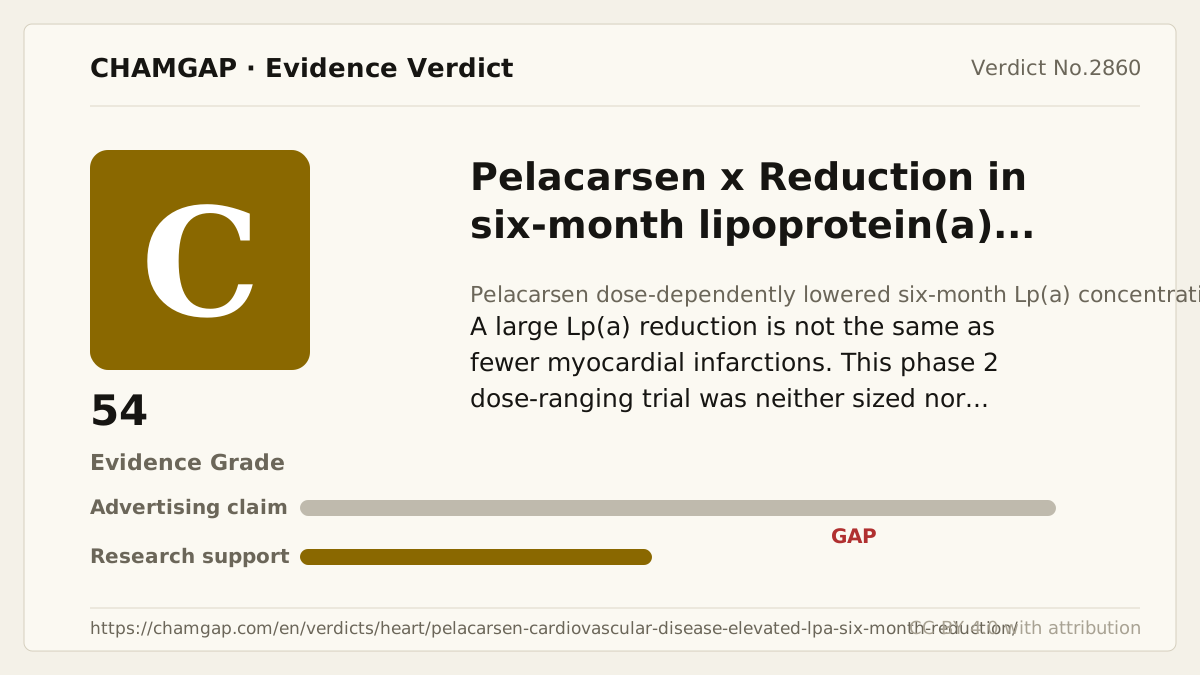
[Chamgap] Benefit: Pelacarsen Lowers 6-Month Lipoprotein(a) Levels in Cardiovascular Disease with Elevated Lipoprotein(a) — Evidence Grade C·54. 2 cited sources checked. Source: https://chamgap.com/en/verdicts/heart/pelacarsen-cardiovascular-disease-elevated-lpa-six-month-reduction/ · CC BY 4.0CC BY 4.0 — free to use with attribution; do not distort grades, numbers, or verdict meaning.
What this document does and does not do
Chamgap is an information source. It reports what research has and has not confirmed; it does not tell readers what to take or buy. That decision belongs to readers and, when needed, medical or legal professionals. This verdict reflects literature available up to the search date and may change as new research appears. Nothing here is medical advice.