
Metoprolol succinate CR/XL,
does it really help with Reduction of all-cause mortality and heart-failure hospitalization in stable symptomatic HFrEF?
research showsMetoprolol succinate CR/XL is rated B with 72 points: a large randomized trial demonstrated lower all-cause mortality and heart-failure hospitalization in stable symptomatic HFrEF, but the citations rest on a single trial reported repeatedly, and replication by different investigators and funders has not been confirmed, so the axis-2 R1 ceiling of B applies. In 3,991 MERIT-HF participants, the relative risk for all-cause death was 0.66 (95% CI 0.53 to 0.81), and hospitalizations for worsening heart failure numbered 317 versus 451. This is ingredient- and formulation-specific survival evidence, not merely a beta-blocker class inference. The separate MDC trial tested immediate-release metoprolol tartrate in 383 patients with idiopathic dilated cardiomyopathy; its primary endpoint (death or need for transplantation) fell 34% but missed significance (p=0.058), and deaths alone were 23 versus 19 with no benefit, so it does not independently replicate this verdict.
ads claimThe result should not be generalized to every beta blocker. This verdict concerns metoprolol succinate CR/XL tested in MERIT-HF and stable HFrEF, not immediate-release metoprolol tartrate or acute decompensated heart failure.
Useful facts when choosing a product
- In stable HFrEF, this prescription medicine is started at a low dose and gradually titrated while monitoring heart rate, blood pressure, congestion, and symptoms.
- Abrupt withdrawal can provoke ischemia, tachycardia, or worsening heart failure and should be avoided.
- Bradycardia, hypotension, and fatigue can occur; initiation or up-titration requires caution during acute decompensation or marked congestion.
What the research actually shows
MERIT-HF enrolled 3,991 patients with NYHA class II to IV chronic heart failure, ejection fraction no greater than 0.40, and clinical stability on optimal standard therapy. Participants received metoprolol CR/XL or placebo, titrated toward 200 mg once daily. All-cause mortality was 7.2% versus 11.0% per patient-year, RR 0.66, with fewer sudden deaths and deaths from worsening heart failure. Hjalmarson's detailed report found 19% lower death or all-cause hospitalization, 31% lower death or worsening-heart-failure hospitalization, and fewer worsening-heart-failure admissions. Although existing verdict 969 rates bisoprolol A for the same drug class and HFrEF indication, this verdict is separately attributed to the ingredient- and formulation-specific MERIT-HF evidence for metoprolol succinate CR/XL.
Why this is classified as B (72)
A large double-blind randomized trial directly demonstrated ingredient- and CR/XL-formulation-specific reductions in all-cause death, sudden death, death from worsening heart failure, and hospitalization. However, the citations rest on a single trial reported repeatedly, without replication by different investigators and funders, so the axis-2 R1 ceiling gives B with 72 points. The separate MDC trial used immediate-release tartrate in dilated cardiomyopathy and missed its primary endpoint (p=0.058), so it does not count as replication. Manufacturer funding notwithstanding, the axis-3 ceiling is waived under the large hard-endpoint prescription-drug RCT exception; bradycardia, hypotension, and acute-decompensation precautions are evaluated separately.
Counterpoint. Within modern multidrug HFrEF care, treatment should still begin after stabilization and be titrated to individual tolerance.
Rejudgment record. New verdict — Assigned B with 72 points because, although the large double-blind MERIT-HF trial showed large and consistent metoprolol succinate CR/XL-specific benefits for all-cause mortality, sudden death, death from worsening heart failure, and hospitalization, both citations are repeat reports of the same trial and replication by different investigators and funders was not confirmed, invoking the axis-2 R1 ceiling (the axis-3 ceiling is waived under the large hard-endpoint prescription-drug RCT exception)
| Endpoint | H | Hard endpoint - actual events such as death |
| Replication | R1 | Single confirmatory trial |
| Independence | I0 | Evidence comes only from manufacturer studies |
| Effect size | E+ | Meets the clinically important threshold |
The scoring table and the verdict agree (B).
Sub-claim grades by effect
This ingredient is marketed for several effects. A single overall grade blends strong and weak claims together, so each effect is graded separately here. The overall grade reflects the strongest disconfirming or core claim.
| Effect (sub-claim) | Grade | Basis |
|---|---|---|
| Reduction in all-cause mortality | A | MERIT-HF reported RR 0.66 (95% CI 0.53 to 0.81). Although in the same class as bisoprolol in existing verdict 969, this result is separately attributed to metoprolol succinate CR/XL. |
| Reduction in heart-failure hospitalization | A | Worsening-heart-failure hospitalizations fell from 451 to 317. |
| Reduction in sudden death | A | The relative risk for sudden death was 0.59 (95% CI 0.45 to 0.78). |
Cross-check — Codex and Claude
Evidence Table
| Study | Design | Sample | Funding | Endpoint | Result | Weight |
|---|---|---|---|---|---|---|
| MERIT-HF Study Group. 1999 | Multicenter randomized double-blind placebo-controlled trial | 3,991 | Supported by Astra Hässle | All-cause mortality | There were 145 versus 217 deaths, RR 0.66 (95% CI 0.53 to 0.81), with fewer sudden deaths and deaths from worsening heart failure. | Decisive ingredient- and formulation-specific survival evidence |
| Hjalmarson A et al. MERIT-HF. 2000 | Prespecified detailed MERIT-HF analysis of hospitalization and composite endpoints | 3,991 | Supported by AstraZeneca | Death, all-cause hospitalization, and worsening-heart-failure hospitalization | Death or all-cause hospitalization fell 19%, death or worsening-heart-failure hospitalization fell 31%, and worsening-heart-failure admissions were 317 versus 451. | Prespecified detailed confirmation of hospitalization benefit |
Receipt — 2 References
All 2 cited sources were verified for existence at the original page (as of 2026-08-11).
Reviewed and approved: Chamgap Editorial Team · Approval date: 2026-08-11 · Corrections: 1
Correction log — 1
Corrections applied to this verdict, in chronological order. Changes are logged, not erased.
- 2026-08-11 · Grade correction for unmet independent-replication requirement — Both cited papers (Lancet 1999 and JAMA 2000) were repeat reports of the same MERIT-HF population of 3,991 patients (a pre-registration-era trial with no registry number). Chamgap's A requires axis-2 R2 (multiple RCTs by different investigators and funders); the only separate trial, MDC, tested immediate-release metoprolol tartrate in 383 patients with idiopathic dilated cardiomyopathy, and its primary endpoint (death or need for transplantation) fell 34% but was not significant (p=0.058), with deaths alone 23 versus 19 showing no benefit, so it is not a replication — axis 2 is R1 and the ceiling is B. The axes were recorded as B·H·R1·I0·E+·B1 and 72 points were assigned (the axis-3 ceiling is waived under the large hard-endpoint prescription-drug RCT exception). The effect itself (all-cause mortality RR 0.66, 95% CI 0.53 to 0.81; worsening-heart-failure hospitalizations 317 versus 451) is not denied. Confirmed in the 2026-08-11 internal audit (workflow verification with concurring Codex cross-check). (grade A→B)
Cite this verdict
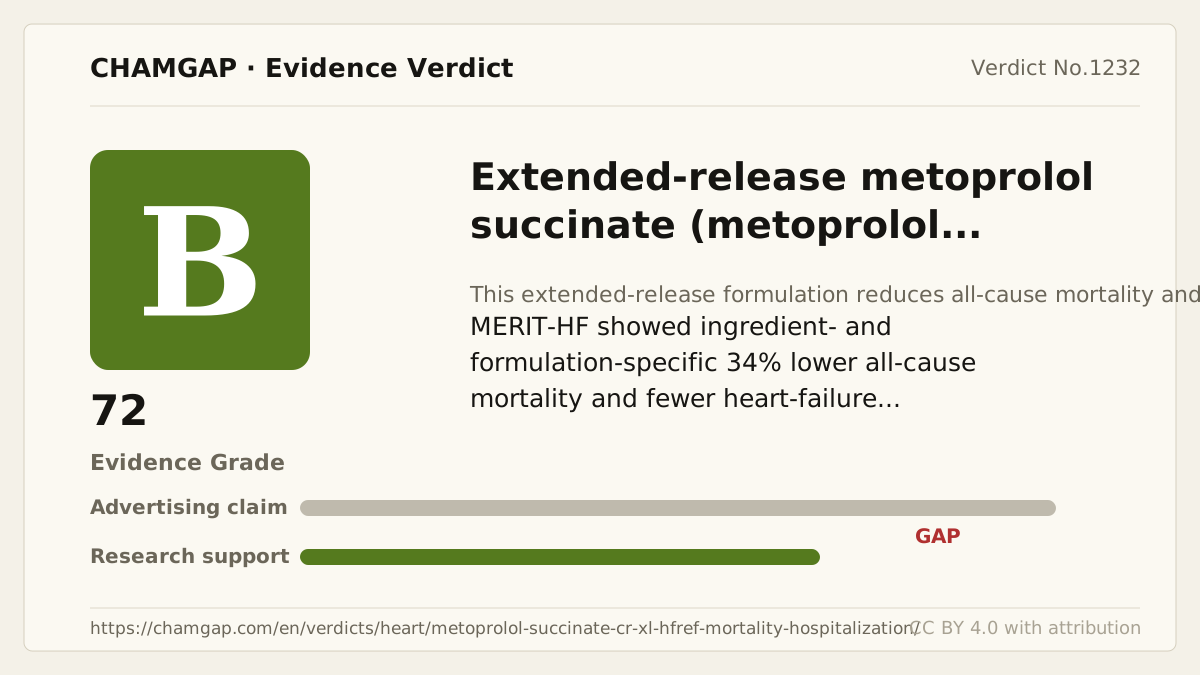
[Chamgap] Metoprolol succinate CR/XL x reduced death and hospitalization in stable symptomatic HFrEF — Evidence Grade B·72. 2 cited sources checked. Source: https://chamgap.com/en/verdicts/heart/metoprolol-succinate-cr-xl-hfref-mortality-hospitalization/ · CC BY 4.0CC BY 4.0 — free to use with attribution; do not distort grades, numbers, or verdict meaning.
What this document does and does not do
Chamgap is an information source. It reports what research has and has not confirmed; it does not tell readers what to take or buy. That decision belongs to readers and, when needed, medical or legal professionals. This verdict reflects literature available up to the search date and may change as new research appears. Nothing here is medical advice.