
Long-haul air travel lasting at least 4 hours,
does it really help with Association with increased symptomatic venous thromboembolism within 8 weeks?
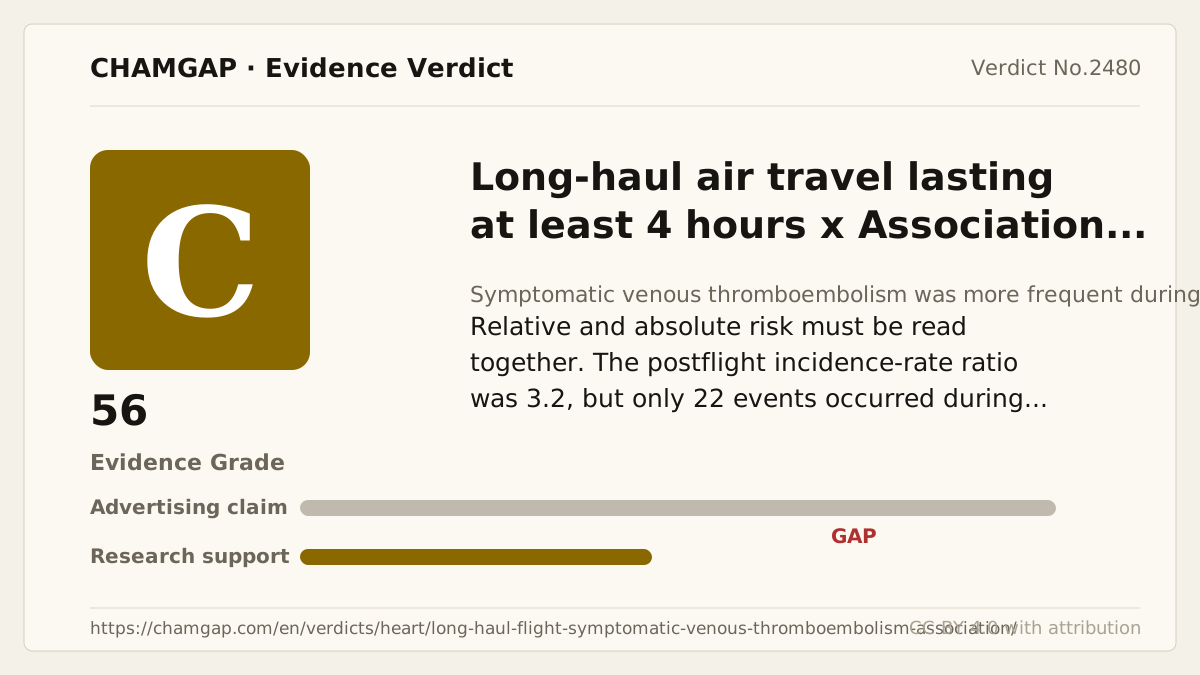
research showsYes, observational evidence supports an association. In a cohort of 8,755 international-organization and company employees linked to travel records, symptomatic venous thrombosis was more frequent during the 8 weeks after flights lasting at least 4 hours than during unexposed time. This was not a randomized trial, and the absolute risk was small: about one event per 4,656 long-haul flights.
ads claimSaying that long-haul travel triples clot risk without the baseline rate exaggerates what most travelers face. The average absolute risk in this cohort was about one event per 4,656 flights and varied with personal risk factors and flight duration. These data do not justify routine anticoagulants for every passenger.
Useful facts when choosing a product
- Exposure was a flight lasting at least 4 hours in company or organization travel records, with an 8-week postflight exposure window.
- The outcome was a symptomatic first event: DVT required compression ultrasound or venography, and pulmonary embolism required spiral CT, a high-probability ventilation-perfusion scan, or angiography.
- The paper states: funded by grant number 2002B53 from The Netherlands Heart Foundation and sponsored by the UK government and the European Commission; funders had no role in design, data collection and analysis, publication decisions, or manuscript preparation.
- Verdict 2311 is C with 54 points and asks whether compression stockings prevent asymptomatic postflight DVT found by screening. The exposure and symptomatic outcome here are different.
- The Korean phrase ‘economy-class syndrome’ can mislead: exposure in this study was defined by flight duration, not seat class, and traveler guidance should pair absolute risk with individual risk factors.
What the research actually shows
Over a mean 4.4 years and 38,910 person-years, 22 events occurred during 6,872 exposed person-years: 3.2 per 1,000 person-years (95% CI 2.0 to 4.7). During 27,772 person-years unexposed to any air travel, 29 events occurred: 1.0 per 1,000 (0.7 to 1.5). The age- and sex-adjusted incidence-rate ratio was 3.2 (1.8 to 5.6). Across 102,429 long-haul flights, absolute risk was 21.5 per 100,000 flights, or one per 4,656. The rate ratio rose 1.4-fold (1.2 to 1.6) per additional overlapping flight and 1.1-fold (1.1 to 1.2) per extra flight hour. Flights longer than 16 hours had one event per 1,264 flights, based on few events. Postflight incidence was 6.6 per 1,000 person-years (1.2 to 16.4) among oral-contraceptive users and 4.7 (2.6 to 7.4) among employees with BMI above 25.
Why this is classified as C (56)
Objectively confirmed symptomatic events, administrative flight records, and time- and dose-related patterns support the harm claim. Yet the evidence remains an observational cohort with 32% participation and incomplete control of diagnostic-search bias and time-varying confounding. Incidence-rate ratios were kept on their ratio scale rather than converted into standardized effects.
Counterpoint. Average absolute risk was very small, and participants were predominantly healthy employees with a mean age of 40 years. The same absolute estimate cannot be assumed for high-risk travelers, nor does the result establish that all long-haul passengers need medication.
Rejudgment record. Cross-check applied — We assessed symptomatic event rates and absolute risk in an observational cohort together with exposure and outcome measurement, selection, diagnostic-search bias, and confounding.
| Endpoint | H | Hard endpoint - actual events such as death |
| Replication | R1 | Single confirmatory trial |
| Independence | I2 | Decisive evidence is publicly or non-profit funded |
| Effect size | E+ | Meets the clinically important threshold |
The scoring table and the verdict agree (C).
Sub-claim grades by effect
This ingredient is marketed for several effects. A single overall grade blends strong and weak claims together, so each effect is graded separately here. The overall grade reflects the strongest disconfirming or core claim.
| Effect (sub-claim) | Grade | Basis |
|---|---|---|
| Symptomatic venous thromboembolism rates are higher during the 8 weeks after flights lasting at least 4 hours. | C | The incidence-rate ratio was 3.2, but observational biases remain. |
| Rates rise with longer flights and more flights clustered in a short period. | C | A dose pattern was present, but event counts in the longest-flight category were small. |
Cross-check — Codex and Claude
Evidence Table
| Study | Design | Sample | Funding | Endpoint | Result | Weight |
|---|---|---|---|---|---|---|
| Study 1 | Cohort person-time analysis linked to employer travel records | 102,429 | Grant 2002B53 from The Netherlands Heart Foundation; sponsored by the UK government and European Commission; no funder role reported | First symptomatic DVT or pulmonary embolism confirmed by objective imaging | Exposed: 22 events/6,872 person-years, 3.2/1,000 (95% CI 2.0-4.7); unexposed: 29/27,772, 1.0/1,000 (0.7-1.5); adjusted IRR 3.2 (1.8-5.6); one event per 4,656 flights | Decisive observational evidence |
Receipt — 2 References
All 2 cited sources were verified for existence at the original page (as of 2026-08-08).
Reviewed and approved: Chamgap Editorial Team · Approval date: 2026-08-08 · Corrections: none
Cite this verdict
[Chamgap] Is long-haul air travel associated with more symptomatic venous thromboembolism? — Evidence Grade C·56. 2 cited sources checked. Source: https://chamgap.com/en/verdicts/heart/long-haul-flight-symptomatic-venous-thromboembolism-association/ · CC BY 4.0CC BY 4.0 — free to use with attribution; do not distort grades, numbers, or verdict meaning.
What this document does and does not do
Chamgap is an information source. It reports what research has and has not confirmed; it does not tell readers what to take or buy. That decision belongs to readers and, when needed, medical or legal professionals. This verdict reflects literature available up to the search date and may change as new research appears. Nothing here is medical advice.