
Liberal transfusion in acute MI with anemia,
does it really help with Reduction in 30-day death or recurrent myocardial infarction versus restrictive transfusion in acute MI with anemia?
research showsThe grade is D. MINT found death or recurrent MI in 295/1,749 (16.9%) with restriction versus 255/1,755 (14.5%) with liberal transfusion, restrictive-versus-liberal RR 1.15, 95% CI 0.99 to 1.34, P=0.07. The 2.4-point numerical difference favored liberal transfusion, but the primary test was borderline and not significant.
ads claimP=0.07 cannot be rounded into a significant reduction, but the interval also does not establish no benefit.
Useful facts when choosing a product
- MINT used a 10-g/dL liberal threshold and a 7-to-8-g/dL restrictive strategy.
- Mean transfusion was 2.5 versus 0.7 red-cell units.
- Recurrent MI was adjudicated by a treatment-blinded committee.
What the research actually shows
MINT analyzed 3,504 patients at 126 sites. Death was 173/1,749 (9.9%) versus 146/1,755 (8.3%), and recurrent MI was 8.5% versus 7.2%. NHLBI and other public sources funded the trial. REALITY randomized 668 and found its broader 30-day composite in 36 (11.0%) versus 45 (14.0%), RR 0.79 with a two-sided 95% upper bound of 1.19 inside its 1.25 noninferiority margin. Because REALITY tested restrictive noninferiority with a different composite, it was not counted as replication of MINT's liberal-superiority primary question.
Why this is classified as D (34)
The primary hard endpoint in a large publicly funded trial was null and imprecise enough to retain benefit, giving D with 34 points.
Counterpoint. The point estimate and several components favor liberal transfusion, so clinical equivalence is not established.
Rejudgment record. Cross-check applied — MINT primary outcome, thresholds, actual transfusion units, blinded adjudication, and comparison with REALITY
| Endpoint | H | Hard endpoint - actual events such as death |
| Replication | R1 | Single confirmatory trial |
| Independence | I2 | Decisive evidence is publicly or non-profit funded |
| Effect size | E0 | Null |
| Precision | C0 | The confidence interval leaves room for benefit |
The scoring table and the verdict agree (D).
Sub-claim grades by effect
This ingredient is marketed for several effects. A single overall grade blends strong and weak claims together, so each effect is graded separately here. The overall grade reflects the strongest disconfirming or core claim.
| Effect (sub-claim) | Grade | Basis |
|---|---|---|
| Reduced 30-day death or recurrent MI | D | The primary endpoint was null at P=0.07. |
| Increased red-cell use | B | Mean use clearly separated, 2.5 versus 0.7 units. |
Cross-check — Codex and Claude
Evidence Table
| Study | Design | Sample | Funding | Endpoint | Result | Weight |
|---|---|---|---|---|---|---|
| Study 1 | Open-label multicenter superiority trial with blinded recurrent-MI adjudication | 1,755 | US NHLBI and other public funding | All-cause death or recurrent MI through 30 days | 295/1,749 (16.9%) versus 255/1,755 (14.5%), restrictive-versus-liberal RR 1.15, 95% CI 0.99 to 1.34, P=0.07 | Decisive large trial |
| Study 2 | Open-label noninferiority trial | 646 | Public grants from the French Ministry of Health and Spanish Ministry of Economy and Competitiveness | 30-day composite of death, stroke, recurrent MI, or emergency revascularization | Restrictive 36 (11.0%) versus liberal 45 (14.0%), RR 0.79, upper 95% bound 1.19 within the 1.25 margin | Supportive trial addressing a different composite and directional question |
Receipt — 2 References
All 2 cited sources were verified for existence at the original page (as of 2026-08-06).
Reviewed and approved: Chamgap Editorial Team · Approval date: 2026-08-06 · Corrections: none
Cite this verdict
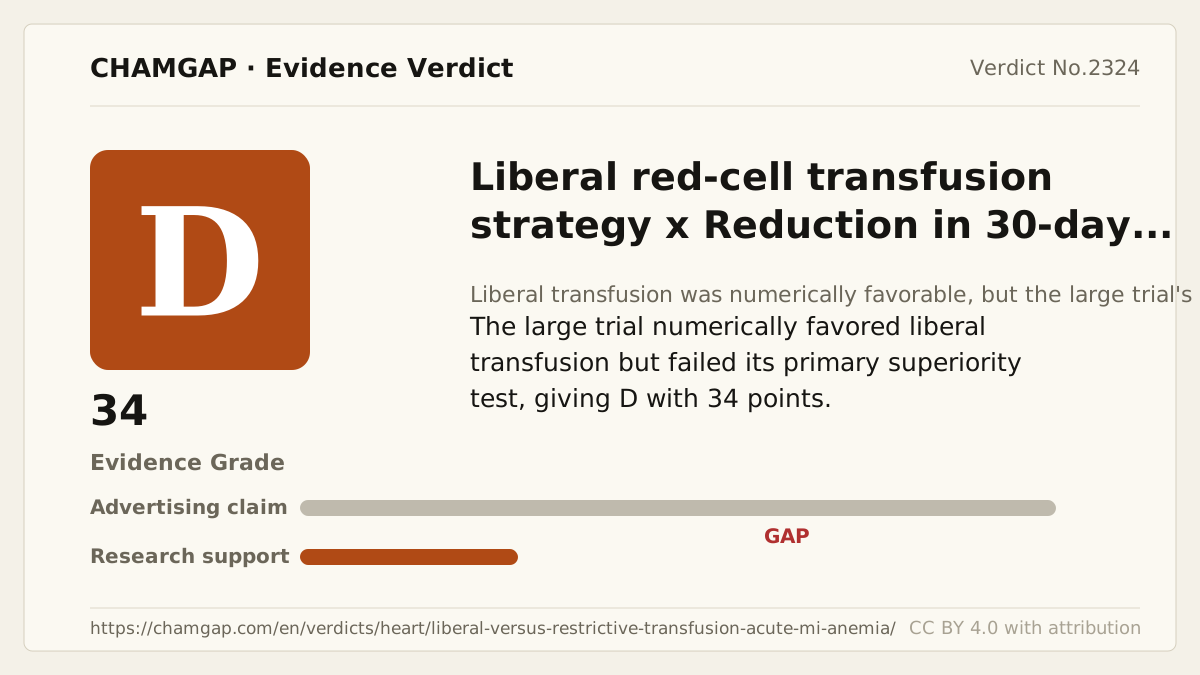
[Chamgap] Liberal transfusion in acute MI with anemia x death or reinfarction — Evidence Grade D·34. 2 cited sources checked. Source: https://chamgap.com/en/verdicts/heart/liberal-versus-restrictive-transfusion-acute-mi-anemia/ · CC BY 4.0CC BY 4.0 — free to use with attribution; do not distort grades, numbers, or verdict meaning.
What this document does and does not do
Chamgap is an information source. It reports what research has and has not confirmed; it does not tell readers what to take or buy. That decision belongs to readers and, when needed, medical or legal professionals. This verdict reflects literature available up to the search date and may change as new research appears. Nothing here is medical advice.