
Expectant management instead of early ibuprofen,
does it really help with Death, necrotizing enterocolitis, or bronchopulmonary dysplasia in extremely preterm PDA?
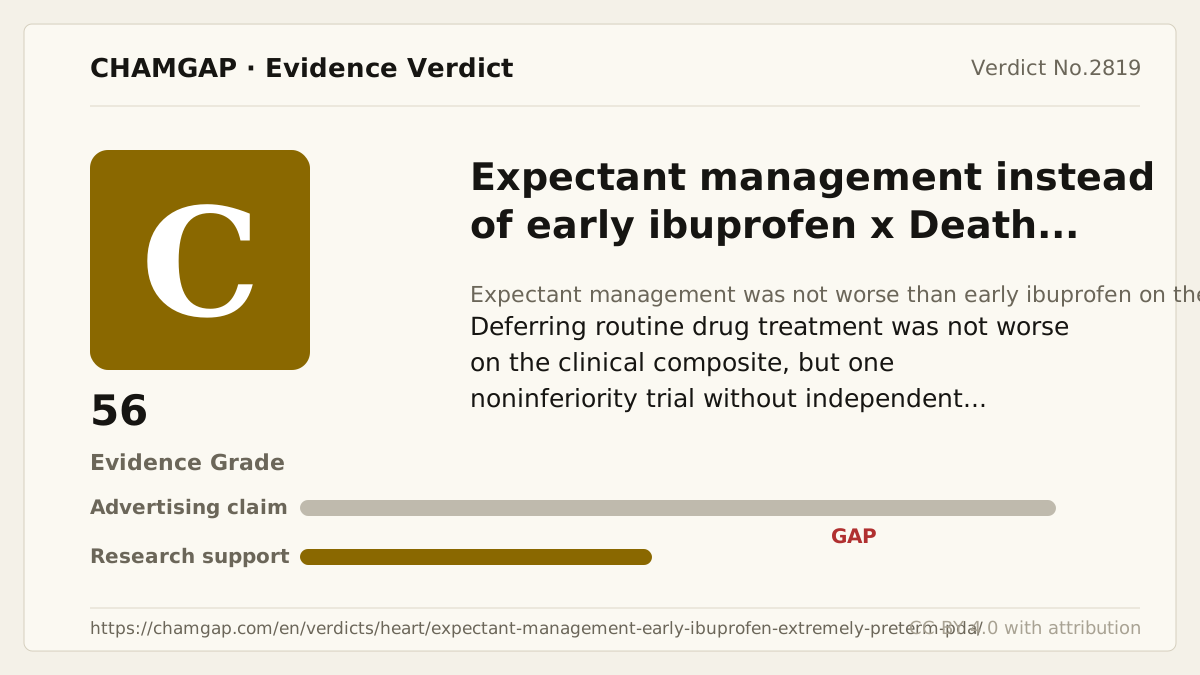
research showsThe grade is C with 56 points. The composite occurred in 63/136 (46.3%) with expectant management and 87/137 (63.5%) with early ibuprofen, an absolute difference of -17.2 percentage points; the upper boundary of the one-sided 95% CI was -7.4 points, below the prespecified +10-point margin.
ads claimWhether to close PDA pharmacologically at once or observe is a real neonatal intensive-care decision. Expectant management here permitted rescue treatment when clinically indicated; it was not unconditional no-treatment.
Useful facts when choosing a product
- Rescue treatment was permitted under the expectant strategy.
- The prespecified noninferiority margin was +10 percentage points.
- Faster ductal closure and clinical death/NEC/BPD outcomes are different endpoints.
What the research actually shows
The trial randomized 273 infants born before 28 weeks, 136 to expectant management and 137 to early ibuprofen. There were two avoidable design limitations. Limitation ① name: noninferiority design. Avoidability: possible - noninferiority was not clearly unavoidable, and a superiority design could have been chosen. Limitation ② name: lack of blinding. Avoidability: possible - another trial addressing the same question used normal-saline placebo to blind parents, research staff, and clinical personnel. Death and Bell stage IIa or higher necrotizing enterocolitis are relatively objective, but bronchopulmonary dysplasia depends on the treatment decision whether to continue supplemental oxygen or positive-pressure respiratory support at 36 weeks, so an effect of unblinded care cannot be excluded. When an oxygen-reduction test was performed, it was adjudicated by a three-member committee unaware of group assignment. Enrollment ended at 273/564 planned participants (48.4%) because funding stopped and recruitment was insufficient, limiting precision. This was not stopping at an efficacy or harm boundary and was not counted as a bias defect. The Netherlands Organization for Health Research and Development and Belgian Health Care Knowledge Center funded it. Open-label rescue drug treatment was given to 1/136 infants in the expectant-management group. Exact arm-specific time-specific ductal-closure counts could not be verified.
Why this is classified as C (56)
The prespecified noninferiority margin was met for death, necrotizing enterocolitis, or bronchopulmonary dysplasia, but this is one noninferiority trial without independent replication and its BPD treatment decisions were vulnerable to unblinded care, giving C with 56 points.
Counterpoint. Successful de-escalation should not be rewritten as proof that ibuprofen causes harm.
Rejudgment record. Cross-check applied — Cross-checked BeNeDuctus and registration for the composite endpoint, +10-point noninferiority margin, absolute difference, independent funding, avoidability of noninferiority design and lack of blinding, oxygen-reduction adjudication, curtailed enrollment, and rescue treatment
| Endpoint | H | Hard endpoint - actual events such as death |
| Replication | R1 | Single confirmatory trial |
| Independence | I2 | Decisive evidence is publicly or non-profit funded |
| Effect size | E+ | Meets the clinically important threshold |
The scoring table and the verdict agree (C).
Sub-claim grades by effect
This ingredient is marketed for several effects. A single overall grade blends strong and weak claims together, so each effect is graded separately here. The overall grade reflects the strongest disconfirming or core claim.
| Effect (sub-claim) | Grade | Basis |
|---|---|---|
| Noninferiority of expectant management on the clinical composite | C | Absolute difference was -17.2 points; one-sided 95% CI upper boundary -7.4. |
Cross-check — Codex and Claude
Evidence Table
| Study | Design | Sample | Funding | Endpoint | Result | Weight |
|---|---|---|---|---|---|---|
| Study 1 | Multicenter open-label randomized noninferiority strategy trial | 137 | Netherlands Organization for Health Research and Development and Belgian Health Care Knowledge Center | Death, Bell stage IIa or higher NEC, or moderate-to-severe BPD at 36 weeks postmenstrual age | 63/136 (46.3%) versus 87/137 (63.5%); absolute -17.2 points; one-sided 95% CI upper boundary -7.4; margin +10 | Pivotal single publicly funded noninferiority trial |
Receipt — 1 References
All 1 cited sources were verified for existence at the original page (as of 2026-08-18).
Reviewed and approved: Chamgap Editorial Team · Approval date: 2026-08-18 · Corrections: none
Cite this verdict
[Chamgap] Expectant Management versus Early Ibuprofen for Extremely Preterm PDA - Benefit — Evidence Grade C·56. 1 cited sources checked. Source: https://chamgap.com/en/verdicts/heart/expectant-management-early-ibuprofen-extremely-preterm-pda/ · CC BY 4.0CC BY 4.0 — free to use with attribution; do not distort grades, numbers, or verdict meaning.
What this document does and does not do
Chamgap is an information source. It reports what research has and has not confirmed; it does not tell readers what to take or buy. That decision belongs to readers and, when needed, medical or legal professionals. This verdict reflects literature available up to the search date and may change as new research appears. Nothing here is medical advice.