
Eplerenone,
does it really help with Reduced all-cause mortality, cardiovascular mortality, and cardiovascular-event hospitalization after acute myocardial infarction complicated by left ventricular dysfunction and heart failure?
research showsEplerenone reduces all-cause death, cardiovascular death, and hospitalization for cardiovascular events when added to standard care after acute myocardial infarction complicated by left ventricular dysfunction and heart failure. In the 6,632-participant EPHESUS trial, all-cause mortality was 14.4% versus 16.7%, RR 0.85 (95% CI 0.75 to 0.96), and cardiovascular death or cardiovascular-event hospitalization was 26.7% versus 30.0%, RR 0.87 (0.79 to 0.95). The 2.3-percentage-point absolute mortality reduction gives an NNT of about 44. These are direct hard outcomes from a large double-blind randomized trial, so the axis-3 manufacturer-funding ceiling does not apply under the exception for large hard-outcome prescription-drug trials. However, EPHESUS is the only cited trial — the second citation is a meta-analysis that includes EPHESUS — and no replication by different investigators with different funding has been confirmed, so the axis-2 R1 ceiling limits the grade to B with 72 points. Hyperkalemia, impaired kidney function, and hypotension are separate safety issues requiring potassium and renal monitoring.
ads claimPromotion can simplify eplerenone into a survival drug for anyone after myocardial infarction. The directly supported population has left ventricular systolic dysfunction plus clinical heart failure, meets potassium and renal criteria, and receives standard post-infarction care concurrently.
Useful facts when choosing a product
- Eplerenone is an oral prescription mineralocorticoid receptor antagonist that selectively blocks aldosterone signaling.
- EPHESUS started treatment 3 to 14 days after acute myocardial infarction at 25 mg once daily and titrated to 50 mg once daily according to tolerance and serum potassium.
- The survival evidence was obtained in patients with a left ventricular ejection fraction of 40% or less and clinical heart failure who also received contemporary standard care for that trial, including an ACE inhibitor or ARB, beta-blockade, and reperfusion when appropriate.
- Serum potassium and kidney function must be checked before treatment and after dose changes, with clinician management of hyperkalemia, renal impairment, hypotension, and interacting potassium-raising medicines.
What the research actually shows
Pitt and the EPHESUS investigators assigned 6,632 patients with a left ventricular ejection fraction of 40% or less and heart failure 3 to 14 days after myocardial infarction to eplerenone, starting at 25 mg and increasing to 50 mg, or placebo. Over a mean 16 months, the relative risks were 0.85 for all-cause death, 0.83 for cardiovascular death, and 0.87 for cardiovascular death or major cardiovascular-event hospitalization. Serious hyperkalemia increased from 3.9% to 5.5%. A meta-analysis by Xu and colleagues of 13 randomized trials and 11,365 participants found 16% reductions in all-cause and cardiovascular mortality with mineralocorticoid receptor antagonists after myocardial infarction, with benefit concentrated in patients with left ventricular dysfunction and no clear mortality benefit without it. The efficacy scope is therefore limited to the EPHESUS-like high-risk population.
Why this is classified as B (72)
EPHESUS showed significant and concordant direct hard outcomes in 6,632 participants: all-cause mortality RR 0.85 with a 2.3-percentage-point absolute reduction and NNT about 44, cardiovascular mortality RR 0.83, and cardiovascular death or cardiovascular-event hospitalization RR 0.87. The axis-3 manufacturer ceiling does not apply under the exception for large hard-outcome prescription-drug trials. However, EPHESUS is the only cited trial — the 13-trial Xu meta-analysis includes EPHESUS and is not separate evidence — and no replication by different investigators with different funding has been confirmed, so the axis-2 R1 ceiling yields B with 72 points. Hyperkalemia and renal risk are scored separately under safety.
Counterpoint. This was an add-on effect to appropriate reperfusion and standard myocardial infarction and heart-failure therapy, not evidence for eplerenone monotherapy. Patients with elevated potassium or inadequate renal function may not share the same benefit-risk balance and require specialist selection and monitoring.
Rejudgment record. New verdict — Accepted the concordant direct hard outcomes of all-cause mortality, cardiovascular mortality, and cardiovascular death or cardiovascular-event hospitalization in the 6,632-participant EPHESUS trial; did not apply the axis-3 manufacturer ceiling under the exception for large hard-outcome prescription-drug trials; recorded axis 2 as R1 with a ceiling of B because EPHESUS is the only cited trial — the Xu 2018 meta-analysis includes EPHESUS — and no replication by different investigators with different funding was confirmed; applicability remains restricted to acute myocardial infarction with left ventricular dysfunction and heart failure
| Endpoint | H | Hard endpoint - actual events such as death |
| Replication | R1 | Single confirmatory trial |
| Independence | I0 | Evidence comes only from manufacturer studies |
| Effect size | E+ | Meets the clinically important threshold |
The scoring table and the verdict agree (B).
Sub-claim grades by effect
This ingredient is marketed for several effects. A single overall grade blends strong and weak claims together, so each effect is graded separately here. The overall grade reflects the strongest disconfirming or core claim.
| Effect (sub-claim) | Grade | Basis |
|---|---|---|
| Reduced all-cause mortality after acute myocardial infarction | A | EPHESUS showed 14.4% versus 16.7%, RR 0.85, with an NNT of about 44. |
| Reduced cardiovascular mortality after acute myocardial infarction | A | Cardiovascular mortality was significantly reduced, RR 0.83 (95% CI 0.72 to 0.94). |
| Reduced cardiovascular death or hospitalization for major cardiovascular events | A | The coprimary composite fell from 30.0% to 26.7%, RR 0.87. |
Cross-check — Codex and Claude
Evidence Table
| Study | Design | Sample | Funding | Endpoint | Result | Weight |
|---|---|---|---|---|---|---|
| Study 1 | Multinational randomized double-blind placebo-controlled trial | 6,632 | Industry-sponsored development trial by Pharmacia/Pfizer | Coprimary endpoints of all-cause mortality and cardiovascular death or hospitalization for cardiovascular events | All-cause mortality was 14.4% versus 16.7%, RR 0.85 (95% CI 0.75 to 0.96); cardiovascular mortality RR was 0.83; cardiovascular death or cardiovascular-event hospitalization RR was 0.87. | Grade-defining large randomized trial with direct hard outcomes |
| Study 2 | Meta-analysis of randomized trials of mineralocorticoid receptor antagonists after myocardial infarction | 11,365 | Academic meta-analysis with no separate industry funding reported | All-cause, cardiovascular, and heart-failure death, left ventricular ejection fraction, and hyperkalemia | All-cause and cardiovascular mortality were each reduced by 16% overall, with benefit in the left ventricular dysfunction subgroup but no clear benefit without dysfunction. | External synthesis supporting the pivotal trial and defining its scope |
Receipt — 2 References
All 2 cited sources were verified for existence at the original page (as of 2026-08-11).
Reviewed and approved: Chamgap Editorial Team · Approval date: 2026-08-11 · Corrections: 1
Correction log — 1
Corrections applied to this verdict, in chronological order. Changes are logged, not erased.
- 2026-08-11 · Grade correction for unmet independent-replication requirement — The only randomized trial among the citations is EPHESUS (no registry number; it predates the 2005 registration mandate), and the second citation, the Xu 2018 meta-analysis, includes EPHESUS and is therefore not separate evidence. Chamgap's A requires axis-2 R2 (multiple RCTs by different investigators with different funding); REMINDER shares the same funding lineage (Pfizer) and excluded heart-failure and left-ventricular-dysfunction patients in a surrogate-endpoint design, while the publicly funded French ALBATROSS trial tested a different regimen (canrenoate followed by spironolactone) with a negative primary endpoint, so no independent replication exists. Axis 2 is R1 and the ceiling is B. The axes were recorded as B-H-R1-I0-E+-B1 (the axis-3 manufacturer ceiling is waived under the large hard-outcome prescription-drug RCT exception) and 72 points were assigned; the effect itself (all-cause mortality RR 0.85, 95% CI 0.75 to 0.96; cardiovascular death or hospitalization RR 0.87) is not disputed. Confirmed in the 2026-08-11 internal audit (workflow verification plus concordant Codex cross-check). (grade A→B)
Cite this verdict
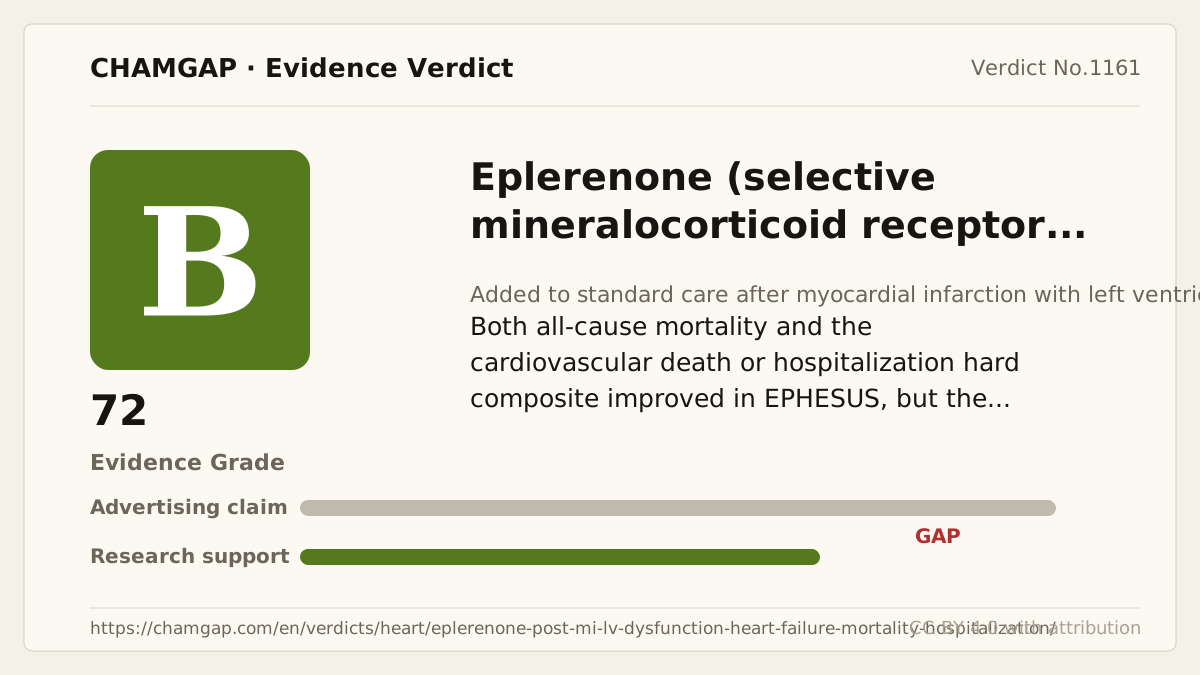
[Chamgap] Eplerenone x reduced mortality and hospitalization after myocardial infarction with left ventricular dysfunction and heart failure — Evidence Grade B·72. 2 cited sources checked. Source: https://chamgap.com/en/verdicts/heart/eplerenone-post-mi-lv-dysfunction-heart-failure-mortality-hospitalization/ · CC BY 4.0CC BY 4.0 — free to use with attribution; do not distort grades, numbers, or verdict meaning.
What this document does and does not do
Chamgap is an information source. It reports what research has and has not confirmed; it does not tell readers what to take or buy. That decision belongs to readers and, when needed, medical or legal professionals. This verdict reflects literature available up to the search date and may change as new research appears. Nothing here is medical advice.