
Epinephrine,
does it really help with Increased 30-day survival?
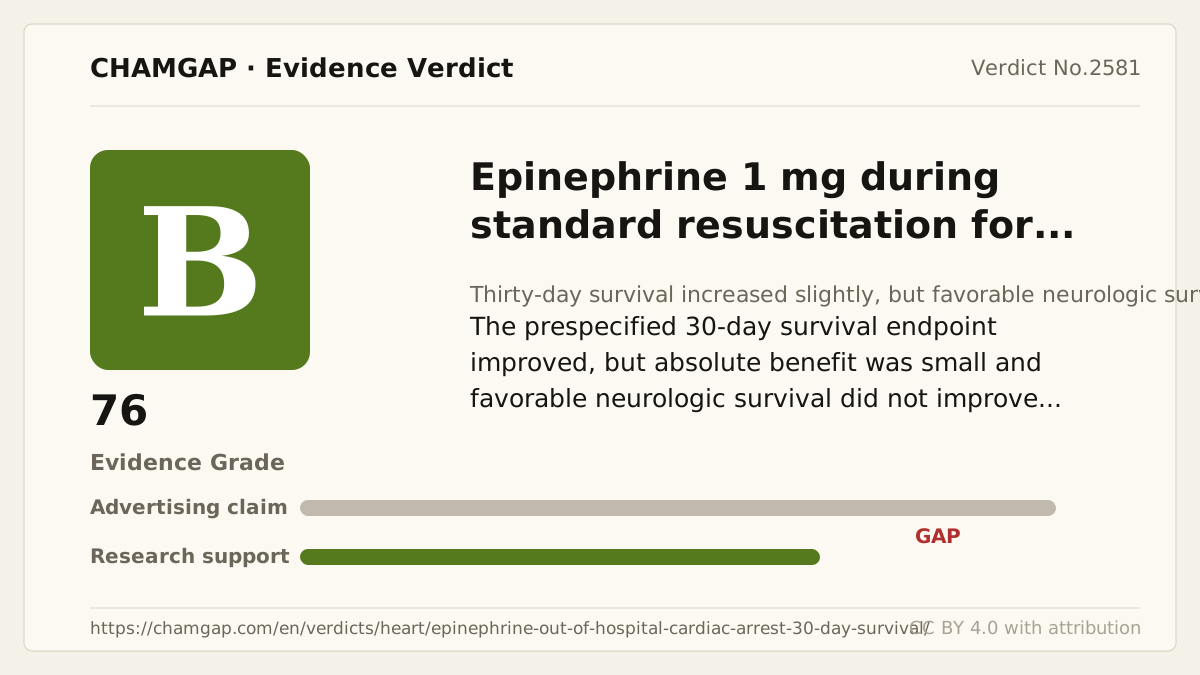
research showsThe grade is B. PARAMEDIC2 randomized 8,103 participants, but 89 were omitted from the primary analysis after randomization, leaving 8,014. Among participants with known 30-day outcomes, survival was 130/4,012 (3.2%) with epinephrine versus 94/3,995 (2.4%) with placebo, unadjusted odds ratio 1.39 (95% CI 1.06 to 1.82). The absolute difference was about 0.8 percentage points, or roughly 112 treated for one additional survivor. Favorable neurologic survival did not increase, and no independent confirmatory trial exists, giving B with 76 points.
ads claimEpinephrine truly produced a small increase in 30-day survival. That result cannot be rewritten as improved neurologically favorable survival or strengthened by combining it with evidence from anaphylaxis.
Useful facts when choosing a product
- The trial compared epinephrine 1 mg about every 3 to 5 minutes with visually identical 0.9% saline.
- Thirty-day survival was the sole primary outcome; favorable neurologic outcome was secondary.
- Verdict 861 is B with 79 points for rapid reversal of respiratory distress and hypotension in anaphylaxis, a wholly different indication.
What the research actually shows
Perkins GD, Ji C, Deakin CD, Quinn T, Nolan JP, Scomparin C, Regan S, Long J, Slowther A, Pocock H, Black JJM, Moore F, Fothergill RT, Rees N, O'Shea L, Docherty M, Gunson I, Han K, Charlton K, Finn J, Petrou S, Stallard N, Gates S, Lall R, and the PARAMEDIC2 Collaborators compared epinephrine 1 mg every 3 to 5 minutes with identical saline packs across five UK ambulance services. Of 8,103 randomized participants, 87 were excluded post-randomization and allocation could not be confirmed for two because their packs were lost, leaving 8,014 in the primary analysis. ISRCTN73485024 lists 30-day survival as the sole primary outcome and neurologic outcomes as secondary. Funding came from the UK NIHR Health Technology Assessment Programme.
Why this is classified as B (76)
A large publicly funded double-blind placebo trial found a significant increase in prespecified 30-day survival. The hard endpoint is a strength, but post-randomization exclusions occurred and independent replication is lacking, giving B with 76 points.
Counterpoint. This grade applies to increased 30-day survival. Increased neurologically favorable survival was not demonstrated and is a separate claim.
Rejudgment record. Cross-check applied — The article and ISRCTN record were cross-checked for the sole primary endpoint, sequential identical packs, masking, analysis population, survival counts, and public funding.
| Endpoint | H | Hard endpoint - actual events such as death |
| Replication | R1 | Single confirmatory trial |
| Independence | I2 | Decisive evidence is publicly or non-profit funded |
| Effect size | E+ | Meets the clinically important threshold |
The scoring table and the verdict agree (B).
Sub-claim grades by effect
This ingredient is marketed for several effects. A single overall grade blends strong and weak claims together, so each effect is graded separately here. The overall grade reflects the strongest disconfirming or core claim.
| Effect (sub-claim) | Grade | Basis |
|---|---|---|
| Increased 30-day survival | B | Rates were 3.2% versus 2.4%, OR 1.39. |
| Increased favorable neurologic survival | D | Rates were 2.2% versus 1.9%, with the interval including 1. |
Cross-check — Codex and Claude
Evidence Table
| Study | Design | Sample | Funding | Endpoint | Result | Weight |
|---|---|---|---|---|---|---|
| Perkins GD, Ji C, Deakin CD, Quinn T, Nolan JP, Scomparin C, Regan S, Long J, Slowther A, Pocock H, Black JJM, Moore F, Fothergill RT, Rees N, O'Shea L, Docherty M, Gunson I, Han K, Charlton K, Finn J, Petrou S, Stallard N, Gates S, Lall R, PARAMEDIC2 Collaborators, 2018 PARAMEDIC2 | Multicenter individually randomized double-blind placebo-controlled trial | 3,999 | UK NIHR Health Technology Assessment Programme 12/127/126 | Survival 30 days after cardiac arrest | Among participants with known 30-day outcomes, 130/4,012 (3.2%) versus 94/3,995 (2.4%); unadjusted OR 1.39 (95% CI 1.06 to 1.82) | Single large publicly funded hard-outcome confirmatory trial |
Receipt — 2 References
All 2 cited sources were verified for existence at the original page (as of 2026-08-14).
Reviewed and approved: Chamgap Editorial Team · Approval date: 2026-08-14 · Corrections: none
Cite this verdict
[Chamgap] Epinephrine x 30-day survival after out-of-hospital cardiac arrest — Evidence Grade B·76. 2 cited sources checked. Source: https://chamgap.com/en/verdicts/heart/epinephrine-out-of-hospital-cardiac-arrest-30-day-survival/ · CC BY 4.0CC BY 4.0 — free to use with attribution; do not distort grades, numbers, or verdict meaning.
What this document does and does not do
Chamgap is an information source. It reports what research has and has not confirmed; it does not tell readers what to take or buy. That decision belongs to readers and, when needed, medical or legal professionals. This verdict reflects literature available up to the search date and may change as new research appears. Nothing here is medical advice.