
Forty intravenous edetate disodium-based chelation infusions,
does it really help with Reduced major cardiovascular events in patients with diabetes and prior myocardial infarction?
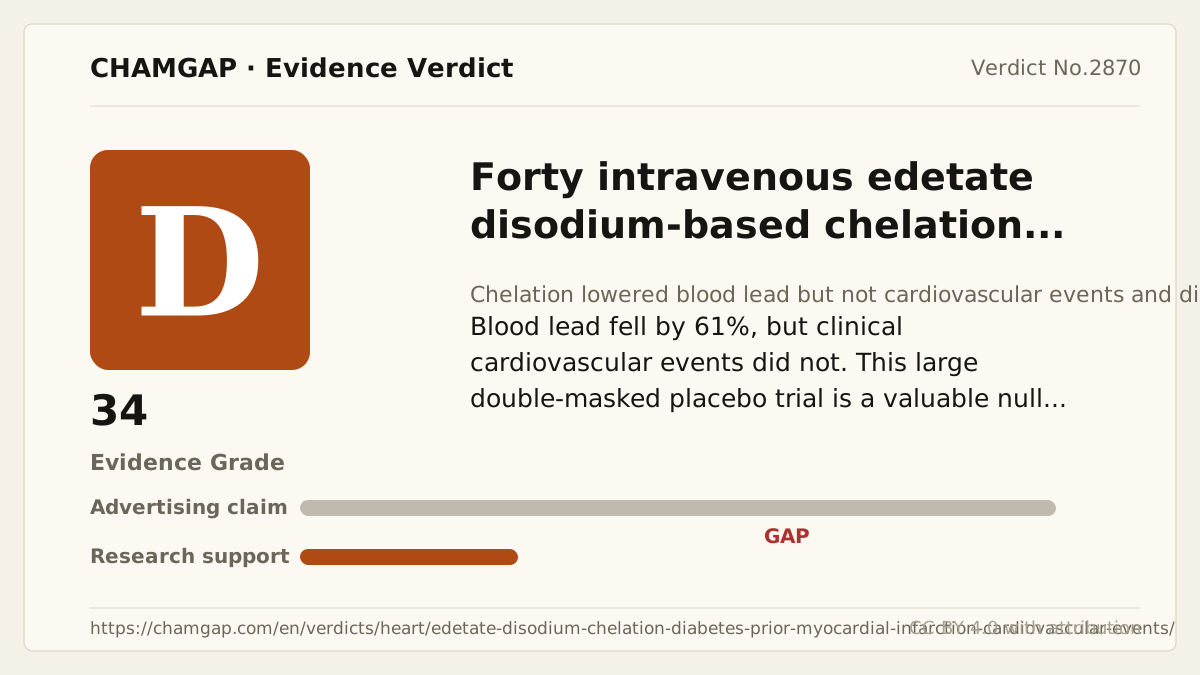
research showsThe grade is D with 34 points. TACT2 randomized 1,000 people with diabetes and prior myocardial infarction. Among 959 receiving at least one infusion, the primary composite occurred in 172/483 (35.6%) with chelation and 170/476 (35.7%) with placebo: adjusted HR 0.93 (95% CI 0.76 to 1.16; P=0.53), absolute difference -0.1 percentage points (95% CI -6.2 to 6.0), a null result.
ads claimIn Korea, searches for 'EDTA chelation,' 'heavy-metal detox infusion,' and 'vascular cleaning' find real clinic procedures and imported oral EDTA supplements. Gangnam Seran Clinic markets intravenous Ca-EDTA to remove heavy metals and waste, while Busan Saeron Clinic recommends EDTA infusions two to three times weekly for 30 to 50 sessions and invokes vascular health and anti-aging. Coupang search results also list a 1,000-mg oral EDTA supplement. These offerings may differ from the TACT2 disodium-edetate combination in salt, dose, and route, but TACT2 does not support expanding chelation into cardiovascular-event prevention.
Useful facts when choosing a product
- The 40-infusion regimen contained up to 3 g of edetate disodium plus vitamins and electrolytes, with each infusion usually lasting three to four hours.
- Five-year Kaplan-Meier primary-event incidence was 45.8% versus 46.5%.
- Blood lead fell from 9.03 to 3.46 microgram/L with chelation, while placebo changed from 9.3 to 8.7.
- Serious adverse events occurred in 81/483 (16.8%) versus 79/476 (16.6%), absolute difference 0.2 percentage points (95% CI -4.9 to 4.6), with no unexpected serious events.
What the research actually shows
The allocation method was: "Randomization was carried out via the TACT2 Medidata Rave system, a web-based, electronic data capture system," assigning equal proportions across the four 2x2 factorial groups. Allocation concealment: after central web allocation, a central pharmacy individually prepared and shipped masked infusion solutions. Masking: the trial was double-masked and placebo-controlled, placebo bags and syringes matched active components, and "No infusions were unmasked during the study." Analysis population and missingness: the primary population comprised 959 people receiving at least one infusion; analyses of all 1,000 randomized participants and prespecified sensitivity analyses for follow-up gaps, consent withdrawal, and loss to follow-up did not materially change the estimate. The 60 withdrawals and 62 losses were censored in time-to-event analysis and were not misclassified as primary-analysis attrition. Prespecified primary endpoint: NCT02733185 and the protocol specified "time to the first occurrence of ... all-cause mortality, MI, stroke, coronary revascularization, or hospitalization for unstable angina," matching the paper. No listed flaw was established, assigning B0. NCCIH, NHLBI, NIDDK, and NIEHS funded and supervised the trial, assigning I2.
Why this is classified as D (34)
The trial has four strengths: H clinical events, I2 public support, rigorous B0 methods, and a 1,000-person large hard-endpoint RCT. Yet TACT and TACT2 were led by the same team and therefore provide R1 rather than independent replication; the result is E0 with no valid exclusion margin, C0, giving D with 34 points.
Counterpoint. The original TACT in 2013 was borderline positive in the overall prior-MI cohort, HR 0.82 (95% CI 0.69 to 0.99; P=0.035), with a larger prespecified diabetes-subgroup signal. TACT2, led by the same investigators to confirm that signal in diabetes, was null. It is not independent replication, but it is a failed targeted confirmation. Verdict 2808 is D with 28 points: the chelator and indication differ, yet claims that chelation improves an outcome were null in each domain.
Rejudgment record. Cross-check applied — Cross-checked NCT02733185, protocol, and JAMA report for event definition, central web randomization, double masking, analysis populations and sensitivity analyses, NIH funding, and TACT history
| Endpoint | H | Hard endpoint - actual events such as death |
| Replication | R1 | Single confirmatory trial |
| Independence | I2 | Decisive evidence is publicly or non-profit funded |
| Effect size | E0 | Null |
| Precision | C0 | The confidence interval leaves room for benefit |
The scoring table and the verdict agree (D).
Sub-claim grades by effect
This ingredient is marketed for several effects. A single overall grade blends strong and weak claims together, so each effect is graded separately here. The overall grade reflects the strongest disconfirming or core claim.
| Effect (sub-claim) | Grade | Basis |
|---|---|---|
| Reduced major cardiovascular events in diabetes with prior MI | D | Events were 35.6% versus 35.7%, HR 0.93 (95% CI 0.76 to 1.16), a null result. |
| Reduced blood lead | B | Blood lead fell 61%, from 9.03 to 3.46 microgram/L, without event benefit. |
Cross-check — Codex and Claude
Evidence Table
| Study | Design | Sample | Funding | Endpoint | Result | Weight |
|---|---|---|---|---|---|---|
| Study 1 | International multicenter 2x2 factorial double-masked placebo-controlled randomized trial | 959 | Public NIH funding and supervision from NCCIH, NHLBI, NIDDK, and NIEHS | First occurrence of all-cause death, MI, stroke, coronary revascularization, or hospitalization for unstable angina | 35.6% versus 35.7%; adjusted HR 0.93 (95% CI 0.76 to 1.16), absolute difference -0.1 points (95% CI -6.2 to 6.0) | Large publicly funded hard-endpoint confirmatory null trial |
Receipt — 4 References
All 4 cited sources were verified for existence at the original page (as of 2026-08-18).
Reviewed and approved: Chamgap Editorial Team · Approval date: 2026-08-18 · Corrections: none
Cite this verdict
[Chamgap] Null: Edetate Disodium-Based Chelation Does Not Reduce Major Cardiovascular Events in Patients With Diabetes and Prior Myocardial Infarction — Evidence Grade D·34. 4 cited sources checked. Source: https://chamgap.com/en/verdicts/heart/edetate-disodium-chelation-diabetes-prior-myocardial-infarction-cardiovascular-events/ · CC BY 4.0CC BY 4.0 — free to use with attribution; do not distort grades, numbers, or verdict meaning.
What this document does and does not do
Chamgap is an information source. It reports what research has and has not confirmed; it does not tell readers what to take or buy. That decision belongs to readers and, when needed, medical or legal professionals. This verdict reflects literature available up to the search date and may change as new research appears. Nothing here is medical advice.