
Early TAVR,
does it really help with Reduced death, stroke, or unplanned cardiovascular hospitalization?
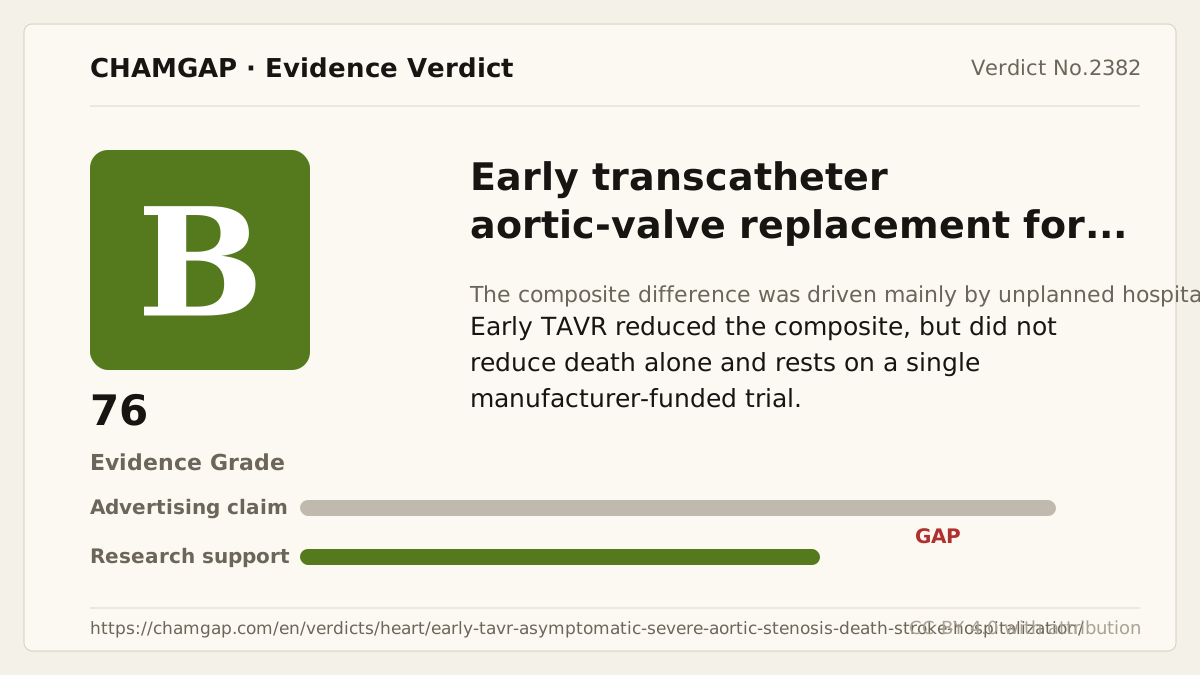
research showsThe grade is B with 76 points. Over a median 3.8 years, the primary outcome occurred in 122/455 (26.8%) versus 202/446 (45.3%), HR 0.50 (95% CI 0.40 to 0.63). The difference was driven mainly by unplanned cardiovascular hospitalization; death alone was 8.4% versus 9.2%.
ads claimA 50% lower composite hazard must not be presented as halving mortality.
Useful facts when choosing a product
- This was an open-label 901-participant trial.
- Hospitalization drove most of the composite difference.
- Death alone was 8.4% versus 9.2%.
- RECOVERY and AVATAR used surgery rather than TAVR.
What the research actually shows
EARLY TAVR randomized 901 patients at 75 US and Canadian sites, 455 to a balloon-expandable TAVR and 446 to surveillance. It was open label with independent event adjudication. Edwards Lifesciences supported the trial and company employees were among the authors.
Why this is classified as B (76)
One large hard-outcome trial supports the composite, but manufacturer funding, reliance on one trial, and no death-alone benefit give B with 76 points.
Counterpoint. Composite benefit is not synonymous with mortality benefit.
Rejudgment record. Cross-check applied — EARLY TAVR directly improved a hard composite, but prior asymptomatic trials used surgery and different primary endpoints
| Endpoint | H | Hard endpoint - actual events such as death |
| Replication | R1 | Single confirmatory trial |
| Independence | I0 | Evidence comes only from manufacturer studies |
| Effect size | E+ | Meets the clinically important threshold |
The scoring table and the verdict agree (B).
Sub-claim grades by effect
This ingredient is marketed for several effects. A single overall grade blends strong and weak claims together, so each effect is graded separately here. The overall grade reflects the strongest disconfirming or core claim.
| Effect (sub-claim) | Grade | Basis |
|---|---|---|
| Reduced primary composite events | B | Rates were 26.8% versus 45.3%. |
| Reduced death alone | D | Death was 8.4% versus 9.2%. |
Cross-check — Codex and Claude
Evidence Table
| Study | Design | Sample | Funding | Endpoint | Result | Weight |
|---|---|---|---|---|---|---|
| Study 1 | Multicenter open-label randomized surveillance-controlled trial | 446 | Supported by Edwards Lifesciences | Composite of death, stroke, or unplanned cardiovascular hospitalization; primary | 122/455 (26.8%) versus 202/446 (45.3%), HR 0.50 (0.40 to 0.63), median 3.8 years | Pivotal single TAVR trial |
| RECOVERY·AVATAR | Randomized early-surgery versus conservative-care trials | 157 | Academic support for RECOVERY; no extramural funding for AVATAR | Operative/cardiovascular death, and death/MI/stroke/HF hospitalization, respectively | Favored early surgery but did not test TAVR | Indirect evidence |
Receipt — 2 References
All 2 cited sources were verified for existence at the original page (as of 2026-08-07).
Reviewed and approved: Chamgap Editorial Team · Approval date: 2026-08-07 · Corrections: none
Cite this verdict
[Chamgap] Early TAVR x death, stroke, and hospitalization in asymptomatic severe aortic stenosis — Evidence Grade B·76. 2 cited sources checked. Source: https://chamgap.com/en/verdicts/heart/early-tavr-asymptomatic-severe-aortic-stenosis-death-stroke-hospitalization/ · CC BY 4.0CC BY 4.0 — free to use with attribution; do not distort grades, numbers, or verdict meaning.
What this document does and does not do
Chamgap is an information source. It reports what research has and has not confirmed; it does not tell readers what to take or buy. That decision belongs to readers and, when needed, medical or legal professionals. This verdict reflects literature available up to the search date and may change as new research appears. Nothing here is medical advice.