
Bypass first for CLTI with adequate great saphenous vein,
does it really help with Reduction in major adverse limb events or death versus an endovascular-first strategy?
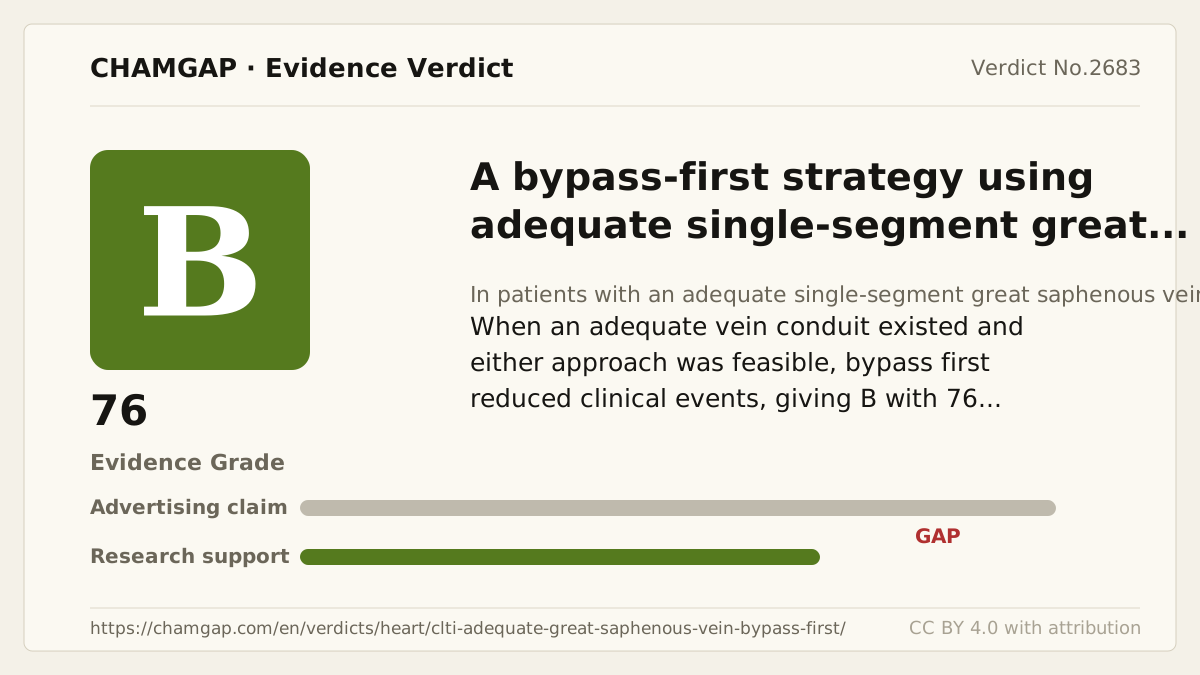
research showsThe grade is B with 76 points. In BEST-CLI cohort 1, limited to patients with an adequate single-segment great saphenous vein, bypass first reduced major adverse limb events or death versus endovascular first: 302/709 (42.6%) versus 408/711 (57.4%), HR 0.68 (95% CI 0.59 to 0.79).
ads claimThis does not mean surgery is superior for every case of chronic limb-threatening ischemia. It applies to cohort 1 after ultrasound confirmation of an adequate single-segment vein and equipoise between both strategies.
Useful facts when choosing a product
- Cohort 1 included only patients with an adequate single-segment great saphenous vein.
- Specialists selected the specific best available technique within each assigned strategy.
- The registration is NCT02060630.
What the research actually shows
Cohort 1 randomized 1,434 participants, 718 to surgery and 716 to endovascular therapy; 1,420 entered the principal analysis after 14 with missing baseline covariates were excluded. Prespecified stratified permuted-block randomization, independent adjudication of first major reintervention, assigned-group analysis, and agreement with the registered primary composite were confirmed. Participant masking was impossible for these procedures. Enrollment stopped for lack of continued funding at 1,830 rather than the planned 2,100, counted as one avoidable limitation. The paper states that the trial was funded by NHLBI. The registry lists Carelon Research as sponsor and NHLBI as collaborator; Carelon was the contract research organization conducting the study, not a funder with a product interest. The comparison was surgery versus endovascular therapy, not a structure sponsored by a particular product manufacturer. Separately from the funding source, multiple authors disclosed consulting and research relationships with device companies.
Why this is classified as B (76)
A large randomized trial found a substantial hard-outcome benefit, but evidence is one trial with funding-limited enrollment, giving B with 76 points.
Counterpoint. Bypass adds operative, wound, anesthesia, and recovery burdens, requiring individualized vascular-team assessment.
Rejudgment record. Cross-check applied — Cross-checked the BEST-CLI paper, registry, and design report for separate cohorts, primary-analysis denominators, event adjudication, enrollment termination, NHLBI funding, and Carelon Research's contract-research role
| Endpoint | H | Hard endpoint - actual events such as death |
| Replication | R1 | Single confirmatory trial |
| Independence | I2 | Decisive evidence is publicly or non-profit funded |
| Effect size | E+ | Meets the clinically important threshold |
The scoring table and the verdict agree (B).
Sub-claim grades by effect
This ingredient is marketed for several effects. A single overall grade blends strong and weak claims together, so each effect is graded separately here. The overall grade reflects the strongest disconfirming or core claim.
| Effect (sub-claim) | Grade | Basis |
|---|---|---|
| Reduction in the primary composite in the adequate-vein cohort | B | The hazard ratio was 0.68 (0.59 to 0.79). |
| Reduction in the primary composite in the alternative-conduit cohort | D | The result was null, HR 0.79 (0.58 to 1.06). |
Cross-check — Codex and Claude
Evidence Table
| Study | Design | Sample | Funding | Endpoint | Result | Weight |
|---|---|---|---|---|---|---|
| Farber A, Menard MT, Conte MS, Kaufman JA, Powell RJ, Choudhry NK, Hamza TH, Assmann SF, Creager MA, Cziraky MJ, Dake MD, Jaff MR, Reid D, Siami FS, Sopko G, White CJ, van Over M, Strong MB, Villarreal MF, McKean M, Azene E, Azarbal A, Barleben A, Chew DK, Clavijo LC, Douville Y, Findeiss L, Garg N, Gasper W, Giles KA, Goodney PP, Hawkins BM, Herman CR, Kalish JA, Koopmann MC, Laskowski IA, Mena-Hurtado C, Motaganahalli R, Rowe VL, Schanzer A, Schneider PA, Siracuse JJ, Venermo M, Rosenfield K, BEST-CLI Investigators. 2022 | Prespecified cohort 1 of a 150-site international open-label randomized superiority trial | 711 | NHLBI funding; registry sponsor Carelon Research was the contract research organization; author device-company relationships were disclosed separately from funding | Composite of above-ankle amputation, major reintervention, or all-cause death | 302/709 (42.6%) versus 408/711 (57.4%), HR 0.68 (95% CI 0.59 to 0.79), P<0.001 | Pivotal single trial limited to the cohort with adequate single-segment great saphenous vein |
Receipt — 1 References
All 1 cited sources were verified for existence at the original page (as of 2026-08-15).
Reviewed and approved: Chamgap Editorial Team · Approval date: 2026-08-15 · Corrections: none
Cite this verdict
[Chamgap] Bypass first for CLTI with adequate great saphenous vein x fewer limb events or deaths — Evidence Grade B·76. 1 cited sources checked. Source: https://chamgap.com/en/verdicts/heart/clti-adequate-great-saphenous-vein-bypass-first/ · CC BY 4.0CC BY 4.0 — free to use with attribution; do not distort grades, numbers, or verdict meaning.
What this document does and does not do
Chamgap is an information source. It reports what research has and has not confirmed; it does not tell readers what to take or buy. That decision belongs to readers and, when needed, medical or legal professionals. This verdict reflects literature available up to the search date and may change as new research appears. Nothing here is medical advice.