
Community pharmacist prescribing and follow-up,
does it really help with Reduced systolic blood pressure in uncontrolled hypertension?
research showsThe grade is C. Fifty-two barbershops and 319 Black men were cluster randomized. Among 303 six-month completers, systolic pressure changed by -27.0 versus -9.3 mm Hg, adjusted difference -21.6 mm Hg (95% CI -28.4 to -14.7). This exceeded the 6.9-mm Hg detectable difference, but blood pressure is a surrogate and the primary analysis was completer-based, giving C with 54 points.
ads claimThis was not simply blood-pressure measurement in a barbershop. Pharmacists prescribed under collaborative agreements and monitored pressure and laboratory safety monthly.
Useful facts when choosing a product
- Pharmacists prescribed antihypertensive drugs under collaborative practice agreements.
- i-STAT was a safety-assessment tool for electrolytes and creatinine, not the treatment under test.
- Controls received blood-pressure education and referral encouragement.
What the research actually shows
Barbershops were assigned 1:1 using a prespecified random-number sequence, and participants and measurers knew assignment. A validated automated monitor recorded five readings, discarding the first two and averaging the last three. The primary analysis used 303 six-month completers from 319 randomized participants; an all-randomized sensitivity analysis carried forward the last measurement. Completer-centered primary analysis is one limitation. Follow-up reached the planned six months, with no early stopping. Funding came from NIH NHLBI and NCATS, the California Endowment, the Lincy Foundation, the Harriet and Steven Nichols Foundation, and Cedars-Sinai institutional sources. Abbott i-STAT was used only to assess electrolytes and creatinine for medication safety; free provision was not reported. The intervention was the pharmacist-care model.
Why this is classified as C (54)
One publicly and noncommercially funded trial found a large surrogate-endpoint difference, but completer-centered primary analysis gives C with 54 points.
Counterpoint. Replication in women, other communities, and less intensively resourced care systems is needed.
Rejudgment record. Cross-check applied — Cross-checked the article and registry for cluster assignment, 319 randomized versus 303 in the primary analysis, intention-to-treat sensitivity analysis, automated pressure protocol, funding, and i-STAT's assessment role
| Endpoint | S | Surrogate marker - laboratory or imaging measures |
| Replication | R1 | Single confirmatory trial |
| Independence | I2 | Decisive evidence is publicly or non-profit funded |
| Effect size | E+ | Meets the clinically important threshold |
The scoring table and the verdict agree (C).
Sub-claim grades by effect
This ingredient is marketed for several effects. A single overall grade blends strong and weak claims together, so each effect is graded separately here. The overall grade reflects the strongest disconfirming or core claim.
| Effect (sub-claim) | Grade | Basis |
|---|---|---|
| Reduced six-month systolic blood pressure | C | The adjusted difference was -21.6 mm Hg. |
| Reduced cardiovascular events | ? | The trial did not test reduction in clinical events. |
Cross-check — Codex and Claude
Evidence Table
| Study | Design | Sample | Funding | Endpoint | Result | Weight |
|---|---|---|---|---|---|---|
| Study 1 | Open cluster-randomized trial in 52 barbershops | 319 | NIH, California Endowment, Lincy Foundation, Harriet and Steven Nichols Foundation, and Cedars-Sinai institutional funding; i-STAT was an assessment tool | Change in systolic blood pressure at six months | -27.0 versus -9.3 mm Hg, adjusted difference -21.6 mm Hg (95% CI -28.4 to -14.7); intention-to-treat sensitivity estimate -21.0 mm Hg | Single publicly and noncommercially funded trial with a large surrogate effect |
Receipt — 1 References
All 1 cited sources were verified for existence at the original page (as of 2026-08-18).
Reviewed and approved: Chamgap Editorial Team · Approval date: 2026-08-18 · Corrections: none
Cite this verdict
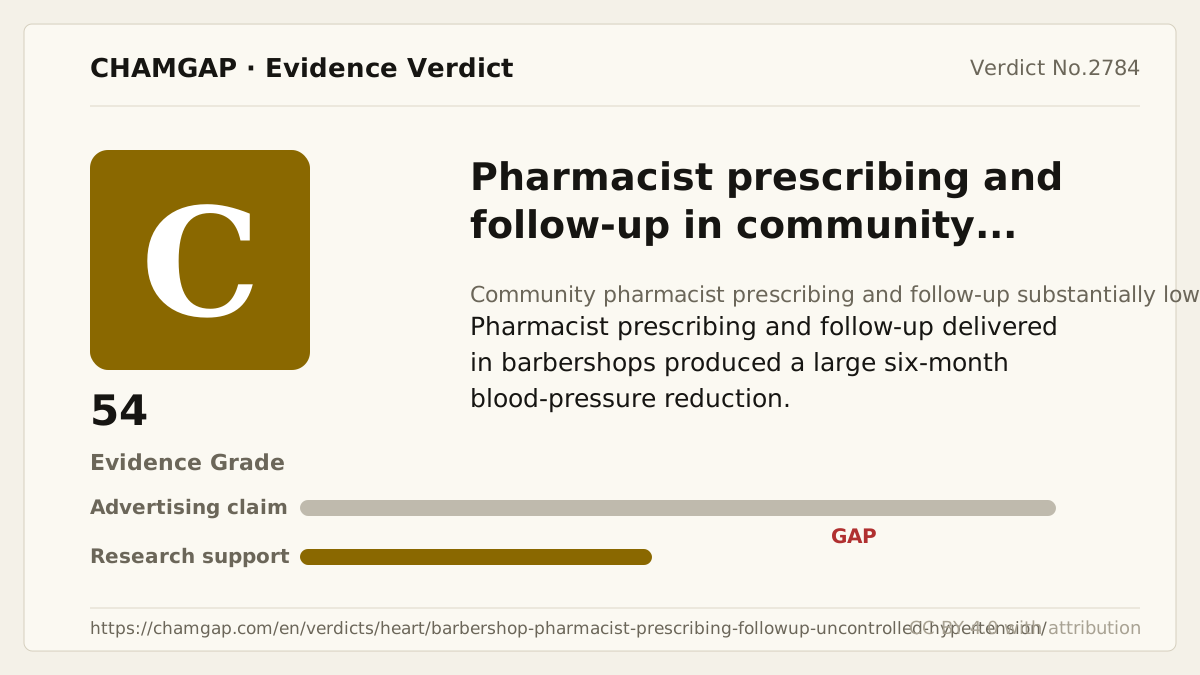
[Chamgap] Community pharmacist prescribing and follow-up x uncontrolled hypertension — Evidence Grade C·54. 1 cited sources checked. Source: https://chamgap.com/en/verdicts/heart/barbershop-pharmacist-prescribing-followup-uncontrolled-hypertension/ · CC BY 4.0CC BY 4.0 — free to use with attribution; do not distort grades, numbers, or verdict meaning.
What this document does and does not do
Chamgap is an information source. It reports what research has and has not confirmed; it does not tell readers what to take or buy. That decision belongs to readers and, when needed, medical or legal professionals. This verdict reflects literature available up to the search date and may change as new research appears. Nothing here is medical advice.