
Artificial-intelligence ECG screening alert,
does it really help with Increased detection of previously undiagnosed low ejection fraction?
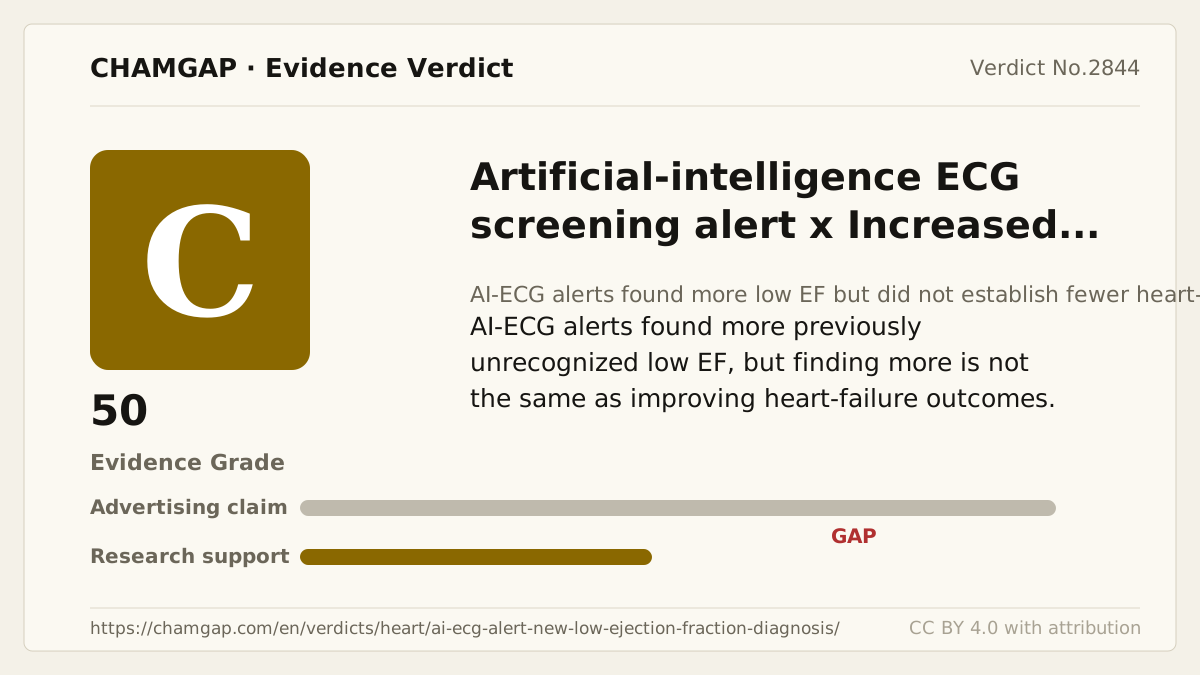
research showsThe grade is C with 50 points. A new EF <=50% diagnosis within 90 days occurred in 2.1% with alerts versus 1.6% with usual care, an absolute increase of 0.5 percentage points and OR 1.32 (95% CI 1.01 to 1.61). This is a detection surrogate, not fewer heart-failure admissions or deaths, so the grade is capped at C.
ads claimEarlier detection of asymptomatic low EF can trigger confirmatory care, but false positives, incidental findings, labeling, extra testing, and treatment cascades can also follow. Net patient benefit was not established by higher yield alone.
Useful facts when choosing a product
- Positive AI results occurred in 6.0% of participants.
- Overall echocardiography differed by only 1.0 percentage point and was not significant.
- The algorithm was proprietary, patent pending, and not publicly released.
What the research actually shows
The EAGLE trial cluster-randomized 120 primary-care teams and 358 clinicians across 45 Minnesota and Wisconsin clinics or hospitals, automatically including 22,641 adults with routine ECGs and no prior heart failure. In a cluster trial, concealment means hiding team alert assignment until teams and the patient-capture pathway are fixed, not concealing individual patient envelopes. Automatic capture of all routine ECGs reduced patient-level selective enrollment, but the publication did not sufficiently describe independent central sequence concealment. Limitation: inadequate randomization or allocation concealment. Listed item: inadequate randomization or allocation concealment. Avoidability: possible - an independent statistician and concealed central release after team registration could have been explicitly reported. EHR capture did not show substantial attrition (>=15%). Mayo's Kern Center supported the work, but the patent-pending proprietary algorithm was licensed to EKO and P.A.F., F.L.-J., S.K., and Z.I.A. could benefit financially from external use, so it is not classified as publicly independent.
Why this is classified as C (50)
New low-EF diagnosis is a detection-rate surrogate and caps the grade at C. The absolute 0.5-point gain is balanced against one RCT, Mayo licensing and author interests, and cluster-concealment reporting limits, giving C with 50 points.
Counterpoint. Other corpus heart-failure verdicts ask whether treatment changes hospitalization, mortality, or symptoms; this verdict asks about detection rather than treatment.
Rejudgment record. New verdict — Large cluster RCT detection gain, S cap, Mayo patent and licensing interests, and concealment reporting limits
| Endpoint | S | Surrogate marker - laboratory or imaging measures |
| Replication | R1 | Single confirmatory trial |
| Independence | I1 | Mixed funding sources |
| Effect size | E+ | Meets the clinically important threshold |
The scoring table and the verdict agree (C).
Sub-claim grades by effect
This ingredient is marketed for several effects. A single overall grade blends strong and weak claims together, so each effect is graded separately here. The overall grade reflects the strongest disconfirming or core claim.
| Effect (sub-claim) | Grade | Basis |
|---|---|---|
| Increased detection of undiagnosed low EF within 90 days | C | Detection increased by 0.5 percentage points. |
| Reduced heart-failure hospitalization or mortality | D | The trial did not establish these patient outcomes. |
Cross-check — Codex and Claude
Evidence Table
| Study | Design | Sample | Funding | Endpoint | Result | Weight |
|---|---|---|---|---|---|---|
| Study 1 | Pragmatic cluster-randomized trial of 120 primary-care teams | 358 | Mayo Clinic Kern Center; Mayo-EKO license and potential financial benefit for four authors | New diagnosis of EF <=50% within 90 days after ECG | 2.1% vs 1.6%; absolute difference +0.5 points; OR 1.32 (95% CI 1.01 to 1.61) | Pivotal large detection-rate cluster RCT |
Receipt — 2 References
All 2 cited sources were verified for existence at the original page (as of 2026-08-18).
Reviewed and approved: Chamgap Editorial Team · Approval date: 2026-08-18 · Corrections: none
Cite this verdict
[Chamgap] Artificial-Intelligence ECG Screening Alerts for Detecting Previously Undiagnosed Low Ejection Fraction — Benefit — Evidence Grade C·50. 2 cited sources checked. Source: https://chamgap.com/en/verdicts/heart/ai-ecg-alert-new-low-ejection-fraction-diagnosis/ · CC BY 4.0CC BY 4.0 — free to use with attribution; do not distort grades, numbers, or verdict meaning.
What this document does and does not do
Chamgap is an information source. It reports what research has and has not confirmed; it does not tell readers what to take or buy. That decision belongs to readers and, when needed, medical or legal professionals. This verdict reflects literature available up to the search date and may change as new research appears. Nothing here is medical advice.