
Laparoscopic distal gastrectomy,
does it really help with Noninferior five-year overall survival versus open surgery in clinical stage I gastric cancer?
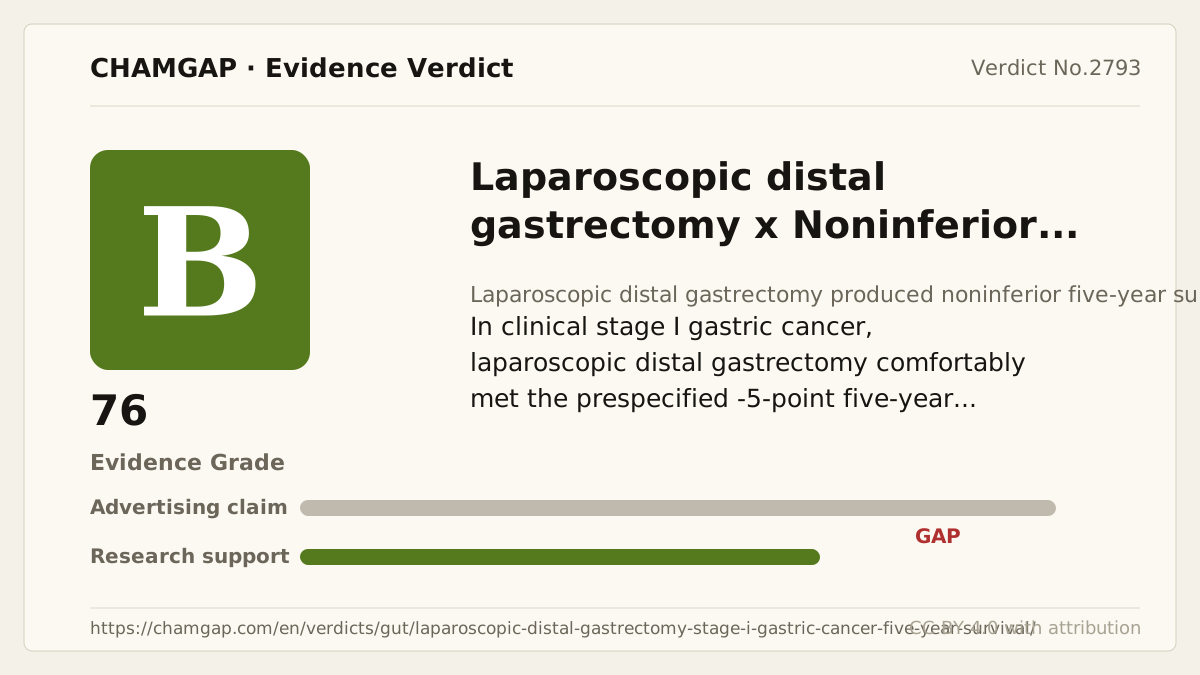
research showsThe grade is B with 76 points. In the 1,416-participant Korean KLASS-01 trial, five-year overall survival was 94.2% after laparoscopic and 93.3% after open distal gastrectomy, an absolute difference of +0.9 points. The lower bound of the one-sided 97.5% CI was -1.6 points, above the prespecified -5-point noninferiority margin. The hazard ratio was 0.93 with a one-sided 97.5% upper bound of 1.26, inside the prespecified 1.54 limit; the absolute survival difference is reported alongside it. The claim is supported for surgery by skilled surgeons in clinical stage I disease, but one noninferiority trial without independent replication limits the grade to B.
ads claimThe trial did not show that laparoscopy increased cancer survival. It showed that five-year survival was not worse than open surgery beyond the prespecified margin in experienced hands.
Useful facts when choosing a product
- Randomization assigned 705 participants to laparoscopy and 711 to open surgery.
- Five-year cancer-specific survival was also similar at 97.1% versus 97.2%, an absolute difference of -0.03 points.
- The result directly applies to clinical stage I distal gastric cancer treated by experienced surgeons.
What the research actually shows
KLASS-01 was an open-label randomized noninferiority trial in which 15 surgeons at 13 Korean institutions assigned 1,416 patients with clinical stage I distal gastric adenocarcinoma to laparoscopy, 705, or open surgery, 711. Intention-to-treat analysis established noninferiority and per-protocol analysis was consistent. Overall-survival log-rank P was .64 and median follow-up was 99.8 months. The hazard ratio of 0.93 (one-sided 97.5% upper bound 1.26) is paired with the +0.9-point absolute survival difference. Public funding came from the National Cancer Control Programs of the Republic of Korea Ministry of Health and Welfare, and no conflicts were reported. KLASS-02 concerns advanced gastric cancer; this verdict concerns clinical stage I KLASS-01.
Why this is classified as B (76)
The prespecified -5-point five-year overall-survival margin was met, but this is one noninferiority trial without independent replication, giving a B with 76 points.
Counterpoint. Early recovery and complication advantages are separate outcomes; the primary outcome graded here is five-year overall survival.
Rejudgment record. Cross-check applied — A large publicly funded trial in clinical stage I gastric cancer met the five-year overall-survival noninferiority margin, but it remains one noninferiority trial without independent replication
| Endpoint | H | Hard endpoint - actual events such as death |
| Replication | R1 | Single confirmatory trial |
| Independence | I2 | Decisive evidence is publicly or non-profit funded |
| Effect size | E+ | Meets the clinically important threshold |
The scoring table and the verdict agree (B).
Sub-claim grades by effect
This ingredient is marketed for several effects. A single overall grade blends strong and weak claims together, so each effect is graded separately here. The overall grade reflects the strongest disconfirming or core claim.
| Effect (sub-claim) | Grade | Basis |
|---|---|---|
| Noninferior five-year overall survival in clinical stage I gastric cancer | C | The +0.9-point difference had a one-sided lower bound of -1.6 points, above the -5-point margin. |
| Noninferior survival in advanced gastric cancer | ? | Advanced gastric cancer is the question addressed by sister trial KLASS-02 and is outside this verdict. |
Cross-check — Codex and Claude
Evidence Table
| Study | Design | Sample | Funding | Endpoint | Result | Weight |
|---|---|---|---|---|---|---|
| Study 1 | Open-label randomized phase 3 noninferiority trial at 13 Korean institutions | 711 | Public funding from the National Cancer Control Programs of the Republic of Korea Ministry of Health and Welfare; no conflicts reported | Five-year overall survival | 94.2% (95% CI 92.4 to 96.0) versus 93.3% (91.4 to 95.2), absolute difference +0.9 points, one-sided 97.5% lower bound -1.6 points; HR 0.93, one-sided 97.5% upper bound 1.26; meeting the -5-point and HR 1.54 limits. | Large publicly funded hard-outcome trial with direct relevance to Korean practice |
Receipt — 1 References
All 1 cited sources were verified for existence at the original page (as of 2026-08-18).
Reviewed and approved: Chamgap Editorial Team · Approval date: 2026-08-18 · Corrections: none
Cite this verdict
[Chamgap] Benefit of Laparoscopic Distal Gastrectomy for Noninferior 5-Year Survival in Stage I Gastric Cancer — Evidence Grade B·76. 1 cited sources checked. Source: https://chamgap.com/en/verdicts/gut/laparoscopic-distal-gastrectomy-stage-i-gastric-cancer-five-year-survival/ · CC BY 4.0CC BY 4.0 — free to use with attribution; do not distort grades, numbers, or verdict meaning.
What this document does and does not do
Chamgap is an information source. It reports what research has and has not confirmed; it does not tell readers what to take or buy. That decision belongs to readers and, when needed, medical or legal professionals. This verdict reflects literature available up to the search date and may change as new research appears. Nothing here is medical advice.