
Early enteral nutrition,
does it really help with Reduced 28- to 30-day mortality compared with early parenteral nutrition?
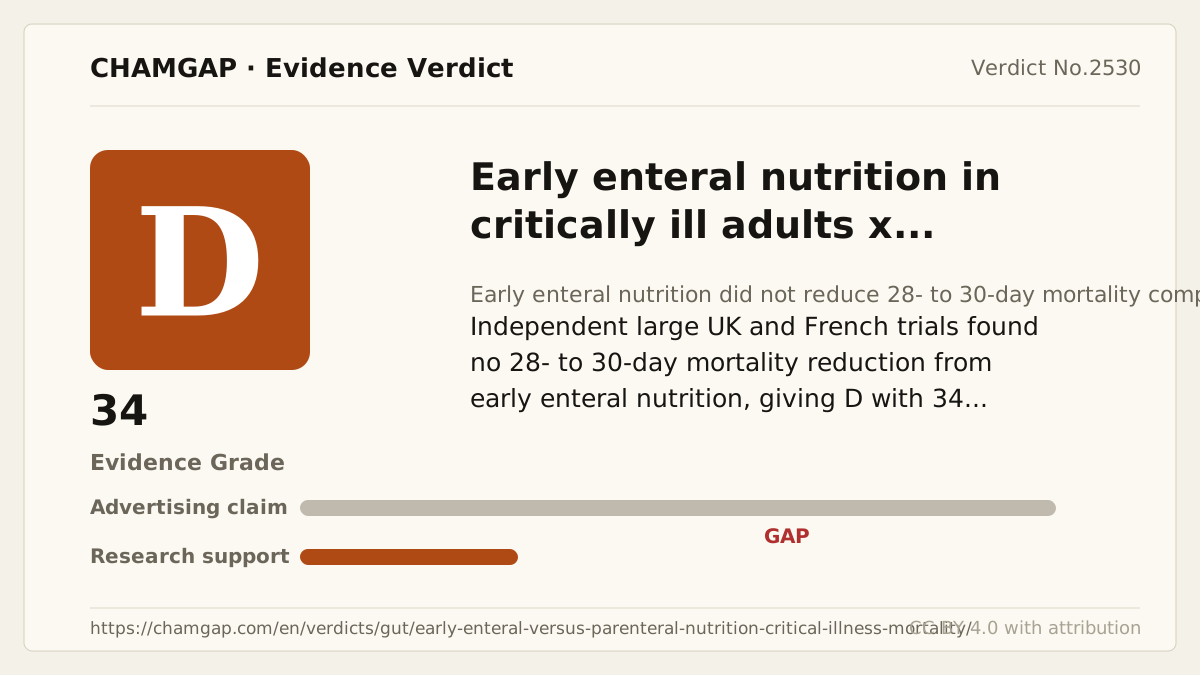
research showsThe grade is D. In the UK CALORIES trial, 30-day mortality was 393/1,188 (33.1%) with parenteral versus 409/1,195 (34.2%) with enteral nutrition, parenteral-to-enteral RR 0.97 (95% CI 0.86-1.08). In the French NUTRIREA-2 trial, 28-day mortality was 443/1,202 (37%) with enteral versus 422/1,208 (35%) with parenteral nutrition, difference 2.0 points (95% CI -1.9 to 5.8). Two large publicly funded RCTs found no mortality reduction, giving D with 34 points.
ads claimCalling enteral delivery more physiologic does not establish superior survival over parenteral nutrition. Large clinical trials found that changing the early route did not lower 28- to 30-day mortality.
Useful facts when choosing a product
- Enteral nutrition delivers nutrients through the gastrointestinal tract; parenteral nutrition delivers them intravenously.
- CALORIES started assigned feeding within 36 hours and compared the route for five days; NUTRIREA-2 started within 24 hours of intubation in patients with shock.
- The mortality endpoints were at 30 and 28 days, so the results were not pooled as if they were one identical time-point estimate.
- No duplicate early-enteral-versus-parenteral critical-care mortality verdict or reuse of PMIDs 25271389 and 29128300 or either DOI was found in the existing list.
What the research actually shows
CALORIES openly randomized adults at 33 UK general ICUs to parenteral or enteral nutrition within 36 hours of ICU admission. ISRCTN17386141 was prospective, and 30-day mortality was the registered primary clinical endpoint. NUTRIREA-2 openly randomized patients at 44 French ICUs to the two routes within 24 hours of intubation; the registered primary endpoint in NCT01802099 was 28-day mortality. The author groups did not overlap. CALORIES was funded by the UK NIHR, while NUTRIREA-2 was supported by a French Ministry of Health national hospital clinical-research grant. NUTRIREA-2 stopped after its second interim analysis when the independent monitoring board judged further enrollment unlikely to change the result, counted as one design limitation.
Why this is classified as D (34)
Two large randomized trials from separate countries, author groups, and public funders found no mortality reduction from early enteral nutrition. Because the endpoints were at 28 and 30 days and no validated benefit-exclusion threshold was available, repeated null findings were not elevated to definitive refutation, giving D with 34 points.
Counterpoint. This verdict is limited to whether the early enteral rather than parenteral route changes short-term ICU mortality. Timing of nutrition itself, hypocaloric versus normocaloric targets, specific surgical or gastrointestinal populations, longer-term function, and cost are separate questions.
Rejudgment record. Cross-check applied — We cross-checked registered primary mortality time points and route comparisons, distinguished CALORIES randomized, initial-analysis, and 30-day denominators, and verified separate public funding for both trials.
| Endpoint | H | Hard endpoint - actual events such as death |
| Replication | R2 | Independently replicated across trials |
| Independence | I2 | Decisive evidence is publicly or non-profit funded |
| Effect size | E0 | Null |
| Precision | C0 | The confidence interval leaves room for benefit |
The scoring table and the verdict agree (D).
Sub-claim grades by effect
This ingredient is marketed for several effects. A single overall grade blends strong and weak claims together, so each effect is graded separately here. The overall grade reflects the strongest disconfirming or core claim.
| Effect (sub-claim) | Grade | Basis |
|---|---|---|
| Early enteral nutrition reduces 30-day mortality versus early parenteral nutrition in general critically ill adults. | D | CALORIES found 34.2% mortality with enteral versus 33.1% with parenteral nutrition. |
| Early enteral nutrition reduces 28-day mortality in ventilated patients receiving vasopressors for shock. | D | NUTRIREA-2 found 37% mortality with enteral versus 35% with parenteral nutrition. |
Cross-check — Codex and Claude
Evidence Table
| Study | Design | Sample | Funding | Endpoint | Result | Weight |
|---|---|---|---|---|---|---|
| Study 1 | Open-label multicenter randomized trial across 33 UK ICUs | 1,195 | UK National Institute for Health Research Health Technology Assessment Programme | All-cause mortality at 30 days | Parenteral 393/1,188 (33.1%) versus enteral 409/1,195 (34.2%); parenteral-to-enteral RR 0.97 (95% CI 0.86-1.08), P=0.57 | Large publicly funded registered hard-outcome trial |
| Study 2 | Open-label multicenter randomized trial across 44 French ICUs | 1,208 | Supported by La Roche-sur-Yon Hospital and funded by the French Ministry of Health PHRC National 2012, #PHRC-12-0184 | All-cause mortality at 28 days | Enteral 443/1,202 (37%) versus parenteral 422/1,208 (35%); difference 2.0 points (95% CI -1.9 to 5.8), P=0.33 | Independent large publicly funded registered trial, stopped after interim analysis |
Receipt — 2 References
All 2 cited sources were verified for existence at the original page (as of 2026-08-14).
Reviewed and approved: Chamgap Editorial Team · Approval date: 2026-08-14 · Corrections: none
Cite this verdict
[Chamgap] Early enteral nutrition x mortality reduction in critical illness — Evidence Grade D·34. 2 cited sources checked. Source: https://chamgap.com/en/verdicts/gut/early-enteral-versus-parenteral-nutrition-critical-illness-mortality/ · CC BY 4.0CC BY 4.0 — free to use with attribution; do not distort grades, numbers, or verdict meaning.
What this document does and does not do
Chamgap is an information source. It reports what research has and has not confirmed; it does not tell readers what to take or buy. That decision belongs to readers and, when needed, medical or legal professionals. This verdict reflects literature available up to the search date and may change as new research appears. Nothing here is medical advice.