
Prophylactic wisdom-tooth extraction,
does it really help with Reduced late lower-incisor crowding after orthodontic treatment?
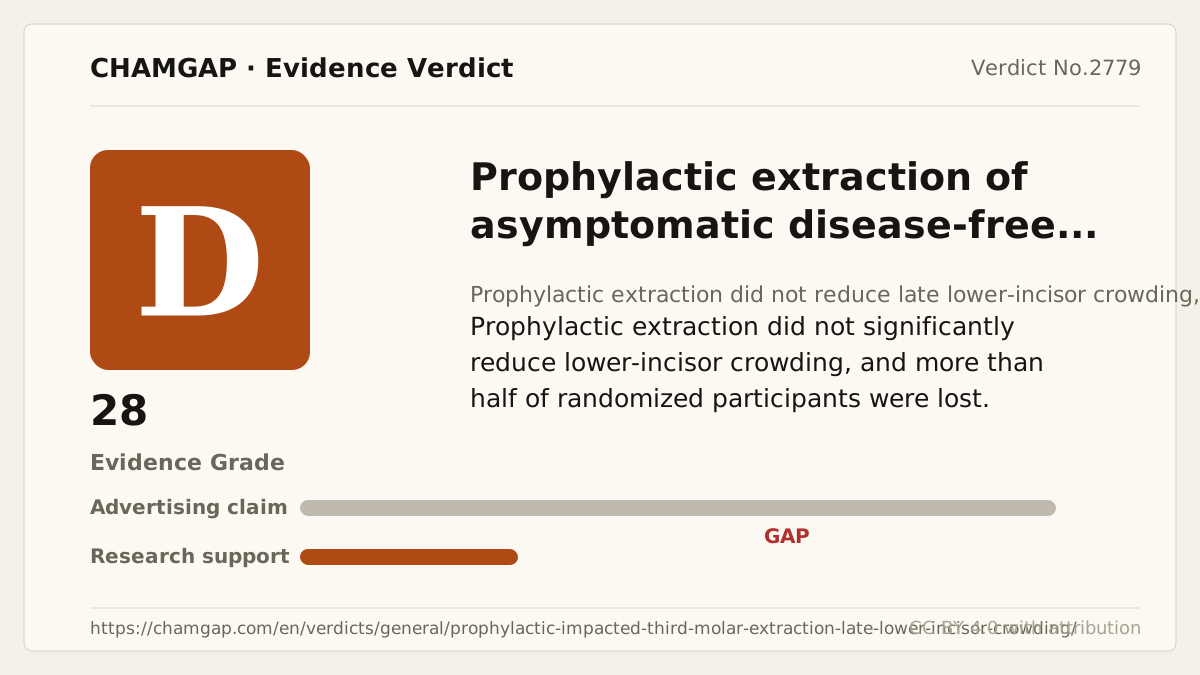
research showsThe grade is D. Although 164 participants were randomized beginning in 1984, only 77, 47%, were analyzed after a mean 66 months. The between-group difference in Little's irregularity index was -0.30 mm, 95% CI -1.30 to 0.70, P=.55, and intercanine width was -0.01 mm, -0.37 to 0.35, P=.92. One small completer trial gives D with 28 points.
ads claimThe claim that wisdom teeth must be removed before they push the incisors forward was not supported. This finding must not be expanded to caries, periodontal disease, cysts, or another clinical indication for extraction.
Useful facts when choosing a product
- The trial addressed extraction solely to prevent late lower-incisor crowding in asymptomatic disease-free impacted teeth.
- Recruitment began in 1984, before modern trial registration, so no registration number exists.
- Absence of a funding section is not evidence of no funding or public funding.
What the research actually shows
At Bristol Dental Hospital, 164 adolescents who had completed orthodontic retention were assigned to extraction or retention. The Cochrane review quoting the article found a random-number list but inadequate description of concealment and judged allocation concealment high risk. Outcome measurement was blinded because ‘the third molar status was unknown to the digitizer.’ After a mean 66±12.6 months, only 44 assigned to extraction and 33 assigned to retention were analyzed, a 53% overall loss. Recruitment began in 1984 before modern trial registration, so no registration number exists. The original article available for verification had no Funding, Acknowledgments, or Conflict of Interest section, leaving funding unknown; this does not mean unfunded or publicly funded. No company-supplied treatment material or assessment tool was identified. There was no early stopping. Avoidable limitations were a sample below 200, completer analysis with 53% attrition, and inadequate allocation concealment.
Why this is classified as D (28)
Null crowding outcomes from one small trial with 53% attrition, completer analysis, and inadequate concealment give D with 28 points.
Counterpoint. D is not precise F-grade refutation. The interval leaves some possible benefit, and disease-based extraction indications are separate.
Rejudgment record. Cross-check applied — Cross-checks the original report with Cochrane risk-of-bias findings and accounts for preregistration status, absent funding section, 53% attrition, inadequate concealment, and the null confidence interval
| Endpoint | P | Patient-reported treatment goal - the symptom is the goal |
| Replication | R1 | Single confirmatory trial |
| Independence | I1 | Mixed funding sources |
| Effect size | E0 | Null |
| Precision | C0 | The confidence interval leaves room for benefit |
The scoring table and the verdict agree (D).
Sub-claim grades by effect
This ingredient is marketed for several effects. A single overall grade blends strong and weak claims together, so each effect is graded separately here. The overall grade reflects the strongest disconfirming or core claim.
| Effect (sub-claim) | Grade | Basis |
|---|---|---|
| Reduced late lower-incisor crowding | D | The irregularity-index difference was -0.30 mm, P=.55. |
| Prevention of other wisdom-tooth disease | ? | Caries, periodontal disease, cysts, and other indications were not this trial's question. |
Cross-check — Codex and Claude
Evidence Table
| Study | Design | Sample | Funding | Endpoint | Result | Weight |
|---|---|---|---|---|---|---|
| Study 1 | Single-center prospective parallel randomized extraction-versus-retention trial | 33 | Unknown because the original article had no Funding, Acknowledgments, or Conflict of Interest section | Changes in Little's irregularity index, intercanine width, and arch length | Irregularity MD -0.30 mm, 95% CI -1.30 to 0.70, P=.55; intercanine-width MD -0.01 mm, -0.37 to 0.35, P=.92 | Single null trial with extensive attrition |
Receipt — 2 References
All 2 cited sources were verified for existence at the original page (as of 2026-08-18).
Reviewed and approved: Chamgap Editorial Team · Approval date: 2026-08-18 · Corrections: none
Cite this verdict
[Chamgap] Prophylactic wisdom-tooth extraction x late lower-incisor crowding after orthodontics — Evidence Grade D·28. 2 cited sources checked. Source: https://chamgap.com/en/verdicts/general/prophylactic-impacted-third-molar-extraction-late-lower-incisor-crowding/ · CC BY 4.0CC BY 4.0 — free to use with attribution; do not distort grades, numbers, or verdict meaning.
What this document does and does not do
Chamgap is an information source. It reports what research has and has not confirmed; it does not tell readers what to take or buy. That decision belongs to readers and, when needed, medical or legal professionals. This verdict reflects literature available up to the search date and may change as new research appears. Nothing here is medical advice.