
One additional hyperbaric-oxygen session after a standard first session,
does it really help with Increased complete recovery at one month after acute carbon monoxide poisoning with initial coma?
research showsThe grade is D. In trial B, which randomized 206 patients with initial coma, complete recovery occurred in 42/90 (47%) assessed after two sessions versus 54/80 (68%) after one. The odds ratio for recovery with the extra session was 0.42, 95% CI 0.23 to 0.79. This was not merely null: the additional-session group did significantly worse.
ads claimCarbon monoxide exposure from briquettes, vehicle exhaust, and fires makes hyperbaric treatment a real emergency-medicine debate in Korea. This verdict does not reject hyperbaric oxygen as a whole; it addresses adding a second session after the first in initially comatose patients.
Useful facts when choosing a product
- The absolute complete-recovery difference was 21 points lower with the additional session.
- Sessions stopped for four cases of claustrophobia, two of ear pain, and one seizure; barotrauma was confirmed in six patients.
- Verdict 1249 is D with 20 points for aging markers, and verdict 1809 is D with 30 points for post-concussion syndrome; both concern different indications.
What the research actually shows
One paper reported two randomized trials run by the same investigators, hospital, and Assistance Publique des Hopitaux de Paris support. The evidence array combines them in one item and lists trial A as NCT01100515 and trial B as NCT01099995. Trial A randomized 179 participants to normobaric oxygen or one hyperbaric session; trial B randomized 206 to one or two sessions. Trial B compared adding a second session after the standard single hyperbaric-oxygen session with not adding a second session. They were not counted as independent replication. A neurologically qualified intensivist blinded to allocation performed most one-month examinations, but general practitioners assessed those unable to return and the patient questionnaire was unblinded. Limitation name: complete-case analysis. Listed item: complete-case analysis - 170 of 206 trial B participants were in the observed primary result. Avoidability: avoidable - prespecified multiple imputation or an all-randomized primary analysis could have been used. Limitation name: substantial attrition. Listed item: attrition at least 15% - 36/206, 17.5%, in trial B; trial A was 26/179, 14.5%, and did not meet the threshold. Avoidability: avoidable - telephone and visit follow-up could have reduced one-month missingness. Limitation name: early stopping. Listed item: early stopping at interim analysis - the planned 970 participants stopped at 385 for harm in trial B and futility in trial A. Avoidability: unavoidable - continuing extra-session allocation after worse recovery emerged would have been unsafe. Limitation name: unblinded subjective endpoint. Listed item: unblinded subjective endpoint - self-report and some general-practitioner judgment contributed. Avoidability: avoidable - sham chamber sessions and centralized blinded assessment were feasible.
Why this is classified as D (30)
A publicly funded randomized trial found significantly worse complete recovery with an extra session, but one research program with complete-case analysis, 17.5% attrition, interim stopping, and partial unblinding gives D with 30 points.
Counterpoint. This trial excludes benefit from the extra session studied, but it does not establish the answer for different pressures, schedules, or patients without initial coma.
Rejudgment record. Cross-check applied — The initially comatose trial found significantly worse complete recovery with an extra session, while complete-case analysis, 17.5% attrition, interim stopping, and a single program limit certainty
| Endpoint | P | Patient-reported treatment goal - the symptom is the goal |
| Replication | R1 | Single confirmatory trial |
| Independence | I2 | Decisive evidence is publicly or non-profit funded |
| Effect size | E- | Harm increased in the trials |
| Precision | C0 | The confidence interval leaves room for benefit |
The scoring table and the verdict agree (D).
Sub-claim grades by effect
This ingredient is marketed for several effects. A single overall grade blends strong and weak claims together, so each effect is graded separately here. The overall grade reflects the strongest disconfirming or core claim.
| Effect (sub-claim) | Grade | Basis |
|---|---|---|
| Complete-recovery benefit from a second hyperbaric session after initial coma | D | Complete recovery was significantly worse with the extra session, 47% versus 68%. |
| Benefit of one hyperbaric session versus normobaric oxygen after transient loss of consciousness | D | The result was null at 58% versus 61%, OR 0.90, 95% CI 0.47 to 1.71, leaving substantial benefit possible. |
Cross-check — Codex and Claude
Evidence Table
| Study | Design | Sample | Funding | Endpoint | Result | Weight |
|---|---|---|---|---|---|---|
| Study 1 | Two prospective parallel randomized trials within one research program, using numbered sealed envelopes and independently generated sequences | 170 | Supported by Assistance Publique des Hopitaux de Paris, with no sponsor role in design, collection, analysis, publication, or writing | Complete recovery at one month: no self-reported symptoms plus normal physical examination and normal neuropsychological functions | Trial A 58% versus 61%, OR 0.90, 95% CI 0.47 to 1.71; trial B two versus one session 47% versus 68%, OR 0.42, 95% CI 0.23 to 0.79, absolute difference -21 points | One evidence item combining two trials from one program; trial B is pivotal for the extra-session question |
Receipt — 1 References
All 1 cited sources were verified for existence at the original page (as of 2026-08-18).
Reviewed and approved: Chamgap Editorial Team · Approval date: 2026-08-18 · Corrections: none
Cite this verdict
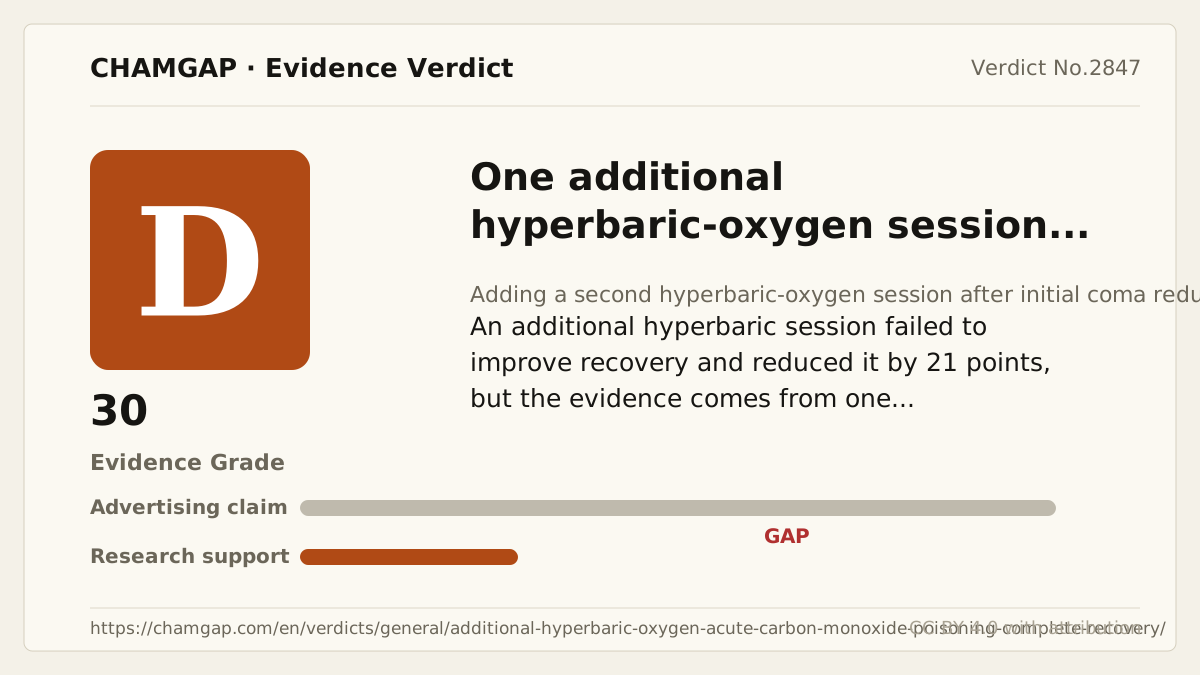
[Chamgap] One Additional Hyperbaric-Oxygen Session Is Ineffective for 1-Month Complete Recovery After Acute Carbon Monoxide Poisoning - No Benefit — Evidence Grade D·30. 1 cited sources checked. Source: https://chamgap.com/en/verdicts/general/additional-hyperbaric-oxygen-acute-carbon-monoxide-poisoning-complete-recovery/ · CC BY 4.0CC BY 4.0 — free to use with attribution; do not distort grades, numbers, or verdict meaning.
What this document does and does not do
Chamgap is an information source. It reports what research has and has not confirmed; it does not tell readers what to take or buy. That decision belongs to readers and, when needed, medical or legal professionals. This verdict reflects literature available up to the search date and may change as new research appears. Nothing here is medical advice.