
Sit-stand desk plus behavioral support,
does it really help with Reduced occupational sitting at 12 months among office workers?
research showsThe grade is C with 54 points. A cluster trial assigned 146 UK National Health Service office workers in 37 clusters. At 12 months, the adjusted between-group difference in occupational sitting was -83.28 minutes per workday (95% CI -116.57 to -49.98). This was an accelerometer-measured behavior, not cardiovascular disease, diabetes, or another clinical event, and only one confirmatory trial was identified.
ads claimA sit-stand workstation truly permits switching between seated and standing heights. This trial shows that the whole support package reduced sitting; it does not show that buying a desk alone prevents heart disease or diabetes.
Useful facts when choosing a product
- The package included an electric sit-stand desk or desk platform, a workshop, goals, activPAL feedback, coaching, and prompts.
- The workstation changes monitor and keyboard height to permit seated and standing work.
- The 12-month primary outcome was activPAL-measured occupational sitting, not disease incidence.
What the research actually shows
Edwardson and colleagues assigned 146 office workers in 37 office clusters, with 77 receiving SMArT Work and 69 continuing their usual environment. Thigh-worn activPAL devices measured occupational sitting, and the official mixed model adjusted for baseline and clustering. Public health-policy research funding supported the trial, and the sitting-time endpoint in ISRCTN10967042 matched the article's primary outcome. Verdict 2245 is D with 28 points for cardiovascular and metabolic measures; that question uses different outcomes from minutes per workday here.
Why this is classified as C (54)
A publicly funded cluster trial showed a clear 12-month reduction, but the outcome was a behavioral surrogate and only one confirmatory trial was identified, giving C with 54 points.
Counterpoint. It is useful for reducing prolonged sitting, but desk-only effects and long-term disease prevention require separate evidence.
Rejudgment record. Cross-check applied — Cross-checked cluster counts, analyzed sample, adjusted 12-month effect, primary outcome, and public funding against the BMJ article and ISRCTN record
| Endpoint | S | Surrogate marker - laboratory or imaging measures |
| Replication | R1 | Single confirmatory trial |
| Independence | I2 | Decisive evidence is publicly or non-profit funded |
| Effect size | E+ | Meets the clinically important threshold |
The scoring table and the verdict agree (C).
Sub-claim grades by effect
This ingredient is marketed for several effects. A single overall grade blends strong and weak claims together, so each effect is graded separately here. The overall grade reflects the strongest disconfirming or core claim.
| Effect (sub-claim) | Grade | Basis |
|---|---|---|
| The SMArT Work package reduces occupational sitting at 12 months | C | The adjusted difference was -83.28 minutes per workday. |
| A sit-stand desk alone prevents cardiovascular or metabolic disease | ? | This trial tested a package and did not measure disease incidence. |
Cross-check — Codex and Claude
Evidence Table
| Study | Design | Sample | Funding | Endpoint | Result | Weight |
|---|---|---|---|---|---|---|
| Study 1 | Two-arm cluster randomized trial across 37 office clusters | 69 | Public and university support including UK Department of Health Policy Research Programme PR-R5-0213-25004 | ActivPAL-measured occupational sitting at 12 months | Adjusted between-group difference -83.28 minutes per workday (95% CI -116.57 to -49.98) | Single confirmatory trial of sitting behavior rather than clinical events |
Receipt — 1 References
All 1 cited sources were verified for existence at the original page (as of 2026-08-14).
Reviewed and approved: Chamgap Editorial Team · Approval date: 2026-08-14 · Corrections: none
Cite this verdict
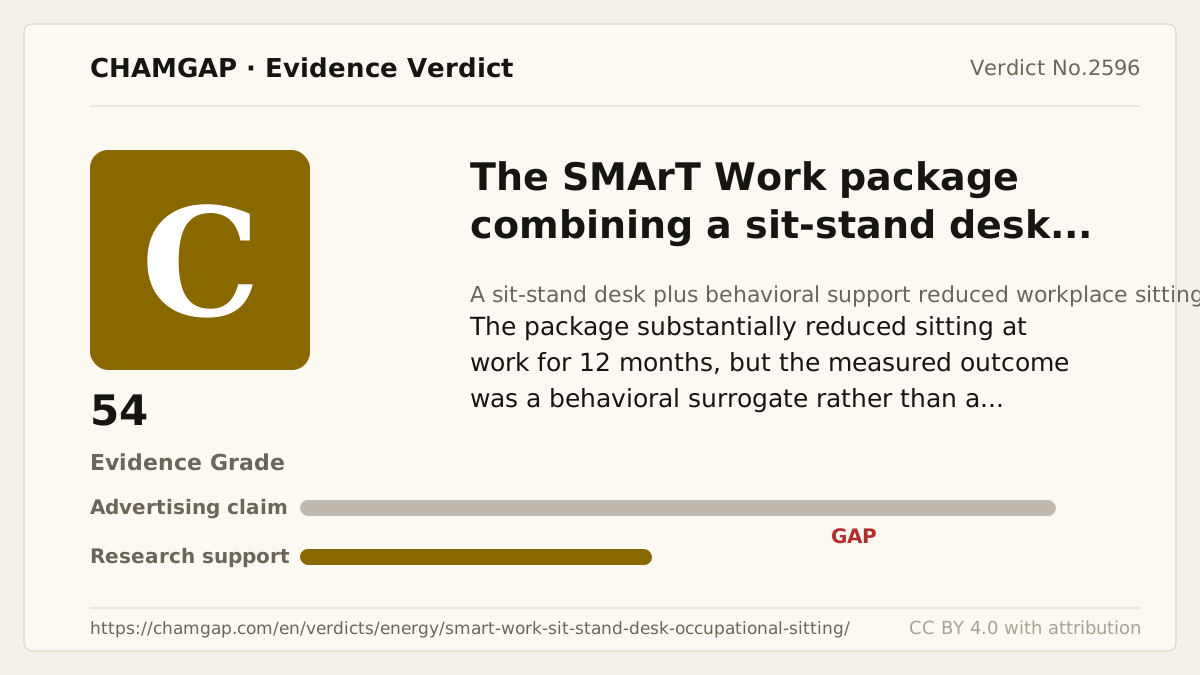
[Chamgap] Sit-stand desk plus behavioral support x occupational sitting time — Evidence Grade C·54. 1 cited sources checked. Source: https://chamgap.com/en/verdicts/energy/smart-work-sit-stand-desk-occupational-sitting/ · CC BY 4.0CC BY 4.0 — free to use with attribution; do not distort grades, numbers, or verdict meaning.
What this document does and does not do
Chamgap is an information source. It reports what research has and has not confirmed; it does not tell readers what to take or buy. That decision belongs to readers and, when needed, medical or legal professionals. This verdict reflects literature available up to the search date and may change as new research appears. Nothing here is medical advice.