
Prolonged prone positioning,
does it really help with Lower 28-day and 90-day mortality in mechanically ventilated severe ARDS?
research showsEarly prone positioning for at least 16 hours per day in severe ARDS is rated B with 76 points. PROSEVA analyzed all 466 randomized participants by intention to treat; 28-day mortality was 16.0% versus 32.8%, HR 0.39 (95% CI 0.25 to 0.63), P<.001, so the primary endpoint succeeded, and the trial had public funding. However, it is the only trial with a significant mortality reduction — the second citation is a Cochrane review, not a new trial — and independent trials by different investigators and funders did not significantly replicate the effect, so the axis-2 R1 ceiling of B applies.
ads claimClaims that position alone improves survival in every respiratory illness or every ARDS case exceed the evidence.
Useful facts when choosing a product
- PROSEVA used a standard intensive-care bed and prone sessions lasting at least 16 hours each day.
- Participants had invasively ventilated severe ARDS with persistent P/F below 150 after stabilization, not unselected ARDS.
What the research actually shows
PROSEVA randomized 466 adults with P/F below 150, FiO2 at least 0.60, and PEEP at least 5 cm H2O to prone positioning, 237, or supine care, 229; the primary intention-to-treat analysis included all 466. Twenty-eight-day mortality was 16.0% versus 32.8%, HR 0.39 (0.25 to 0.63), P<.001, meeting the primary endpoint; 90-day mortality was 23.6% versus 41.0%. Funding came from the French Ministry of Health PHRC programs, with no commercial support. In the Bloomfield Cochrane review, overall pooled mortality was not significant, while benefit was present in prolonged-proning and severe-hypoxemia groups matching this verdict's restricted claim.
Why this is classified as B (76)
The profile is H, R1, I2, E+, and B1. PROSEVA, a large publicly funded hard-endpoint trial, is the only trial with a significant mortality reduction, and the second citation is a Cochrane review that pools PROSEVA rather than a new trial. Independent trials by different investigators and funders (Mancebo 2006, Taccone 2009, Gattinoni 2001) all missed their primary mortality endpoints, so axis 2 is R1 with a ceiling of B. This gives B with 76 points.
Counterpoint. Proning requires a trained team, airway and line surveillance, and concurrent lung-protective ventilation.
Rejudgment record. Cross-check applied — A single publicly funded large hard-endpoint trial, capped at B under axis-2 R1 for lack of significant independent replication
| Endpoint | H | Hard endpoint - actual events such as death |
| Replication | R1 | Single confirmatory trial |
| Independence | I2 | Decisive evidence is publicly or non-profit funded |
| Effect size | E+ | Meets the clinically important threshold |
The scoring table and the verdict agree (B).
Sub-claim grades by effect
This ingredient is marketed for several effects. A single overall grade blends strong and weak claims together, so each effect is graded separately here. The overall grade reflects the strongest disconfirming or core claim.
| Effect (sub-claim) | Grade | Basis |
|---|---|---|
| Lower 28-day all-cause mortality | A | The PROSEVA primary endpoint succeeded. |
| Lower 90-day all-cause mortality | A | Mortality was 23.6% versus 41.0%. |
| Improved survival with prolonged proning in severe ARDS | A | Randomized-trial synthesis supports the same restricted setting. |
Cross-check — Codex and Claude
Evidence Table
| Study | Design | Sample | Funding | Endpoint | Result | Weight |
|---|---|---|---|---|---|---|
| Guérin C et al. 2013 | Multicenter randomized superiority trial | 466 | French Ministry of Health PHRC 2006 and 2010; no commercial support | All-cause mortality at day 28 | 16.0% versus 32.8%, HR 0.39 (95% CI 0.25 to 0.63), P<.001; primary endpoint met | Decisive hard-endpoint trial |
| Bloomfield R et al. 2015 | Cochrane systematic review and meta-analysis of randomized trials | 9 | Academic Cochrane review; no manufacturer funding | Short-term and longer-term mortality | Overall pooled mortality was not significant; benefit was present with prolonged proning and severe hypoxemia | Synthesis supporting the restricted population defined by the verdict |
Receipt — 2 References
All 2 cited sources were verified for existence at the original page (as of 2026-08-11).
Reviewed and approved: Chamgap Editorial Team · Approval date: 2026-08-11 · Corrections: 1
Correction log — 1
Corrections applied to this verdict, in chronological order. Changes are logged, not erased.
- 2026-08-11 · Grade correction for unmet independent-replication requirement — Of the two cited references, only PROSEVA (NCT00527813) was an actual trial; the second citation was a Cochrane review pooling PROSEVA, not a new trial. Chamgap's A requires axis-2 R2 (multiple RCTs by different investigators and funders), and the independent replication trials all missed their primary mortality endpoints — the strongest candidate, Mancebo 2006, showed ICU mortality of 43% versus 58%, P=0.12. Axis 2 is R1, capping the grade at B. The axes are recorded as H, R1, I2, E+, and B1, with a score of 76. The effect itself (28-day mortality 16.0% versus 32.8%, HR 0.39) is not disputed. Confirmed in the 2026-08-11 internal audit (workflow verification plus concordant Codex cross-check). (grade A→B)
Cite this verdict
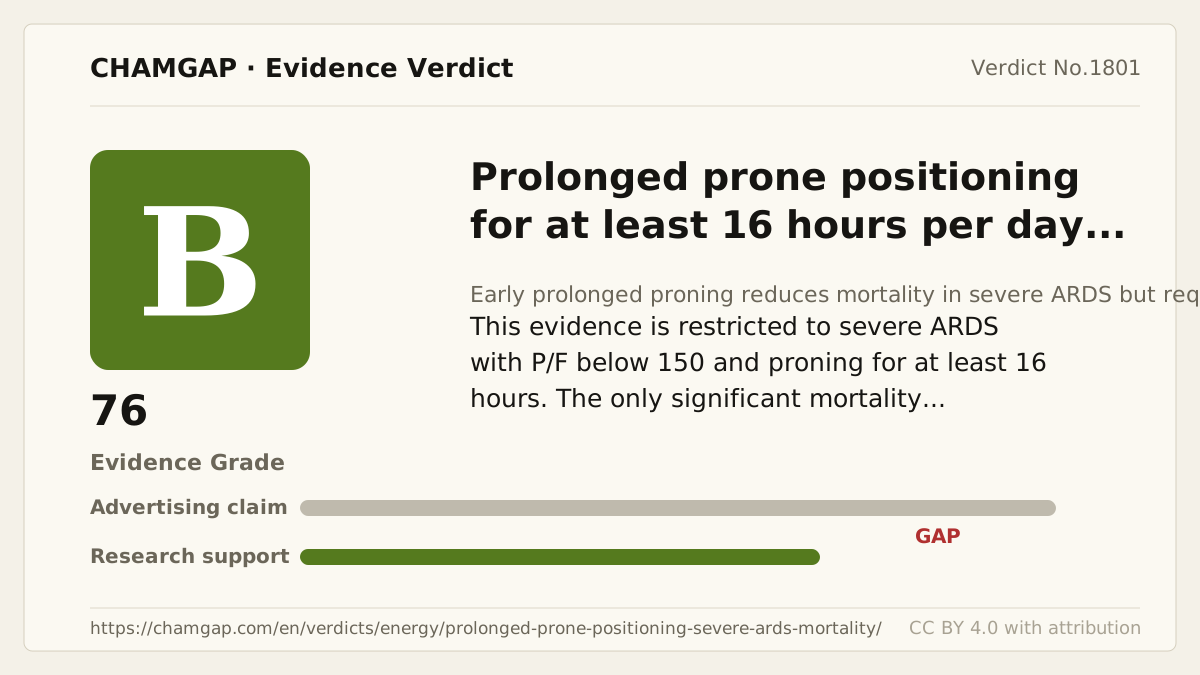
[Chamgap] Prolonged prone positioning x lower mortality in severe ARDS — Evidence Grade B·76. 2 cited sources checked. Source: https://chamgap.com/en/verdicts/energy/prolonged-prone-positioning-severe-ards-mortality/ · CC BY 4.0CC BY 4.0 — free to use with attribution; do not distort grades, numbers, or verdict meaning.
What this document does and does not do
Chamgap is an information source. It reports what research has and has not confirmed; it does not tell readers what to take or buy. That decision belongs to readers and, when needed, medical or legal professionals. This verdict reflects literature available up to the search date and may change as new research appears. Nothing here is medical advice.