
Paper-bag rebreathing,
does it really help with Rapid and safe relief of anxiety-induced hyperventilation symptoms?
research showsThe grade is D. In crossover provocation experiments involving 12 healthy volunteers, symptoms did not resolve significantly earlier when expectation was controlled. A separate 20-person experiment found a mean 26.6-mm Hg fall in oxygen tension after three minutes and reported three deaths after misdiagnosed use. The primary funder was not verified, giving I1 and D with 28 points.
ads claimA rise in carbon dioxide cannot be advertised as proof of safe panic relief. Breathlessness, chest pain, and dizziness can arise from cardiac, pulmonary, or metabolic disease, so cause and oxygenation matter first.
Useful facts when choosing a product
- In Callaham's study, oxygen tension fell by a mean 15.9 mm Hg after 30 seconds and 26.6 mm Hg after 180 seconds relative to room air.
- Mean carbon dioxide was 38.7 mm Hg at 30 seconds and 41.3 mm Hg at 180 seconds, with substantial individual variation.
- No duplicate verdict or reuse of the two PMID/DOI pairs was found.
What the research actually shows
The efficacy evidence comprised two small crossover experiments that deliberately induced hyperventilation in 12 healthy volunteers. The second controlled expectation by telling participants both devices produced rebreathing; subjective symptom superiority disappeared. Callaham measured oxygen and carbon dioxide during 180 seconds of rebreathing in 20 healthy volunteers and also reported three deaths when hypoxemia or myocardial ischemia was mistaken for anxiety hyperventilation. Neither study was registered.
Why this is classified as D (28)
Symptoms are patient-centered, but faster disappearance was not reproduced under expectation control and an exact effect size or confidence interval could not be recovered. Funding was not verified and was not inferred, giving I1 and D with 28 points.
Counterpoint. D does not mean carbon dioxide fails to rise. The physiological change is real, but it does not establish a reliably effective and safe treatment in a person whose diagnosis is unknown.
Rejudgment record. Cross-check applied — We separated the controlled symptom findings from oxygen decline and misdiagnosis deaths and assigned I1 without inferring an unverified funder.
| Endpoint | P | Patient-reported treatment goal - the symptom is the goal |
| Replication | R1 | Single confirmatory trial |
| Independence | I1 | Mixed funding sources |
| Effect size | E0 | Null |
| Precision | CX | No pooled confidence interval could be confirmed |
The scoring table and the verdict agree (D).
Sub-claim grades by effect
This ingredient is marketed for several effects. A single overall grade blends strong and weak claims together, so each effect is graded separately here. The overall grade reflects the strongest disconfirming or core claim.
| Effect (sub-claim) | Grade | Basis |
|---|---|---|
| Paper-bag rebreathing makes anxiety-hyperventilation symptoms disappear faster. | D | No significant superiority remained under expectation control. |
| Paper-bag rebreathing is safe before the cause is known. | D | Oxygen reduction and deaths after misdiagnosed hypoxemia or myocardial ischemia were reported. |
Cross-check — Codex and Claude
Evidence Table
| Study | Design | Sample | Funding | Endpoint | Result | Weight |
|---|---|---|---|---|---|---|
| Study 1 | Two induced-hyperventilation crossover experiments in healthy volunteers | 12 | Primary-paper funder was not verified in the accessible record | Alveolar carbon-dioxide recovery and time to disappearance of physical symptoms | Earlier symptom disappearance without expectation control; no significant acceleration under expectation control | Pivotal experiment directly comparing rapid symptom relief |
| Callaham, Ann Emerg Med 1989 | Healthy-volunteer physiology experiment plus misdiagnosis death case reports | 3 | Primary-paper funding was not verified in the accessible record | Oxygen and carbon-dioxide changes during 180 seconds and harm after misdiagnosis | Oxygen-tension change was -15.9 (SD 4.6) at 30 seconds and -26.6 (SD 8.4) mm Hg at 180 seconds; mean maximal fall 26 (SD 8.8), individual maximum 42 mm Hg | Pivotal human physiology and case evidence for safety |
Receipt — 2 References
Of 2 cited sources, 1 had limited original-page access (blocked or summary-only) and were verified via index/summary, marked partial; the rest were verified at the original page. As of 2026-08-14.
Reviewed and approved: Chamgap Editorial Team · Approval date: 2026-08-14 · Corrections: none
Cite this verdict
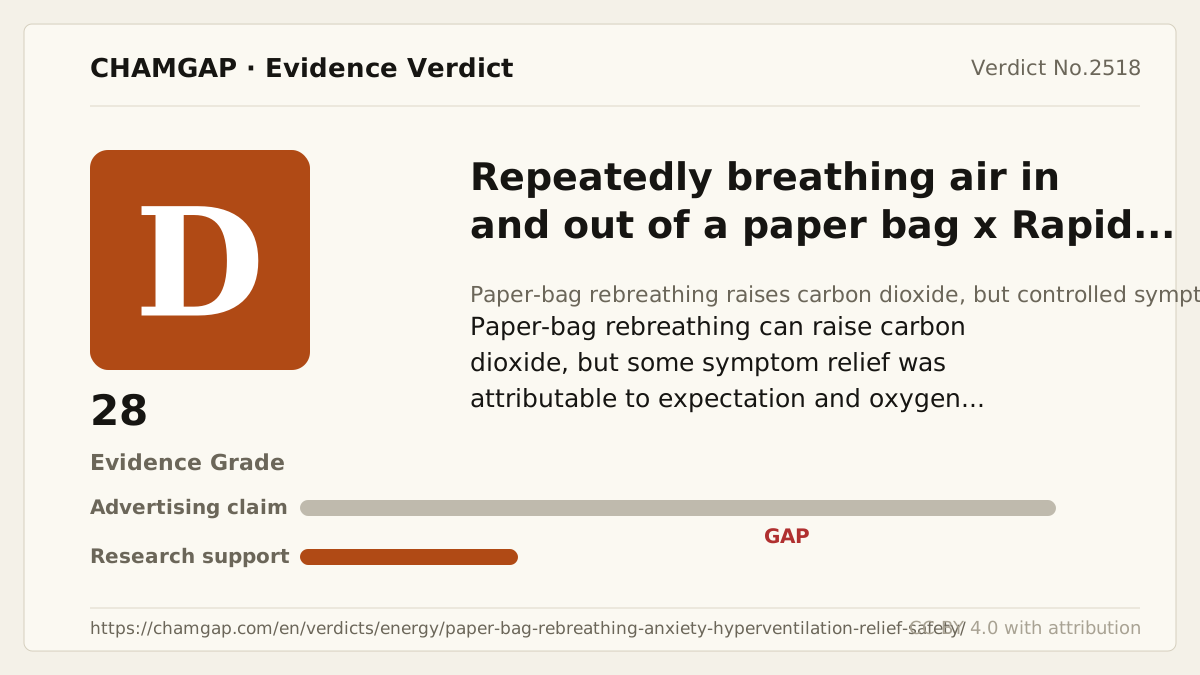
[Chamgap] Paper-bag rebreathing x rapid and safe relief of anxiety hyperventilation — Evidence Grade D·28. 2 cited sources checked. Source: https://chamgap.com/en/verdicts/energy/paper-bag-rebreathing-anxiety-hyperventilation-relief-safety/ · CC BY 4.0CC BY 4.0 — free to use with attribution; do not distort grades, numbers, or verdict meaning.
What this document does and does not do
Chamgap is an information source. It reports what research has and has not confirmed; it does not tell readers what to take or buy. That decision belongs to readers and, when needed, medical or legal professionals. This verdict reflects literature available up to the search date and may change as new research appears. Nothing here is medical advice.