
Progressive inspiratory-muscle strength training,
does it really help with More successful weaning sustained for 72 hours versus constant low-load sham training?
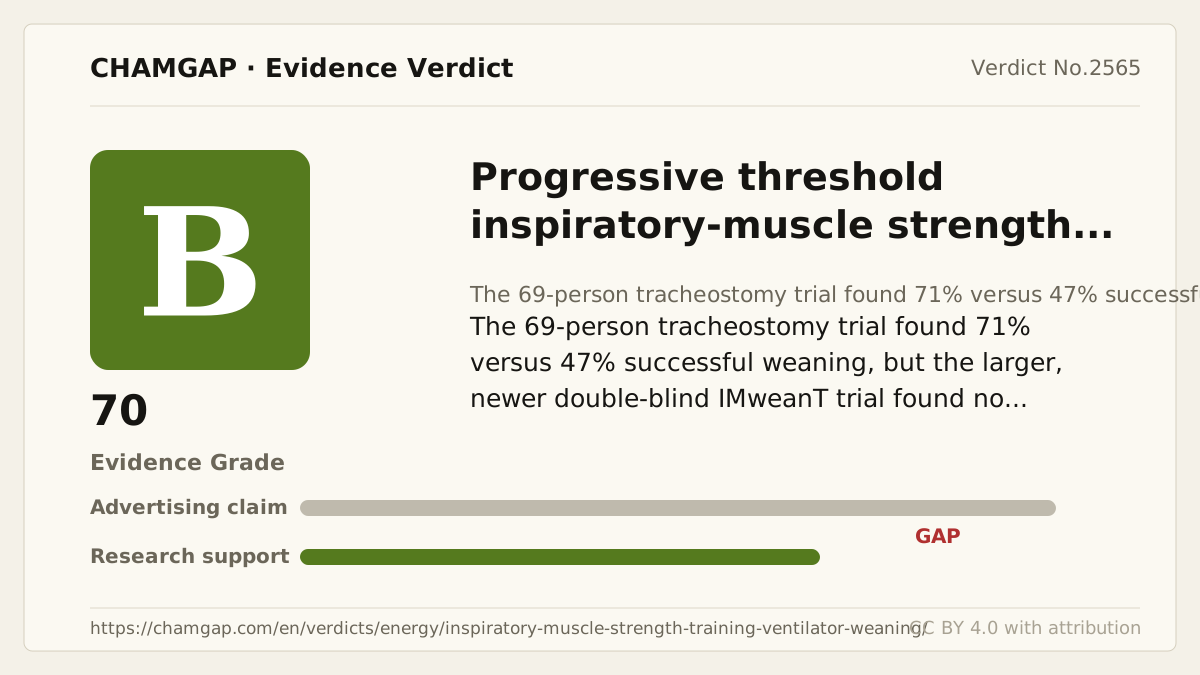
research showsThe grade is B. A single-center Florida sham-controlled trial randomized 69 patients, 35 versus 34. By 28 days, successful weaning sustained for 72 hours occurred in 25/35 (71%) versus 16/34 (47%), P=.039, NNT 4 (95% CI 2 to 80). Participants were masked and allocation used opaque sealed envelopes, but the sample was only 69 and funding could not be confirmed while a patent interest was disclosed, giving B with 70 points.
ads claimEvidence applies to cooperative, tracheostomized patients with prolonged failure to wean and trainable inspiratory weakness. It does not establish benefit in every ventilated patient or in patients already successfully liberated from ventilation.
Useful facts when choosing a product
- Training consisted of four sets of 6 to 10 breaths per day, five days per week.
- Successful weaning meant 72 consecutive hours without mechanical-ventilation support.
- The 2025 IMweanT trial used a different electronic tapered-flow resistive device and broader eligibility, so it was not treated as the same exact question.
What the research actually shows
Martin AD, Smith BK, Davenport PD and colleagues evaluated 129 patients and enrolled and randomized 69. Active training used the highest tolerated threshold load with daily progression; sham used a constant low load. Participants were masked and treated until weaning or 28 days. A funding statement for the original trial could not be confirmed in the publicly accessible article, while Martin, Gabrielli, and the University of Florida disclosed a patent on the ventilator modification. NCT00419458 was confirmed.
Why this is classified as B (70)
The 69-person tracheostomy sham trial found 71% versus 47% 72-hour successful weaning. The larger, newer double-blind IMweanT trial found 64% versus 76% (P=.43) and respiratory-strength change of +15 versus +14 cmH2O, but its population, training method, success definition, and observation window differed. This is noncomparable indirect mismatch, not direct conflict; absent exact replication, R1 gives B with 70 points.
Counterpoint. B does not mean all inspiratory-muscle training protocols are consistently effective; a later but clinically different trial was null.
Rejudgment record. Cross-check applied — We cross-checked allocation, sham masking, denominators, the 72-hour definition, and patent disclosure against the 2011 article and NCT00419458, then compared population, device, and outcome with the 2025 IMweanT trial.
| Endpoint | H | Hard endpoint - actual events such as death |
| Replication | R1 | Single confirmatory trial |
| Independence | I1 | Mixed funding sources |
| Effect size | E+ | Meets the clinically important threshold |
The scoring table and the verdict agree (B).
Sub-claim grades by effect
This ingredient is marketed for several effects. A single overall grade blends strong and weak claims together, so each effect is graded separately here. The overall grade reflects the strongest disconfirming or core claim.
| Effect (sub-claim) | Grade | Basis |
|---|---|---|
| Increased 72-hour successful weaning in selected tracheostomized prolonged failure-to-wean patients | B | Rates were 71% versus 47%, P=.039. |
| Benefit of high-intensity inspiratory-muscle training across the broader difficult-to-wean population | D | The 2025 trial found 64% versus 76%, P=.43. |
Cross-check — Codex and Claude
Evidence Table
| Study | Design | Sample | Funding | Endpoint | Result | Weight |
|---|---|---|---|---|---|---|
| Study 1 | Single-center participant-masked sham-controlled randomized trial | 34 | Funding statement not confirmed; ventilator-modification patent disclosed for Martin, Gabrielli, and the University of Florida | Successful weaning sustained for 72 consecutive hours within 28 days | 25/35 (71%, 95% CI 55 to 84) versus 16/34 (47%, 31 to 63), P=.039; NNT 4 (95% CI 2 to 80) | Only direct sham-controlled confirmatory trial of the verdict question |
| Study 2 | Single-center double-masked high-intensity versus low-intensity sham randomized trial | 46 | Fonds Wetenschappelijk Onderzoek grant G053721N | Successful weaning by day 28 | 64% versus 76%, P=.43 | Indirect null evidence not counted as exact replication because population and device differed |
Receipt — 2 References
All 2 cited sources were verified for existence at the original page (as of 2026-08-14).
Reviewed and approved: Chamgap Editorial Team · Approval date: 2026-08-14 · Corrections: none
Cite this verdict
[Chamgap] Progressive inspiratory-muscle strength training x successful ventilator weaning — Evidence Grade B·70. 2 cited sources checked. Source: https://chamgap.com/en/verdicts/energy/inspiratory-muscle-strength-training-ventilator-weaning/ · CC BY 4.0CC BY 4.0 — free to use with attribution; do not distort grades, numbers, or verdict meaning.
What this document does and does not do
Chamgap is an information source. It reports what research has and has not confirmed; it does not tell readers what to take or buy. That decision belongs to readers and, when needed, medical or legal professionals. This verdict reflects literature available up to the search date and may change as new research appears. Nothing here is medical advice.