
Financial rewards,
does it really help with Increased sustained abstinence through six months versus usual cessation support?
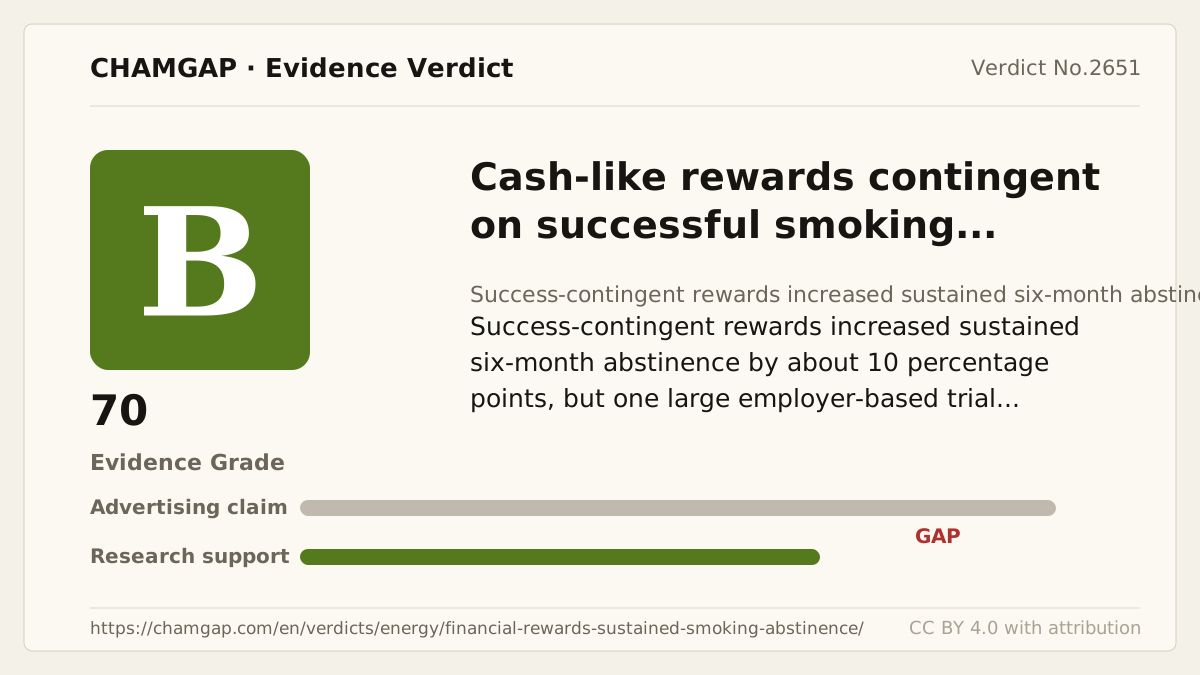
research showsThe grade is B with 70 points. In a randomized trial of 2,538 CVS Caremark employees, relatives, and friends, sustained six-month abstinence occurred in 159/1,017 (15.6%) across the two reward arms versus 28/468 (6.0%) with usual support. The approximately 9.6-point absolute difference concerned biochemically verified abstinence, but no independent replication of the same program was established and CVS Caremark participated in funding and authorship.
ads claimRewards do not make everyone quit. Marketing should report average benefit, uptake, biochemical verification, and the background provision of information and cessation aids.
Useful facts when choosing a product
- The reward programs offered approximately $800 contingent on verified cessation, while usual care included information and free cessation aids.
- The two reward arms had 159/1,017 sustained quitters versus 28/468 with usual care.
- Existing cessation verdicts address different interventions or populations, such as medicines or pregnancy vouchers; this verdict is limited to employer-based success-contingent cash rewards.
What the research actually shows
The 2015 adaptive randomized trial by Halpern SD, French B, Small DS, Saulsgiver K, Harhay MO, Audrain-McGovern J, Loewenstein G, Brennan TA, Asch DA, and Volpp KG analyzed all 2,538 randomized participants as assigned. Group sizes were 468 usual care, 498 individual reward, 519 collaborative reward, 582 competitive deposit, and 471 individual deposit. Six-month sustained abstinence was 6.0%, 15.4%, 16.0%, 9.4%, and 11.1%, respectively. This verdict compares the two reward arms with usual care and does not merge the deposit arms. Funding came from NCI R01 CA159932, NIA RC2 AG036592, and CVS Caremark; a CVS Caremark executive was a coauthor. Because a financial-reward intervention inherently cannot blind participants or investigators, criterion 44(2) cannot be filled from the article; this design-inherent limitation was not escalated to a B2 defect.
Why this is classified as B (70)
A large randomized trial with a biochemically verified six-month event and a sizable absolute difference is a strength. Independent replication is absent, funding was mixed public-company, and an inherently unblindable financial-reward intervention cannot meet all four B0 requirements, so bias remains B1 and the verdict B with 70 points.
Counterpoint. Financial rewards are a behavioral intervention distinct from varenicline or nicotine replacement. They should be read as an addition to background support, not a substitute for medication or counseling.
Rejudgment record. Cross-check applied — Cross-checked the primary endpoint, all-randomized analysis, arm-specific abstinence rates, NIH plus CVS Caremark funding, and inherent inability to blind a financial-reward intervention against the NEJM article and NCT01526265
| Endpoint | H | Hard endpoint - actual events such as death |
| Replication | R1 | Single confirmatory trial |
| Independence | I1 | Mixed funding sources |
| Effect size | E+ | Meets the clinically important threshold |
The scoring table and the verdict agree (B).
Sub-claim grades by effect
This ingredient is marketed for several effects. A single overall grade blends strong and weak claims together, so each effect is graded separately here. The overall grade reflects the strongest disconfirming or core claim.
| Effect (sub-claim) | Grade | Basis |
|---|---|---|
| Increased sustained six-month abstinence from offering rewards | B | The rates were 15.6% versus 6.0%. |
| Deposit contracts being more effective overall than rewards | D | Overall effectiveness, including differential uptake, favored rewards. |
Cross-check — Codex and Claude
Evidence Table
| Study | Design | Sample | Funding | Endpoint | Result | Weight |
|---|---|---|---|---|---|---|
| Halpern SD, French B, Small DS, Saulsgiver K, Harhay MO, Audrain-McGovern J, Loewenstein G, Brennan TA, Asch DA, Volpp KG. 2015 | Five-arm adaptive randomized trial; two reward arms compared with usual support; participants and investigators could not be blinded to financial rewards | 468 | NCI R01 CA159932, NIA RC2 AG036592, and CVS Caremark; a CVS Caremark executive was a coauthor | Biochemically verified sustained abstinence through six months after the target quit date | Rewards 159/1,017 (15.6%) versus usual support 28/468 (6.0%), approximately +9.6 percentage points | Only direct large randomized trial; no independent replication; unavoidable nonblinding leaves B0 requirements incomplete |
Receipt — 1 References
All 1 cited sources were verified for existence at the original page (as of 2026-08-15).
Reviewed and approved: Chamgap Editorial Team · Approval date: 2026-08-15 · Corrections: none
Cite this verdict
[Chamgap] Financial rewards x increased sustained smoking abstinence — Evidence Grade B·70. 1 cited sources checked. Source: https://chamgap.com/en/verdicts/energy/financial-rewards-sustained-smoking-abstinence/ · CC BY 4.0CC BY 4.0 — free to use with attribution; do not distort grades, numbers, or verdict meaning.
What this document does and does not do
Chamgap is an information source. It reports what research has and has not confirmed; it does not tell readers what to take or buy. That decision belongs to readers and, when needed, medical or legal professionals. This verdict reflects literature available up to the search date and may change as new research appears. Nothing here is medical advice.