
Ice-water sheet cooling,
does it really help with Adequate cooling and preserved survival when cold-water immersion is difficult in exertional heat stroke?
research showsThe grade is D. In a retrospective US military EMS series of 462 casualties, the overall core cooling rate was 0.07±0.08°C/min and 0.16±0.08°C/min when starting temperature was at least 39°C; mortality was 1/462 (0.2%, 95% CI 0.01-1.20). There was no concurrent cold-water-immersion group, so the comparative effect and interval needed to call it an equivalent alternative cannot be calculated, giving D with 30 points.
ads claimThe observation that ice-water sheets can lower temperature is real, but it does not establish the same survival benefit as cold-water immersion. Heat stroke requires the fastest feasible cooling and emergency transport; preparing sheets must not delay cooling.
Useful facts when choosing a product
- The EMS method applied ice-water-soaked sheets to the body and replaced them repeatedly.
- The 0.07°C/min figure covers the full cohort, whereas 0.16°C/min covers the subgroup starting at 39°C or higher.
- Existing verdict 1247 concerns postexercise recovery rather than heat-stroke survival and emergency cooling; no direct PMID or DOI duplicate was found.
What the research actually shows
DeGroot retrospectively analyzed de-identified military EMS records for 462 suspected exertional-heat-stroke casualties treated with ice sheets, using rectal temperatures on scene and on hospital arrival plus survival. There was neither randomization nor a concurrent cold-water-immersion group. The overall and at-least-39°C cooling rates describe different starting-temperature groups, not a between-treatment comparison. Complete Funding or Acknowledgment text was not confirmed in accessible sources, so military affiliation alone was not labeled government funding.
Why this is classified as D (30)
A 462-person cohort recorded mortality, but the single axis-6 flaw counted was absence of a concurrent comparator. Nonrandomized design was not split into multiple allocation and masking defects, giving D with 30 points.
Counterpoint. D does not mean sheets cannot lower temperature; it separates practical cooling from proven comparative clinical effectiveness.
Rejudgment record. Cross-check applied — We cross-checked cohort size, cooling rates, deaths, and rectal temperatures and counted only absence of a concurrent comparator as the axis-6 flaw.
| Endpoint | H | Hard endpoint - actual events such as death |
| Replication | R1 | Single confirmatory trial |
| Independence | I1 | Mixed funding sources |
| Effect size | E0 | Null |
| Precision | CX | No pooled confidence interval could be confirmed |
The scoring table and the verdict agree (D).
Sub-claim grades by effect
This ingredient is marketed for several effects. A single overall grade blends strong and weak claims together, so each effect is graded separately here. The overall grade reflects the strongest disconfirming or core claim.
| Effect (sub-claim) | Grade | Basis |
|---|---|---|
| Ice-water sheets lower core temperature in exertional heat stroke. | C | The 462-person cohort cooled at 0.07°C/min overall and 0.16°C/min when starting temperature was at least 39°C. |
| Ice-water sheets are a survival-equivalent alternative to cold-water immersion. | D | No concurrent direct comparator or comparative effect interval was available. |
Cross-check — Codex and Claude
Evidence Table
| Study | Design | Sample | Funding | Endpoint | Result | Weight |
|---|---|---|---|---|---|---|
| Study 1 | Retrospective prehospital cohort of exertional heat-stroke casualties treated with ice-water sheets | 462 | Funding or acknowledgment text was not confirmed in accessible sources | Rectal core cooling rate from scene to hospital arrival and mortality | Overall 0.07±0.08°C/min; 0.16±0.08°C/min when starting temperature was at least 39°C; mortality 1/462 (0.2%, 95% CI 0.01-1.20) | Largest real-patient ice-sheet cohort, but without a direct comparator |
Receipt — 1 References
All 1 cited sources were verified for existence at the original page (as of 2026-08-14).
Reviewed and approved: Chamgap Editorial Team · Approval date: 2026-08-14 · Corrections: none
Cite this verdict
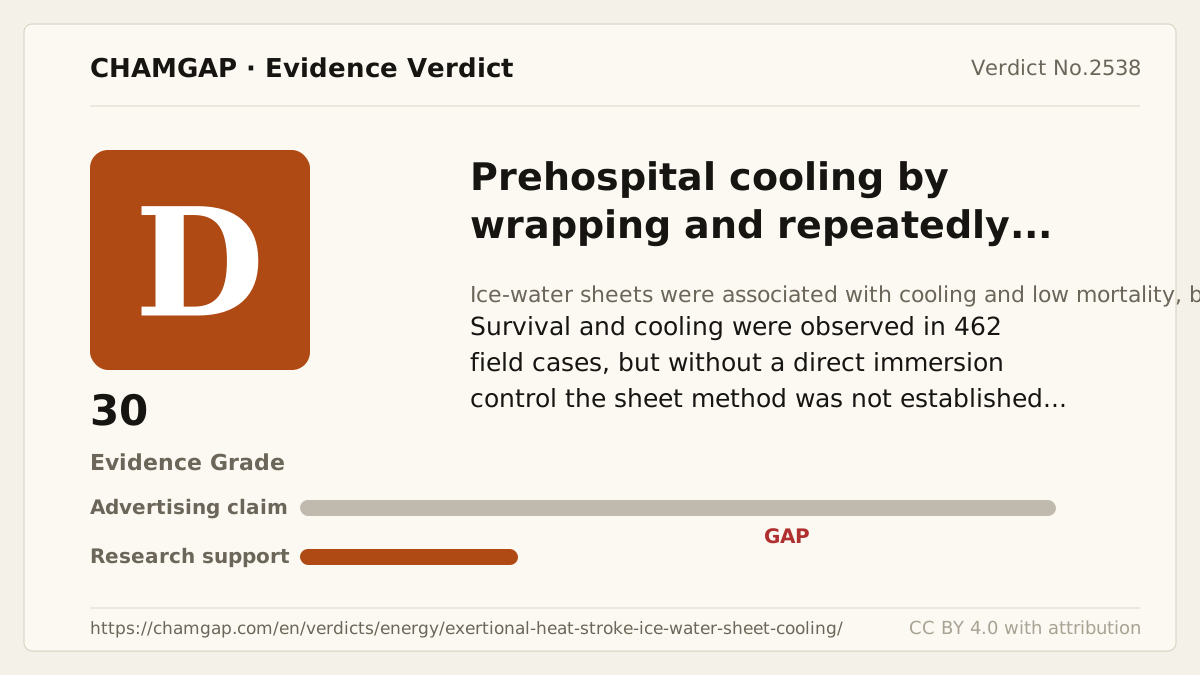
[Chamgap] Ice-water sheet cooling x exertional heat stroke — Evidence Grade D·30. 1 cited sources checked. Source: https://chamgap.com/en/verdicts/energy/exertional-heat-stroke-ice-water-sheet-cooling/ · CC BY 4.0CC BY 4.0 — free to use with attribution; do not distort grades, numbers, or verdict meaning.
What this document does and does not do
Chamgap is an information source. It reports what research has and has not confirmed; it does not tell readers what to take or buy. That decision belongs to readers and, when needed, medical or legal professionals. This verdict reflects literature available up to the search date and may change as new research appears. Nothing here is medical advice.