
33°C targeted temperature management,
does it really help with Increased survival with favorable neurologic function at day 90?
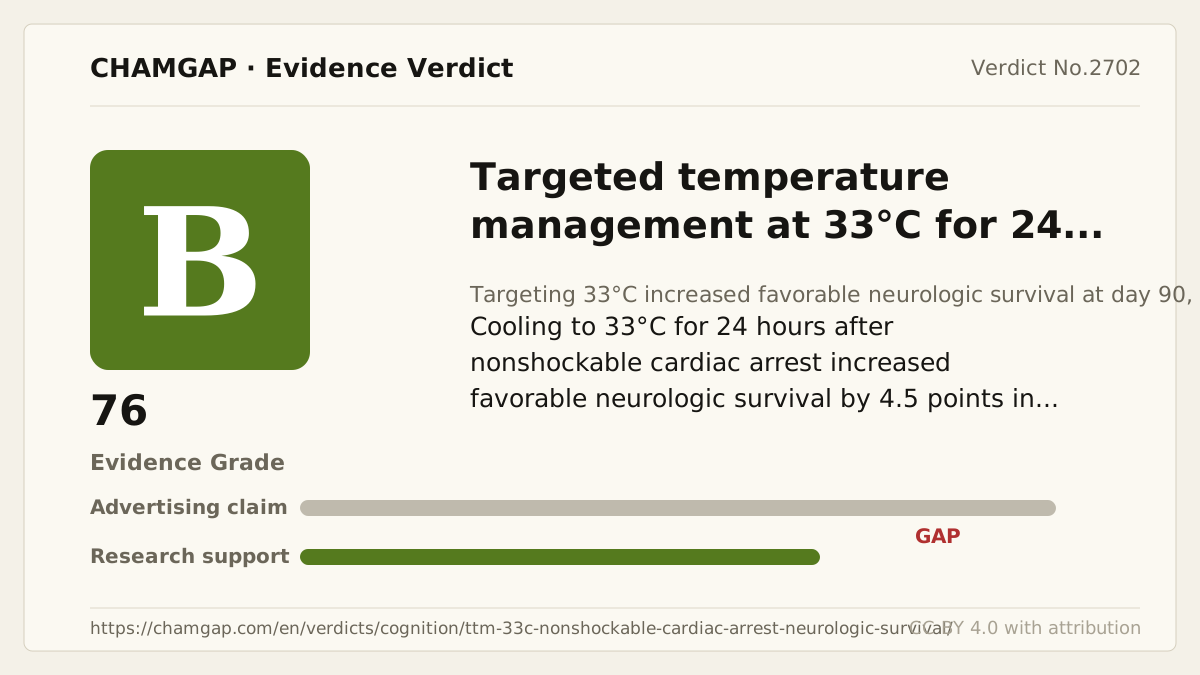
research showsThe grade is B with 76 points. HYPERION randomized 584 patients and analyzed 581 after three withdrew consent. At day 90, 29/284 (10.2%) in the 33°C group versus 17/297 (5.7%) in the 37°C group were alive with CPC 1 or 2, an absolute difference of 4.5 percentage points (95% CI 0.1-8.9; P=0.04). This was a real survival-and-disability event, but evidence rests on one confirmatory trial and the interval's lower bound was only 0.1 point.
ads claimAchieving a 33°C target is a physical fact; improving favorable neurologic survival is a separate clinical claim. The observed benefit applies to the HYPERION conditions of coma, nonshockable rhythm, and treatment within 300 minutes after resuscitation.
Useful facts when choosing a product
- The protocol maintained 32.5-33.5°C for 24 hours, rewarmed at 0.25-0.50°C per hour, then maintained normothermia.
- The 2015 design paper and 2019 main paper are reports from one HYPERION trial, NCT01994772.
- Day-90 all-cause mortality was not significantly reduced; only the prespecified CPC 1-or-2 survival endpoint was positive.
What the research actually shows
HYPERION was an open-treatment, assessor-masked trial that used web-based allocation for 584 patients at 25 French ICUs. An independent statistician generated variable blocks, and a trained assessor unaware of assignment measured CPC by telephone at day 90. The assigned-group analysis included 581 participants after three consent withdrawals, with loss to follow-up prespecified as death. The registry and article both identify day-90 survival with CPC 1 or 2 as primary. The 2015 paper is the design protocol and the 2019 paper the main result from the same registration, so they are reports of one trial. Independent grants came from the French Ministry of Health, a nonprofit hospital, and the Laerdal Foundation, with no funder role in design, analysis, or writing. Axis 6 B0 basis ① Allocation concealment: "Randomization is centralized, web-based" ② Masking: "primary outcome is assessed by a psychologist blinded" — participant masking is impossible for hypothermia treatment, but the endpoint assessor was masked, so this is not a defect. ③ Analysis population and missing data: "The intention-to-treat principle will be applied." ④ Prespecified primary endpoint: "The primary outcome was survival with a favorable day-90 neurologic outcome" — matches day-90 CPC 1 or 2 in registration NCT01994772
Why this is classified as B (76)
Allocation concealment, assessor masking, ITT analysis, and the prespecified primary endpoint are all confirmed in the source, leaving no avoidable defect; absent independent replication gives B with 76 points.
Counterpoint. The estimate was borderline and mortality alone was not reduced, so it should not be generalized to other arrest rhythms or broader temperature strategies.
Rejudgment record. Cross-check applied — Cross-checked the HYPERION article, protocol, and registry for trial identity, primary endpoint, allocation, masking, analysis, and funding
| Endpoint | H | Hard endpoint - actual events such as death |
| Replication | R1 | Single confirmatory trial |
| Independence | I2 | Decisive evidence is publicly or non-profit funded |
| Effect size | E+ | Meets the clinically important threshold |
The scoring table and the verdict agree (B).
Sub-claim grades by effect
This ingredient is marketed for several effects. A single overall grade blends strong and weak claims together, so each effect is graded separately here. The overall grade reflects the strongest disconfirming or core claim.
| Effect (sub-claim) | Grade | Basis |
|---|---|---|
| Targeting 33°C increases favorable neurologic survival at day 90 | B | Rates were 10.2% versus 5.7%, an absolute difference of 4.5 points. |
| Targeting 33°C reduces all-cause mortality at day 90 | D | Mortality was 81.3% versus 83.2%, with the interval crossing no effect. |
Cross-check — Codex and Claude
Evidence Table
| Study | Design | Sample | Funding | Endpoint | Result | Weight |
|---|---|---|---|---|---|---|
| Lascarrou JB, Merdji H, Le Gouge A, Colin G, Grillet G, Girardie P, Coupez E, Dequin PF, Cariou A, Boulain T, Brule N, Frat JP, Asfar P, Pichon N, Landais M, Plantefeve G, Quenot JP, Chakarian JC, Sirodot M, Legriel S, Letheulle J, Thevenin D, Desachy A, Delahaye A, Botoc V, Vimeux S, Martino F, Giraudeau B, Reignier J, CRICS-TRIGGERSEP Group. 2019 HYPERION; Lascarrou JB, Meziani F, Le Gouge A, Boulain T, Bousser J, Belliard G, Asfar P, Frat JP, Dequin PF, Gouello JP, Delahaye A, Hssain AA, Chakarian JC, Pichon N, Desachy A, Bellec F, Thevenin D, Quenot JP, Sirodot M, Labadie F, Plantefeve G, Vivier D, Girardie P, Giraudeau B, Reignier J, Clinical Research in Intensive Care and Sepsis (CRICS) Group and HYPERION Study Group. 2015 protocol | Open-treatment, outcome-assessor-masked randomized trial in 25 French ICUs; protocol and main report from the same trial | 297 | Independent grants from the French Ministry of Health, nonprofit Centre Hospitalier Départemental Vendée, and Laerdal Foundation | Survival with CPC 1 or 2 at day 90 | 29/284 (10.2%) versus 17/297 (5.7%), absolute difference 4.5 points (95% CI 0.1-8.9), P=0.04 | Single large confirmatory trial; both papers report the same trial |
Receipt — 2 References
All 2 cited sources were verified for existence at the original page (as of 2026-08-17).
Reviewed and approved: Chamgap Editorial Team · Approval date: 2026-08-17 · Corrections: none
Cite this verdict
[Chamgap] 33°C targeted temperature management x favorable neurologic survival after nonshockable cardiac arrest — Evidence Grade B·76. 2 cited sources checked. Source: https://chamgap.com/en/verdicts/cognition/ttm-33c-nonshockable-cardiac-arrest-neurologic-survival/ · CC BY 4.0CC BY 4.0 — free to use with attribution; do not distort grades, numbers, or verdict meaning.
What this document does and does not do
Chamgap is an information source. It reports what research has and has not confirmed; it does not tell readers what to take or buy. That decision belongs to readers and, when needed, medical or legal professionals. This verdict reflects literature available up to the search date and may change as new research appears. Nothing here is medical advice.