
Daily self-monitoring of blood glucose,
does it really help with Improved hemoglobin A1c at 52 weeks?
research showsThe grade is F with 12 points. In MONITOR, baseline-adjusted 52-week between-group HbA1c differences were -0.05 percentage points (95% CI -0.27 to 0.17) for once-daily testing and -0.09 (-0.31 to 0.14) for testing with tailored messages. In DiGEM, the matching 12-month comparisons were -0.14 (-0.35 to 0.07) for less intensive and -0.17 (-0.37 to 0.03) for more intensive monitoring. All four intervals remained inside the clinically important benefit boundary of -0.5 points set by the NICE guideline committee.
ads claimKorean meter, strip, reimbursement, and education claims must distinguish insulin users from nonusers. The standard arm saw one daily number, while the enhanced arm also received automated messages based on value, timing, and meals. Providers in both testing arms received electronic summaries and treatment options, and all arms received education about targets and hypo- and hyperglycemia symptoms.
Useful facts when choosing a product
- Randomization included 152 no-testing, 150 standard-testing, and 148 messaging participants; 92.9% provided both coprimary outcomes at 52 weeks.
- Neither SF-36 component nor diabetes distress, symptoms, empowerment, satisfaction, or communication improved between groups.
- There were no finger-stick infections and one severe hypoglycemia event, adjudicated as unrelated to the intervention.
What the research actually shows
All five replication gates passed. The bibliographic records identify distinct MONITOR 2017 and DiGEM 2007 trials. The complete MONITOR author list is Laura A Young, John B Buse, Mark A Weaver, Maihan B Vu, C Madeline Mitchell, Tamara Blakeney, Kimberlea Grimm, Jennifer Rees, Franklin Niblock, and Katrina E Donahue; the complete DiGEM list is Andrew Farmer, Alisha Wade, Elizabeth Goyder, Patricia Yudkin, David French, Anthea Craven, Rury Holman, Ann-Louise Kinmonth, and Andrew Neil, with no overlap. Funding differed: PCORI CE-12-11-4980 and NIH UL1TR001111 for MONITOR versus the NHS and NIHR Health Technology Assessment Programme for DiGEM. Both populations had type 2 diabetes without insulin use, both controls received usual care without self-monitoring, and both primary estimands were baseline-adjusted between-group HbA1c at 12 months. Registration `NCT02033499` matched MONITOR's coprimary HbA1c and SF-36 outcomes.
Why this is classified as F (12)
MONITOR and DiGEM pass all five independent-replication gates, and all four intervals for the same 12-month baseline-adjusted between-group HbA1c estimand remain inside the NICE committee's 0.5-point threshold, giving F with 12 points.
Counterpoint. HbA1c is a surrogate. Insulin titration, hypoglycemia detection, pregnancy, acute illness, and treatment-change monitoring are outside this verdict.
Rejudgment record. Cross-check applied — Independent MONITOR and DiGEM replication, matching baseline-adjusted 12-month between-group HbA1c estimands, and four intervals inside the NICE 0.5-point threshold
| Endpoint | S | Surrogate marker - laboratory or imaging measures |
| Replication | RX | Repeatedly refuted in the same indication |
| Independence | I2 | Decisive evidence is publicly or non-profit funded |
| Effect size | E0 | Null |
| Precision | C1 | The confidence interval excludes meaningful benefit |
The scoring table and the verdict agree (F).
Sub-claim grades by effect
This ingredient is marketed for several effects. A single overall grade blends strong and weak claims together, so each effect is graded separately here. The overall grade reflects the strongest disconfirming or core claim.
| Effect (sub-claim) | Grade | Basis |
|---|---|---|
| Improved HbA1c at 52 weeks | F | Neither once-daily testing nor tailored messages significantly outperformed no testing. |
| Improved quality of life at 52 weeks | D | Neither SF-36 physical nor mental scores differed between groups. |
Cross-check — Codex and Claude
Evidence Table
| Study | Design | Sample | Funding | Endpoint | Result | Weight |
|---|---|---|---|---|---|---|
| Study 1 | Open-label pragmatic randomized trial in 15 primary-care practices | 139 | Original wording: “Research reported in this publication was funded through a Patient-Centered Outcomes Research Institute Award CE-12-11-4980. Further support was provided by the National Center for Advancing Translational Sciences, National Institutes of Health, through Grant Award Number UL1TR001111.” | Coprimary 52-week change in HbA1c and SF-36 quality of life | HbA1c change +0.04 (SD 1.12), -0.05 (1.00), and -0.10 (1.14) points; adjusted differences -0.05 (-0.27 to 0.17) and -0.09 (-0.31 to 0.14) | Pivotal publicly funded trial |
| Study 2 | Three-arm open randomized trial | 453 | NHS and the National Institute for Health Research health technology assessment programme | HbA1c at 12 months | Less intensive monitoring -0.14 points (95% CI -0.35 to 0.07) and more intensive monitoring -0.17 (-0.37 to 0.03) versus usual care | Independent replication of the same primary-analysis estimand |
Receipt — 4 References
All 4 cited sources were verified for existence at the original page (as of 2026-08-08).
Reviewed and approved: Chamgap Editorial Team · Approval date: 2026-08-08 · Corrections: none
Cite this verdict
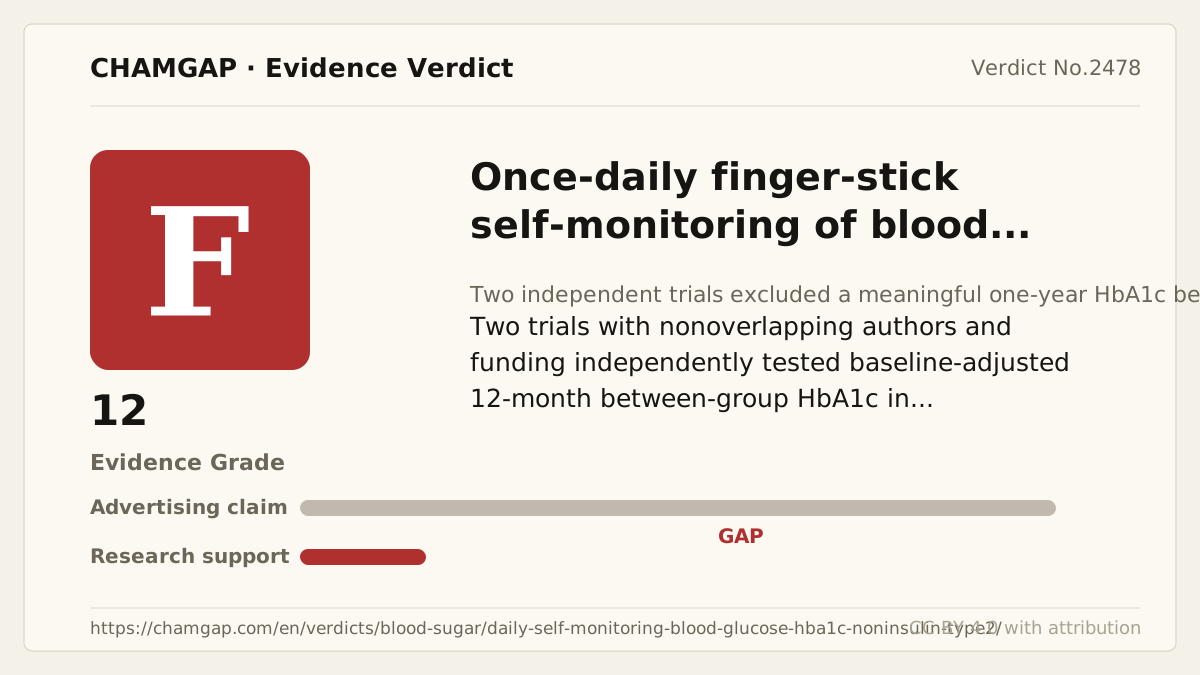
[Chamgap] Daily self-monitoring of blood glucose x HbA1c in non-insulin-treated type 2 diabetes — Evidence Grade F·12. 4 cited sources checked. Source: https://chamgap.com/en/verdicts/blood-sugar/daily-self-monitoring-blood-glucose-hba1c-noninsulin-type2/ · CC BY 4.0CC BY 4.0 — free to use with attribution; do not distort grades, numbers, or verdict meaning.
What this document does and does not do
Chamgap is an information source. It reports what research has and has not confirmed; it does not tell readers what to take or buy. That decision belongs to readers and, when needed, medical or legal professionals. This verdict reflects literature available up to the search date and may change as new research appears. Nothing here is medical advice.