
Warm perineal compresses,
does it really help with Reduced third- and fourth-degree perineal tears?
research showsThe grade is B. Severe tears were 3/404 (0.7%) versus 6/404 (1.5%) in the US trial and 15/360 (4.2%) versus 31/357 (8.7%) in Australia. The point estimates were nearly identical, and the wide US interval did not exclude the Australian effect. Two independent teams found the same direction, but outcome blinding was incomplete, giving B with 72 points.
ads claimEvidence supports the narrow claim of fewer third- and fourth-degree tears. It does not establish prevention of all tears, suturing, episiotomy, and later incontinence as one package.
Useful facts when choosing a product
- The Australian trial used a sterile pad soaked in 38-44 C water from perineal distension until birth.
- The US trial compared warm compresses, lubricated massage, and hands off.
- Temperature and skin checks are required in clinical use.
What the research actually shows
The US NIH-supported trial randomized 1,211 women to warm compresses, lubricated massage, or hands off. The Australian trial randomized 717 nulliparous women and analyzed by intention to treat. Johnson & Johnson Medical funded translation of questionnaires and consent materials but, according to the paper, had no role in design or content. Teams and funding streams differed. Clinicians knew the intervention, and complete blinding of independent trauma assessment was difficult in practice.
Why this is classified as B (72)
Two separate teams produced nearly identical severe-tear estimates with different funding streams, but incomplete outcome-assessment blinding gives B with 72 points.
Counterpoint. Use depends on maternal preference and delivery circumstances and does not replace obstetric judgment.
Rejudgment record. New verdict — Similar severe-tear risk ratios in two independent randomized trials with incomplete outcome blinding
| Endpoint | H | Hard endpoint - actual events such as death |
| Replication | R2 | Independently replicated across trials |
| Independence | I1 | Mixed funding sources |
| Effect size | E+ | Meets the clinically important threshold |
The scoring table and the verdict agree (B).
Sub-claim grades by effect
This ingredient is marketed for several effects. A single overall grade blends strong and weak claims together, so each effect is graded separately here. The overall grade reflects the strongest disconfirming or core claim.
| Effect (sub-claim) | Grade | Basis |
|---|---|---|
| Reduced third- and fourth-degree tears | B | Both trials had point estimates near RR 0.5. |
| Reduced need for perineal suturing | D | The Australian trial did not find a significant reduction. |
| Reduced all genital-tract trauma | D | Overall trauma distribution was equal across the US trial groups. |
Cross-check — Codex and Claude
Evidence Table
| Study | Design | Sample | Funding | Endpoint | Result | Weight |
|---|---|---|---|---|---|---|
| Study 1 | Three-arm randomized trial | 404 | US NIH/NINR grant R01 NR005252 | Third- and fourth-degree perineal tears | 3/404 (0.7%) versus 6/404 (1.5%), RR about 0.50 (95% CI about 0.13 to 1.99) | Publicly funded supportive trial with few events |
| Study 2 | Parallel-group randomized trial | 357 | Johnson & Johnson Medical funded translation of questionnaires and consent materials, with no role in design or content | Third- and fourth-degree perineal tears | 15/360 (4.2%) versus 31/357 (8.7%), RR about 0.48 (95% CI about 0.26 to 0.87) | Independent replication with the same event and effect magnitude |
Receipt — 2 References
All 2 cited sources were verified for existence at the original page (as of 2026-08-14).
Reviewed and approved: Chamgap Editorial Team · Approval date: 2026-08-14 · Corrections: none
Cite this verdict
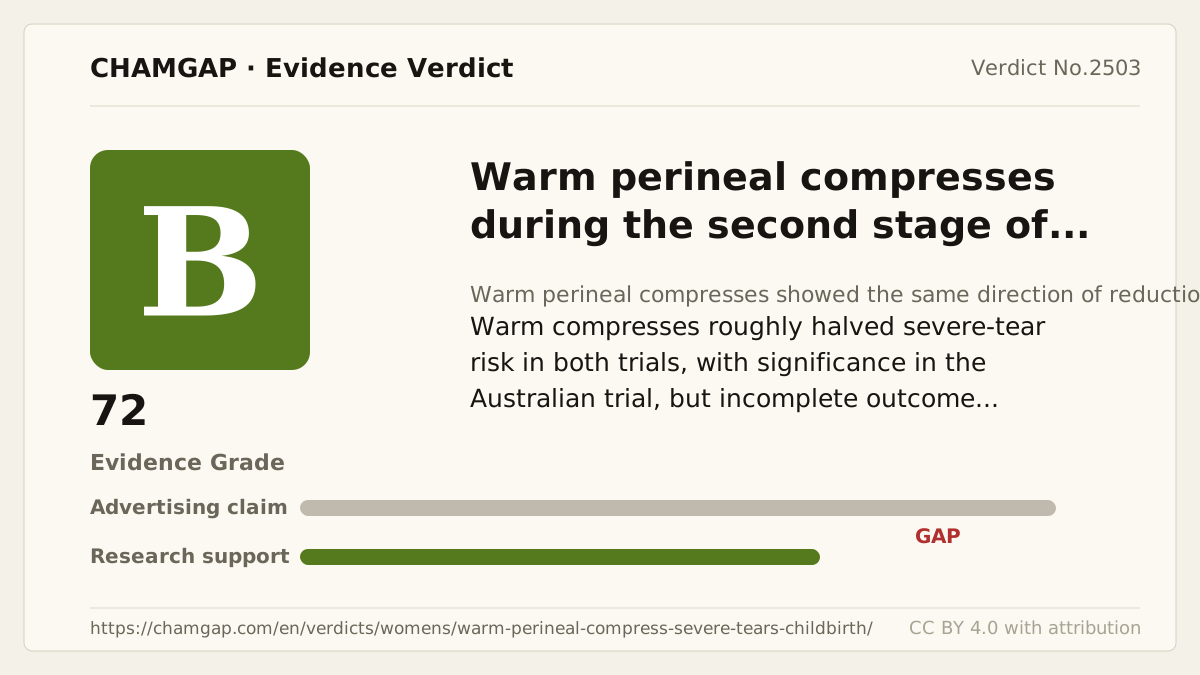
[Chamgap] Warm perineal compresses x severe tears during childbirth — Evidence Grade B·72. 2 cited sources checked. Source: https://chamgap.com/en/verdicts/womens/warm-perineal-compress-severe-tears-childbirth/ · CC BY 4.0CC BY 4.0 — free to use with attribution; do not distort grades, numbers, or verdict meaning.
What this document does and does not do
Chamgap is an information source. It reports what research has and has not confirmed; it does not tell readers what to take or buy. That decision belongs to readers and, when needed, medical or legal professionals. This verdict reflects literature available up to the search date and may change as new research appears. Nothing here is medical advice.