
Time-lapse embryo selection,
does it really help with Increased live birth after IVF or ICSI?
research showsThe grade is D with 34 points. Live birth was TILT's prespecified primary outcome. Rates were 175/520 (33.7%) with time-lapse selection versus 172/522 (33.0%) with standard care, adjusted OR 1.04 (97.5% CI 0.73 to 1.47), absolute difference 0.7 points (-5.85 to 7.25).
ads claimUndisturbed culture and more images are real workflow properties, but they did not establish more live births per woman.
Useful facts when choosing a product
- Time-lapse systems repeatedly image embryos without removal from the incubator.
- Live birth was TILT's primary outcome.
- Control was conventional incubation plus routine morphology.
- The protocol disclosed £3,000 from Pharmasure for consumables; free equipment was not confirmed.
What the research actually shows
TILT randomized 525 participants to each of three groups. Live birth was 33.7% with time-lapse selection, 36.6% with undisturbed time-lapse culture plus conventional morphology, and 33.0% with standard care. Funding came from Barts Charity, Pharmasure Pharmaceuticals, Hong Kong OG Trust Fund, Hong Kong Health and Medical Research Fund, and Hong Kong Matching Fund. The protocol states Pharmasure contributed £3,000 toward consumables and had no role. Sites used CE-marked systems of their choice; free manufacturer equipment was not identified in the accessible report.
Why this is classified as D (34)
A large null primary live-birth trial still allowed potential benefit and exact repeated precise refutation was not established, giving D with 34 points.
Counterpoint. Laboratory stability and live birth are different claims.
Rejudgment record. Cross-check applied — TILT's primary live-birth outcome was null, but earlier null studies often used different primary outcomes and no validated benefit threshold supported precise refutation
| Endpoint | H | Hard endpoint - actual events such as death |
| Replication | R1 | Single confirmatory trial |
| Independence | I1 | Mixed funding sources |
| Effect size | E0 | Null |
| Precision | C0 | The confidence interval leaves room for benefit |
The scoring table and the verdict agree (D).
Sub-claim grades by effect
This ingredient is marketed for several effects. A single overall grade blends strong and weak claims together, so each effect is graded separately here. The overall grade reflects the strongest disconfirming or core claim.
| Effect (sub-claim) | Grade | Basis |
|---|---|---|
| Increased live birth | D | Rates were 33.7% versus 33.0%. |
| Undisturbed incubation | B | This is a real physical workflow property. |
Cross-check — Codex and Claude
Evidence Table
| Study | Design | Sample | Funding | Endpoint | Result | Weight |
|---|---|---|---|---|---|---|
| Study 1 | Three-arm multicenter double-masked randomized trial | 522 | Barts Charity, Pharmasure Pharmaceuticals, and Hong Kong charitable/public funds | Live birth; primary | 175/520 (33.7%) versus 172/522 (33.0%); OR 1.04 (97.5% CI 0.73 to 1.47) | Pivotal live-birth trial |
| Study 2 | Systematic review of randomized time-lapse trials | 826 | Academic Cochrane review | Live birth or ongoing pregnancy | OR 0.91 (0.67 to 1.23) | Earlier null but imprecise evidence |
Receipt — 2 References
All 2 cited sources were verified for existence at the original page (as of 2026-08-07).
Reviewed and approved: Chamgap Editorial Team · Approval date: 2026-08-07 · Corrections: none
Cite this verdict
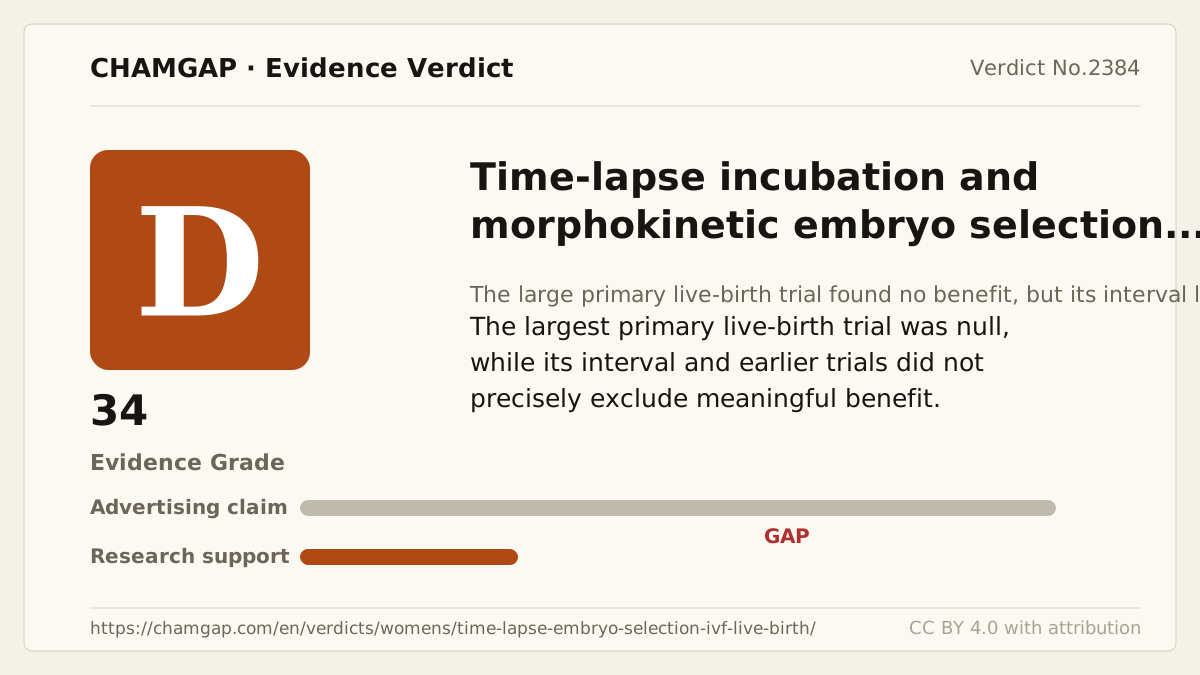
[Chamgap] Time-lapse embryo selection x live birth after IVF — Evidence Grade D·34. 2 cited sources checked. Source: https://chamgap.com/en/verdicts/womens/time-lapse-embryo-selection-ivf-live-birth/ · CC BY 4.0CC BY 4.0 — free to use with attribution; do not distort grades, numbers, or verdict meaning.
What this document does and does not do
Chamgap is an information source. It reports what research has and has not confirmed; it does not tell readers what to take or buy. That decision belongs to readers and, when needed, medical or legal professionals. This verdict reflects literature available up to the search date and may change as new research appears. Nothing here is medical advice.