
Simple hysterectomy with lymph-node assessment,
does it really help with Noninferiority to radical hysterectomy for three-year pelvic recurrence in early low-risk cervical cancer?
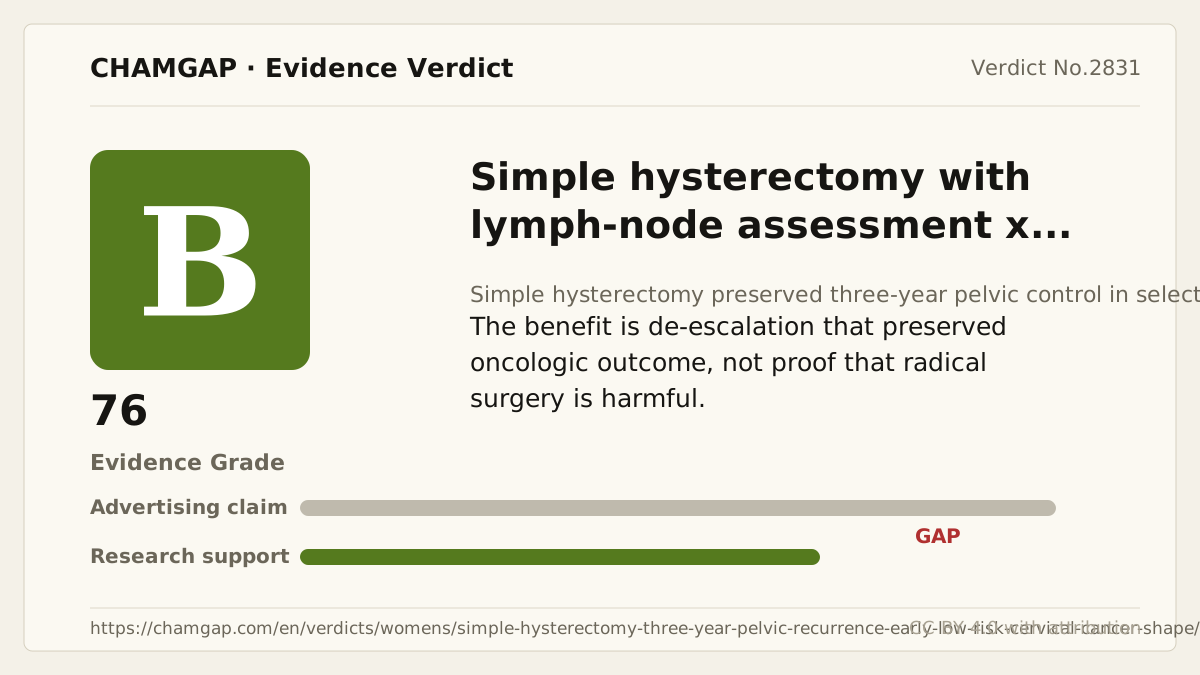
research showsThe grade is B with 76 points. In the 700-participant SHAPE trial, three-year pelvic recurrence was 2.52% after simple hysterectomy and 2.17% after radical hysterectomy, an absolute difference of 0.35 percentage points (90% CI -1.62 to 2.32). The upper bound was below the prespecified 4-point noninferiority margin.
ads claimVerdict 691 is A with 91 points, verdict 1661 is A with 90 points, verdict 2331 is B with 76 points, and verdict 2801 is C with 56 points; all address cervical-cancer prevention or screening. This verdict addresses how extensively an existing cancer should be operated on and directly informs gynecologic oncology surgery in Korea only for carefully selected patients.
Useful facts when choosing a product
- Urinary incontinence was 2.4% versus 5.5% within four weeks and 4.7% versus 11.0% beyond four weeks.
- Urinary retention was 0.6% versus 11.0% within four weeks and 0.6% versus 9.9% beyond four weeks.
- A later patient-reported analysis favored simple surgery for sexual function, sexual distress, and several cervical-cancer-specific quality-of-life domains, but questionnaire missingness limits those secondary outcomes.
What the research actually shows
The trial randomized 700 patients at 130 centers in 12 countries, 350 per arm. The primary analysis included all randomized patients, and a prespecified per-protocol analysis of 317 versus 312 was consistent. Limitation name: noninferiority design. Which listed item: noninferiority design. Was it avoidable: yes - a still larger superiority trial could have tested recurrence reduction, whereas this de-escalation trial asked whether simple surgery was no more than 4 points worse. Substantial attrition (>=15%): not applicable because the three-year endpoint used all 700 randomized patients with time-to-event censoring. Active comparator only: unavoidable - sham hysterectomy would delay cancer treatment and cannot ethically reproduce surgical extent, so it was not counted. Public and nonprofit funders included the Canadian Cancer Society, Canadian Institutes of Health Research, Cancer Trials Ireland, the French PHRC program, and Cancer Research UK.
Why this is classified as B (76)
A large publicly funded multicenter randomized trial measured actual three-year pelvic recurrence and met a prespecified 4-point margin. One pivotal trial and its noninferiority design limit the grade to B with 76 points.
Counterpoint. This does not show that simple hysterectomy cures cancer better or that radical hysterectomy is inherently harmful. It shows oncologic preservation with less extensive surgery in eligible low-risk patients.
Rejudgment record. Article and registry cross-check — SHAPE intention-to-treat pelvic recurrence, the prespecified 4-point margin, public funding, and the noninferiority-design limitation
| Endpoint | H | Hard endpoint - actual events such as death |
| Replication | R1 | Single confirmatory trial |
| Independence | I2 | Decisive evidence is publicly or non-profit funded |
| Effect size | E+ | Meets the clinically important threshold |
The scoring table and the verdict agree (B).
Sub-claim grades by effect
This ingredient is marketed for several effects. A single overall grade blends strong and weak claims together, so each effect is graded separately here. The overall grade reflects the strongest disconfirming or core claim.
| Effect (sub-claim) | Grade | Basis |
|---|---|---|
| Noninferiority for three-year pelvic recurrence | B | The 2.32-point upper bound was below the prespecified 4-point margin. |
| Reduced postoperative urinary complications | B | Urinary incontinence and retention were less frequent with simple surgery. |
| Improved sexual function and quality of life | C | Several domains favored simple surgery, with limitations from secondary analysis and missing questionnaires. |
Cross-check — Codex and Claude
Evidence Table
| Study | Design | Sample | Funding | Endpoint | Result | Weight |
|---|---|---|---|---|---|---|
| Study 1 | International multicenter randomized noninferiority surgical trial | 312 | Public and nonprofit funding including the Canadian Cancer Society, CIHR, Cancer Trials Ireland, French PHRC, and Cancer Research UK | Pelvic recurrence within three years after randomization | 2.52% versus 2.17%; absolute difference 0.35 points (90% CI -1.62 to 2.32); noninferiority margin 4 points | Pivotal single large hard-outcome trial |
Receipt — 2 References
All 2 cited sources were verified for existence at the original page (as of 2026-08-18).
Reviewed and approved: Chamgap Editorial Team · Approval date: 2026-08-18 · Corrections: none
Cite this verdict
[Chamgap] Simple Hysterectomy for Three-Year Pelvic Recurrence in Early Low-Risk Cervical Cancer - Benefit — Evidence Grade B·76. 2 cited sources checked. Source: https://chamgap.com/en/verdicts/womens/simple-hysterectomy-three-year-pelvic-recurrence-early-low-risk-cervical-cancer-shape/ · CC BY 4.0CC BY 4.0 — free to use with attribution; do not distort grades, numbers, or verdict meaning.
What this document does and does not do
Chamgap is an information source. It reports what research has and has not confirmed; it does not tell readers what to take or buy. That decision belongs to readers and, when needed, medical or legal professionals. This verdict reflects literature available up to the search date and may change as new research appears. Nothing here is medical advice.