
Raloxifene,
does it really help with Primary prevention of breast cancer in high-risk postmenopausal women?
research showsThe grade is B. STAR randomized 19,747 postmenopausal women with a five-year invasive breast-cancer risk of at least 1.66% by the Gail model or equivalent criteria. At a mean 47 months, invasive cancer occurred in 168/9,745 raloxifene participants, 4.41 per 1,000 woman-years, versus 163/9,726 tamoxifen participants, 4.30 per 1,000, RR 1.02 (95% CI 0.82 to 1.28).
ads claimThe same drug is spelled raloxifene under a different Korean transliteration in verdict 984, which is B with 77 points for new vertebral-fracture reduction in postmenopausal osteoporosis. This verdict concerns primary breast-cancer prevention, a different indication and benefit-harm balance.
Useful facts when choosing a product
- Raloxifene is a prescription selective estrogen receptor modulator.
- STAR used tamoxifen 20 mg daily, not placebo, as the comparator.
- Invasive and noninvasive cancer results differed.
- Prior venous thromboembolism and prolonged immobilization require particular caution.
What the research actually shows
Participants were postmenopausal and had a mean Gail five-year risk of 4.03% (SD 2.17%). Blinded treatment was planned for five years, with the initial analysis after a mean 47 months. Manufacturer money was present: “The STAR study has been supported to date by $88 million from the National Cancer Institute and $30 million from Eli Lilly & Co., the maker of raloxifene.”
Why this is classified as B (72)
A large double-blind randomized trial found similar prevention of the hard endpoint of invasive breast cancer versus tamoxifen. Active control without placebo, mixed manufacturer funding, and one directly matched confirmatory trial give B with 72 points.
Counterpoint. MORE and RUTH placebo-controlled trials pointed toward lower invasive breast cancer but enrolled osteoporosis or cardiovascular-risk populations and were not counted as exact replication of the STAR high-risk population.
Rejudgment record. Cross-check applied — Gail risk, menopausal status, active control, invasive and noninvasive events, thrombosis, uterine cancer, and mixed funding were checked
| Endpoint | H | Hard endpoint - actual events such as death |
| Replication | R1 | Single confirmatory trial |
| Independence | I1 | Mixed funding sources |
| Effect size | E+ | Meets the clinically important threshold |
The scoring table and the verdict agree (B).
Sub-claim grades by effect
This ingredient is marketed for several effects. A single overall grade blends strong and weak claims together, so each effect is graded separately here. The overall grade reflects the strongest disconfirming or core claim.
| Effect (sub-claim) | Grade | Basis |
|---|---|---|
| Prevention of invasive breast cancer | B | Similar to tamoxifen. |
| Prevention of noninvasive breast cancer | D | Eighty versus 57 cases left equivalence uncertain. |
Cross-check — Codex and Claude
Evidence Table
| Study | Design | Sample | Funding | Endpoint | Result | Weight |
|---|---|---|---|---|---|---|
| Study 1 | Multicenter double-blind active-controlled randomized trial | 9,726 | $88 million from the National Cancer Institute and $30 million from Eli Lilly & Co. | Primary invasive breast cancer; noninvasive cancer, uterine cancer, and thromboembolism | 168 cases (4.41/1,000 woman-years) vs 163 (4.30/1,000), RR 1.02 (95% CI 0.82 to 1.28) | Decisive direct evidence |
Receipt — 2 References
All 2 cited sources were verified for existence at the original page (as of 2026-08-07).
Reviewed and approved: Chamgap Editorial Team · Approval date: 2026-08-07 · Corrections: none
Cite this verdict
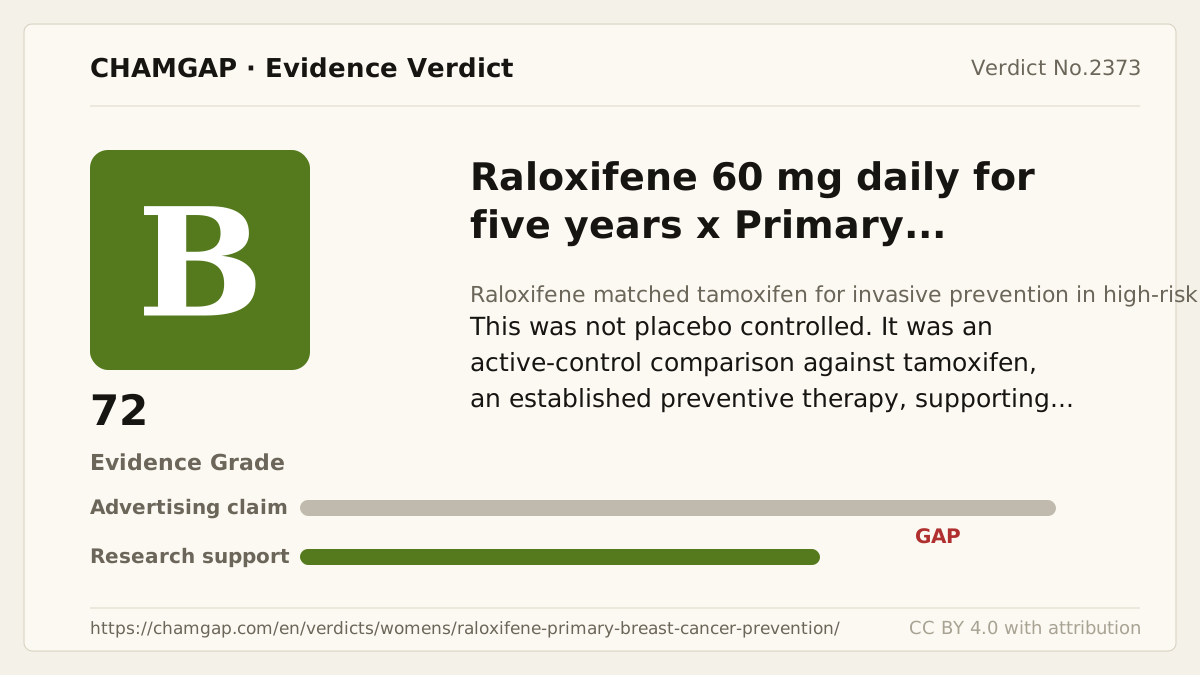
[Chamgap] Raloxifene x primary breast-cancer prevention in high-risk postmenopausal women — Evidence Grade B·72. 2 cited sources checked. Source: https://chamgap.com/en/verdicts/womens/raloxifene-primary-breast-cancer-prevention/ · CC BY 4.0CC BY 4.0 — free to use with attribution; do not distort grades, numbers, or verdict meaning.
What this document does and does not do
Chamgap is an information source. It reports what research has and has not confirmed; it does not tell readers what to take or buy. That decision belongs to readers and, when needed, medical or legal professionals. This verdict reflects literature available up to the search date and may change as new research appears. Nothing here is medical advice.