
Postpartum perineal ice pack for 20 minutes,
does it really help with Relief of perineal pain?
research showsThe grade is D. A trial randomized 114 primiparous women, 38 each, to ice, a room-temperature water pack, or no treatment. Pain at 20 minutes was 1.6 (95% CI 1.0-2.3), 2.1 (1.6-2.7), and 3.3 (2.6-4.1) on a 0-10 scale. Ice beat no treatment but not the room-temperature pack (P=.945).
ads claimIn Korean postpartum care, cooling may be used for brief comfort, but evidence for durable treatment is weak. Ice should be wrapped and limited to roughly 10-20 minutes, distinct from sitz baths, analgesics, and wound assessment.
Useful facts when choosing a product
- The intervention was one 20-minute ice-pack application, with both room-temperature pack and no-treatment controls.
- Pain was followed only to 60 minutes in the pivotal trial.
- Variability was reported as 95% confidence intervals, not standard errors.
What the research actually shows
The Brazilian birth-center trial randomized 114 primiparous women after spontaneous vaginal birth to ice, a water pack at a set room temperature, or no treatment. A single pack was applied for 20 minutes; pain was rated before, immediately at 20 minutes, and at 40 and 60 minutes. Baseline means were 4.6, 4.6, and 4.5. At 60 minutes they were 1.5 (0.9-2.1), 1.8 (1.2-2.6), and 3.1 (2.4-3.9). The table reports means and 95% confidence intervals, not standard errors; with 38 per group, back-calculated endpoint SDs are approximately 1.7-2.4 points. The paper's 30% Farrar threshold concerns within-person chronic-pain change and cannot validate this acute postpartum between-group contrast. The 13-mm acute-pain VAS change from Todd and Funk is also an individual-change value not validated for between-group postpartum perineal pain. No directly applicable group MCID was confirmed, so precision was not upgraded. Analgesic consumption was not confirmed as a key outcome in this 114-participant trial. Cochrane 2020 rated cooling evidence very uncertain.
Why this is classified as D (28)
Cooling added no benefit over a room-temperature pack in a small single trial, giving D with 28 points.
Counterpoint. The immediate difference versus no treatment was large but included nonspecific contact and expectation effects.
Rejudgment record. Cross-check applied — Null cooling-specific comparison against a room-temperature pack in one small trial
| Endpoint | P | Patient-reported treatment goal - the symptom is the goal |
| Replication | R1 | Single confirmatory trial |
| Independence | I1 | Mixed funding sources |
| Effect size | E0 | Null |
| Precision | C0 | The confidence interval leaves room for benefit |
The scoring table and the verdict agree (D).
Sub-claim grades by effect
This ingredient is marketed for several effects. A single overall grade blends strong and weak claims together, so each effect is graded separately here. The overall grade reflects the strongest disconfirming or core claim.
| Effect (sub-claim) | Grade | Basis |
|---|---|---|
| Immediate pain relief versus a room-temperature pack | D | There was no difference at 20 minutes, P=.945. |
Cross-check — Codex and Claude
Evidence Table
| Study | Design | Sample | Funding | Endpoint | Result | Weight |
|---|---|---|---|---|---|---|
| Study 1 | Three-arm randomized controlled trial | 38 | The exact Funding and Acknowledgement wording could not be verified in the accessible record | Pain score at 20 minutes, treated as primary, with 40- and 60-minute follow-up | At 20 minutes: ice 1.6 (1.0-2.3), room-temperature pack 2.1 (1.6-2.7), no treatment 3.3 (2.6-4.1); ice versus room temperature P=.945 | Direct test isolating the effect of cooling |
Receipt — 2 References
All 2 cited sources were verified for existence at the original page (as of 2026-08-08).
Reviewed and approved: Chamgap Editorial Team · Approval date: 2026-08-08 · Corrections: none
Cite this verdict
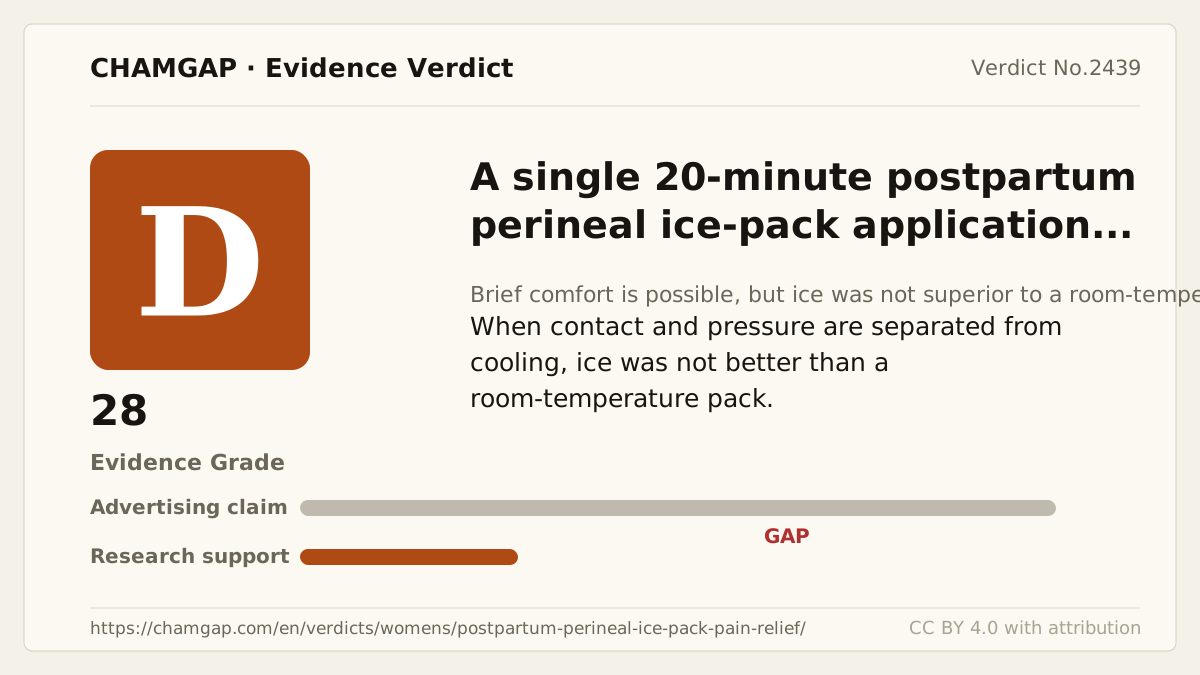
[Chamgap] Postpartum perineal ice pack for 20 minutes x immediate pain relief — Evidence Grade D·28. 2 cited sources checked. Source: https://chamgap.com/en/verdicts/womens/postpartum-perineal-ice-pack-pain-relief/ · CC BY 4.0CC BY 4.0 — free to use with attribution; do not distort grades, numbers, or verdict meaning.
What this document does and does not do
Chamgap is an information source. It reports what research has and has not confirmed; it does not tell readers what to take or buy. That decision belongs to readers and, when needed, medical or legal professionals. This verdict reflects literature available up to the search date and may change as new research appears. Nothing here is medical advice.