
Oral contraceptives,
does it really help with Reduced ovarian-cancer incidence?
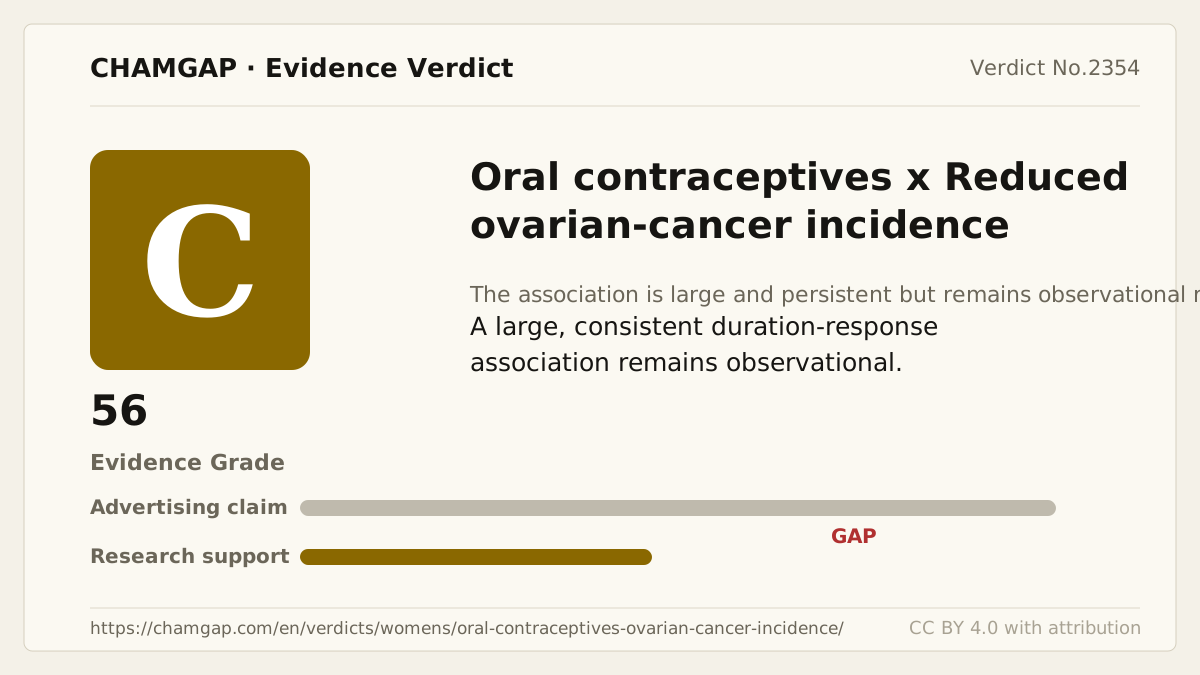
research showsC. A collaborative individual-data reanalysis of 45 observational studies, 23,257 cases, and 87,303 controls found RR 0.73 (0.70–0.76) for ever use. Duration response and persistence are strong, but this was not randomized.
ads claimLarge relative reductions should be presented alongside low absolute baseline risk and other contraceptive risks.
Useful facts when choosing a product
- The design composition was 13 prospective, 19 population-control case-control, and 13 hospital-control case-control studies.
- Adjustment for 12 additional potential confounders changed the 20%-per-five-years estimate by less than one percentage point.
- Breast- and cervical-cancer evidence concerns different endpoints and was not graded here.
What the research actually shows
This was a pooled reanalysis, not an RCT. Ever use was reported by 31% of cases and 37% of controls. In high-income countries, ten years of use was estimated to lower ovarian-cancer risk before age 75 from about 1.2% to 0.8%, and mortality from 0.7% to 0.5%.
Why this is classified as C (56)
Hard cancer incidence, scale, consistency, and duration response are strong, but lack of randomization and avoidable recall, selection, and residual-confounding concerns yield C with 56 points.
Counterpoint. Absolute benefit may be larger in genetically high-risk women, with a different balance of harms.
Rejudgment record. New verdict — Accepted the strong duration-response association in pooled individual observational data while accounting for nonrandomization, recall, selection, and residual confounding
| Endpoint | H | Hard endpoint - actual events such as death |
| Replication | R1 | Single confirmatory trial |
| Independence | I2 | Decisive evidence is publicly or non-profit funded |
| Effect size | E+ | Meets the clinically important threshold |
The scoring table and the verdict agree (C).
Sub-claim grades by effect
This ingredient is marketed for several effects. A single overall grade blends strong and weak claims together, so each effect is graded separately here. The overall grade reflects the strongest disconfirming or core claim.
| Effect (sub-claim) | Grade | Basis |
|---|---|---|
| Reduced ovarian-cancer incidence | C | Duration response in observational evidence |
Cross-check — Codex and Claude
Evidence Table
| Study | Design | Sample | Funding | Endpoint | Result | Weight |
|---|---|---|---|---|---|---|
| Collaborative Group on Epidemiological Studies of Ovarian Cancer 2008 | Collaborative individual-data reanalysis of 45 observational studies | 87,303 | Cancer Research UK and Medical Research Council | Incident ovarian cancer | Ever-use RR 0.73 (0.70–0.76); 20% reduction per five years | Decisive observational evidence |
Receipt — 3 References
All 3 cited sources were verified for existence at the original page (as of 2026-08-07).
Reviewed and approved: Chamgap Editorial Team · Approval date: 2026-08-07 · Corrections: none
Cite this verdict
[Chamgap] Oral contraceptives × reduced ovarian-cancer incidence — Evidence Grade C·56. 3 cited sources checked. Source: https://chamgap.com/en/verdicts/womens/oral-contraceptives-ovarian-cancer-incidence/ · CC BY 4.0CC BY 4.0 — free to use with attribution; do not distort grades, numbers, or verdict meaning.
What this document does and does not do
Chamgap is an information source. It reports what research has and has not confirmed; it does not tell readers what to take or buy. That decision belongs to readers and, when needed, medical or legal professionals. This verdict reflects literature available up to the search date and may change as new research appears. Nothing here is medical advice.