
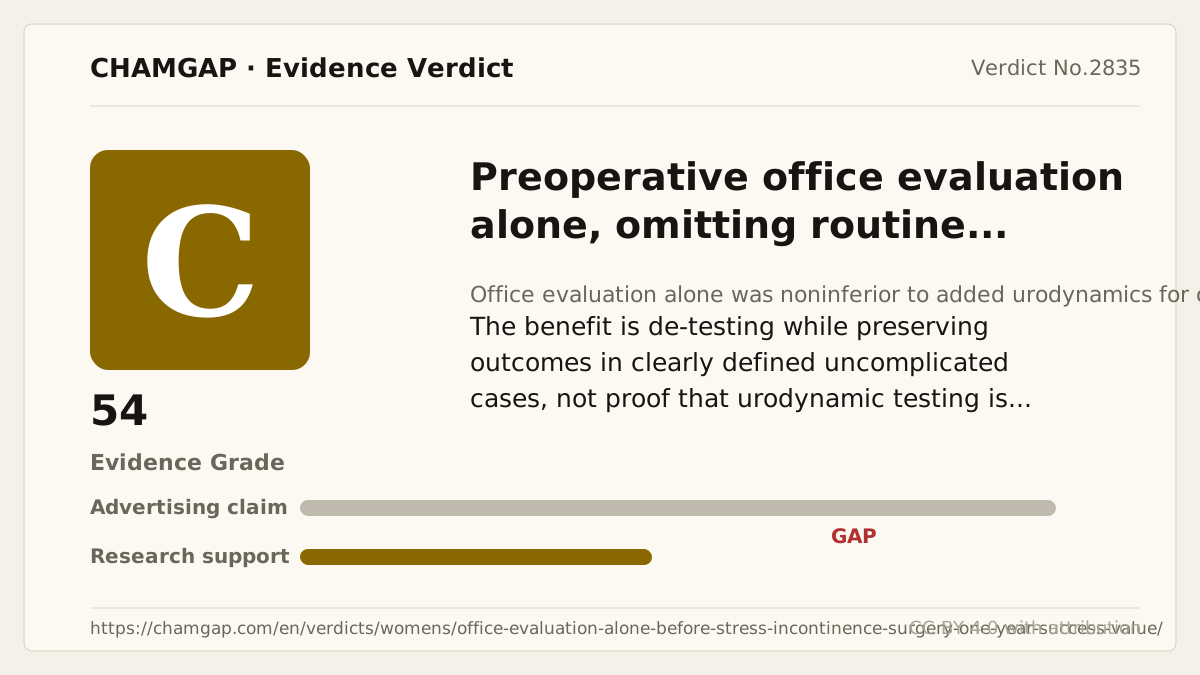
Preoperative office evaluation alone, omitting routine urodynamic testing,
does it really help with Noninferiority to added urodynamic testing for one-year patient-reported treatment success in uncomplicated stress urinary incontinence?
research showsThe grade is C with 54 points. In ValUE's prespecified per-protocol analysis, one-year success was 200/259 (77.2%) with office evaluation alone and 203/264 (76.9%) with added urodynamics. The office-minus-urodynamics difference was 0.3 percentage points (95% CI -6.9 to 7.5), within the prespecified 11-point margin.
ads claimVerdict 1663 is B with 72 points for pelvic-floor muscle training as treatment, and verdict 2665 is C with 54 points for preventive training during pregnancy. This verdict asks which test to add before surgery, not which treatment to use. It bears directly on Korean reimbursement and practice, but uncomplicated status must be established first.
Useful facts when choosing a product
- Office evaluation required demonstrable stress leakage, postvoid residual below 150 mL, negative urinalysis or culture, and assessment of urethral mobility.
- About 93% underwent midurethral-sling surgery, and urodynamics did not significantly alter the overall surgery distribution.
- Any adverse event occurred in 21.3% versus 19.4%, P=0.55.
What the research actually shows
Eleven US centers used an automated system to randomize 630 women, 315 per arm. The prespecified primary population was per protocol, with one-year data in 264 versus 259; ITT and sensitivity analyses assigning missing outcomes as all successes or all failures were consistent. Limitation 1: noninferiority design. Which listed item: noninferiority design. Was it avoidable: yes - superiority could test a higher success rate, but the study asked whether omission was no more than 11 points worse. Limitation 2: substantial attrition. Which listed item: substantial attrition (>=15%); 523/630 were in the PP primary analysis, leaving 107/630 (17.0%) outside it. Was it avoidable: yes - stronger 12-month follow-up and questionnaire retrieval could reduce missing primary data below 15%. Open-label subjective endpoint: participants knew whether testing occurred, but sham urodynamics would require invasive catheterization and bladder filling without benefit and was unavoidable; blinded outcome evaluators were used, so this was not counted separately. Active comparator only was not counted because the question was office assessment versus added testing and sham or no assessment was not feasible. NIDDK and NICHD provided public funding.
Why this is classified as C (54)
A publicly funded multicenter RCT found one-year patient-reported success within an 11-point margin, but evidence is one noninferiority trial and 17.0% were outside the PP primary analysis. A patient-centered rather than hard endpoint gives C with 54 points.
Counterpoint. Omission is a strategy for uncomplicated, clearly demonstrated stress incontinence. Urodynamics may remain useful when diagnosis is uncertain or disease is complex.
Rejudgment record. Article and registry cross-check — Patient-reported success classified as patient-centered, the 11-point margin, 523-person PP population, 17.0% outside primary analysis, and public funding
| Endpoint | P | Patient-reported treatment goal - the symptom is the goal |
| Replication | R1 | Single confirmatory trial |
| Independence | I2 | Decisive evidence is publicly or non-profit funded |
| Effect size | E+ | Meets the clinically important threshold |
The scoring table and the verdict agree (C).
Sub-claim grades by effect
This ingredient is marketed for several effects. A single overall grade blends strong and weak claims together, so each effect is graded separately here. The overall grade reflects the strongest disconfirming or core claim.
| Effect (sub-claim) | Grade | Basis |
|---|---|---|
| Noninferiority for one-year patient-reported treatment success | C | The risk-difference interval remained within the prespecified 11-point margin. |
| Harm from urodynamic testing | D | Adverse events were 21.3% versus 19.4%, without a significant difference. |
| Omission in complex incontinence | ? | This population was outside the trial's eligibility scope. |
Cross-check — Codex and Claude
Evidence Table
| Study | Design | Sample | Funding | Endpoint | Result | Weight |
|---|---|---|---|---|---|---|
| Study 1 | Eleven-center randomized noninferiority diagnostic-strategy trial | 259 | Public funding from NIDDK and NICHD | Twelve-month success requiring both at least 70% UDI reduction and PGI-I much or very much better | Office evaluation 77.2% versus added urodynamics 76.9%; office-minus-testing difference 0.3 points (95% CI -6.9 to 7.5); 11-point noninferiority margin | Pivotal single patient-centered noninferiority trial |
Receipt — 1 References
All 1 cited sources were verified for existence at the original page (as of 2026-08-18).
Reviewed and approved: Chamgap Editorial Team · Approval date: 2026-08-18 · Corrections: none
Cite this verdict
[Chamgap] Office Evaluation Alone Before Stress-Incontinence Surgery Is Noninferior for 1-Year Treatment Success - Benefit — Evidence Grade C·54. 1 cited sources checked. Source: https://chamgap.com/en/verdicts/womens/office-evaluation-alone-before-stress-incontinence-surgery-one-year-success-value/ · CC BY 4.0CC BY 4.0 — free to use with attribution; do not distort grades, numbers, or verdict meaning.
What this document does and does not do
Chamgap is an information source. It reports what research has and has not confirmed; it does not tell readers what to take or buy. That decision belongs to readers and, when needed, medical or legal professionals. This verdict reflects literature available up to the search date and may change as new research appears. Nothing here is medical advice.