
Planned induction at 39 weeks,
does it really help with Perinatal outcomes and cesarean delivery in low-risk nulliparous women?
research showsThe grade is B. ARRIVE randomized 6,106 low-risk nulliparous women to induction at 39 weeks 0-4 days or expectant management. The neonatal composite was not significant under the prespecified boundary, 4.3% versus 5.4%, RR 0.80 (95% CI 0.64-1.00), while cesarean delivery was lower, 18.6% versus 22.2%, RR 0.84 (0.76-0.93).
ads claimThe result applies to low-risk, nulliparous women with a singleton cephalic pregnancy, not automatically to every term pregnancy.
Useful facts when choosing a product
- Planned induction occurred at 39 weeks 0-4 days.
- The expectant group could undergo indicated induction or cesarean delivery.
- Outcome denominators were 3059 and 3037, slightly below randomized totals.
What the research actually shows
The trial randomized 3062 versus 3044 women and analyzed outcomes in 3059 versus 3037. The source did not report an independent blinded event-adjudication committee, although it did use a separate blinded central review of relevant records. Component intervals were not adjusted for multiplicity. Neonatal intermediate or intensive care admission was 11.7% vs 13.0%, chorioamnionitis 13.3% vs 14.1%, postpartum hemorrhage 4.6% vs 4.5%, and maternal death was zero in both groups.
Why this is classified as B (76)
A large publicly funded randomized trial supports the cesarean result, but a single confirmatory trial limits the grade to B with 76 points.
Counterpoint. The primary neonatal composite failed, so severe neonatal improvement is not established.
Rejudgment record. Cross-check applied — A large randomized trial showing lower cesarean delivery but a failed primary neonatal composite
| Endpoint | H | Hard endpoint - actual events such as death |
| Replication | R1 | Single confirmatory trial |
| Independence | I2 | Decisive evidence is publicly or non-profit funded |
| Effect size | E+ | Meets the clinically important threshold |
The scoring table and the verdict agree (B).
Sub-claim grades by effect
This ingredient is marketed for several effects. A single overall grade blends strong and weak claims together, so each effect is graded separately here. The overall grade reflects the strongest disconfirming or core claim.
| Effect (sub-claim) | Grade | Basis |
|---|---|---|
| Lower cesarean delivery | B | Rates were significantly lower, 18.6% versus 22.2%. |
| Improved severe perinatal outcome | D | Rates were 4.3% versus 5.4%, but the prespecified significance boundary was not crossed. |
Cross-check — Codex and Claude
Evidence Table
| Study | Design | Sample | Funding | Endpoint | Result | Weight |
|---|---|---|---|---|---|---|
| Study 1 | Multicenter randomized trial | 6,096 | Eunice Kennedy Shriver National Institute of Child Health and Human Development | Primary perinatal death or severe neonatal complication composite; principal secondary cesarean delivery | Composite 4.3% vs 5.4%, RR 0.80 (0.64-1.00); cesarean 18.6% vs 22.2%, RR 0.84 (0.76-0.93) | Large publicly funded hard-outcome RCT |
Receipt — 1 References
All 1 cited sources were verified for existence at the original page (as of 2026-08-07).
Reviewed and approved: Chamgap Editorial Team · Approval date: 2026-08-07 · Corrections: none
Cite this verdict
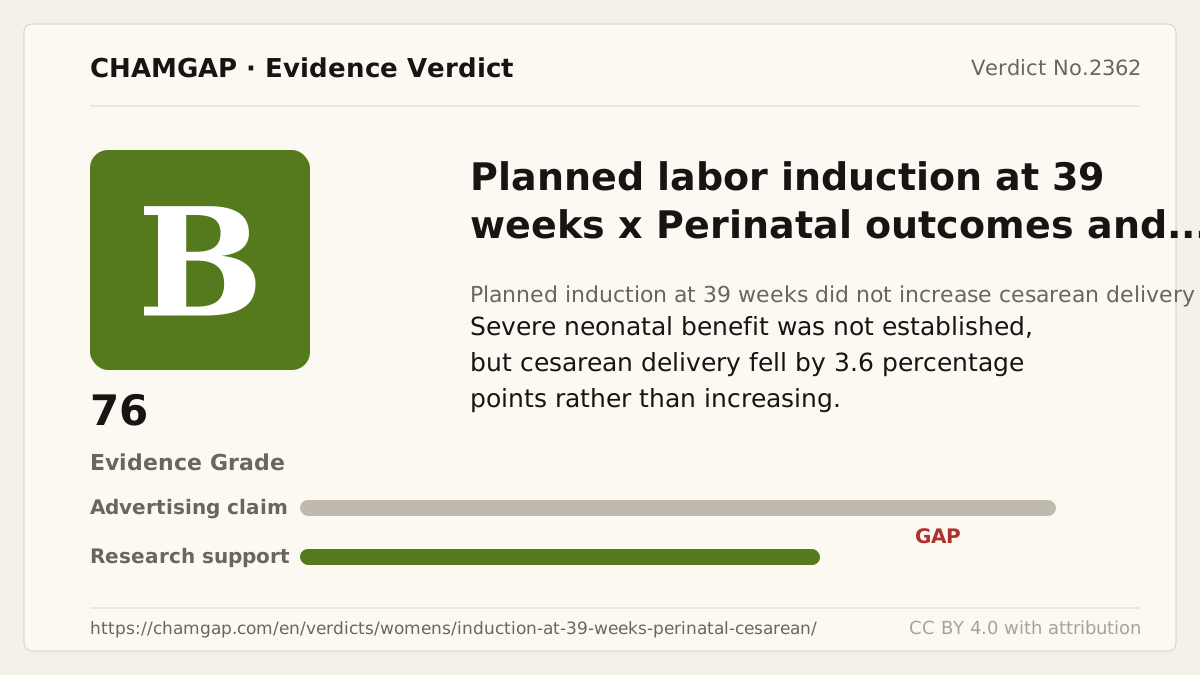
[Chamgap] Planned induction at 39 weeks x perinatal outcomes and cesarean delivery — Evidence Grade B·76. 1 cited sources checked. Source: https://chamgap.com/en/verdicts/womens/induction-at-39-weeks-perinatal-cesarean/ · CC BY 4.0CC BY 4.0 — free to use with attribution; do not distort grades, numbers, or verdict meaning.
What this document does and does not do
Chamgap is an information source. It reports what research has and has not confirmed; it does not tell readers what to take or buy. That decision belongs to readers and, when needed, medical or legal professionals. This verdict reflects literature available up to the search date and may change as new research appears. Nothing here is medical advice.